
icnlive

ICN.live

Mariam Al-Yazidi

  • The UAE Government Media Office launched a new Government Media Content Guideline for federal teams.
  • Saeed Al Eter named Agentic AI as the next chapter for government communication.
  • The framework guides planning, messaging, production, and channel distribution across all federal entities.
  • A NCEMA session covered crisis media management and the value of public trust.

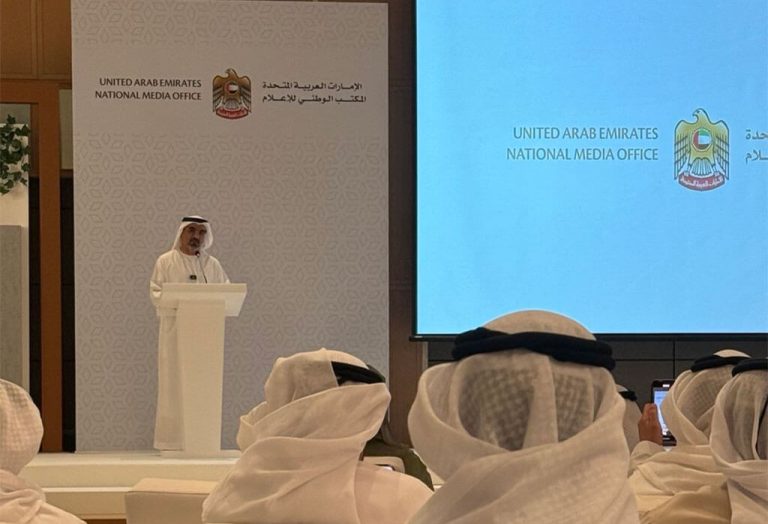
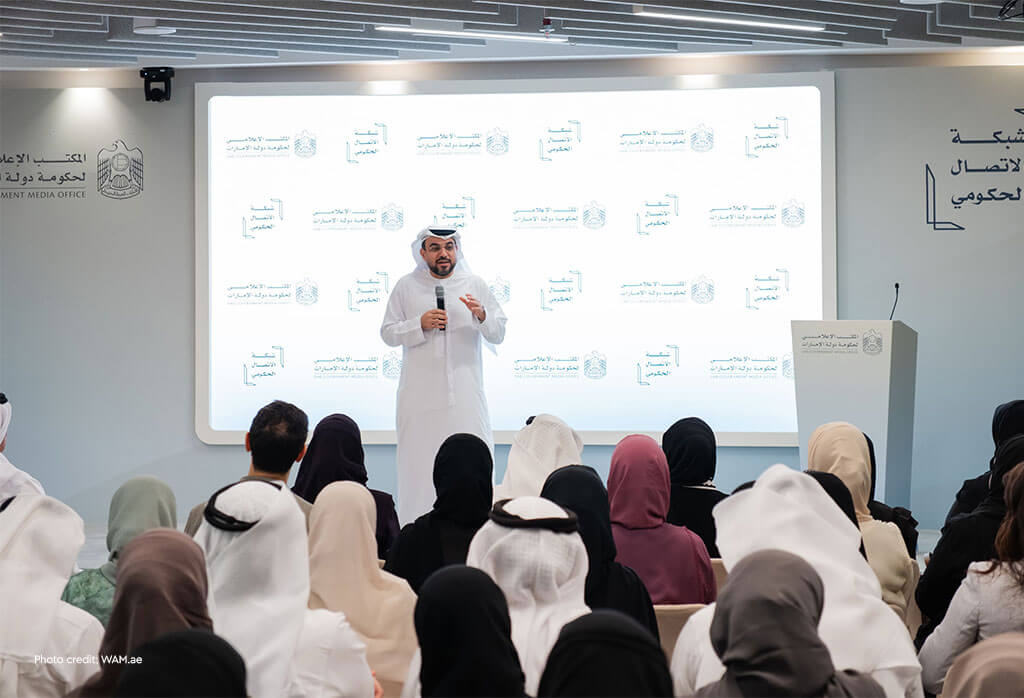
UAE Government Media Office launched a practical content guideline for every federal communication team this week. The launch happened during the latest Government Communication Network meeting at Creators HQ in Dubai. Communication directors and officials from across federal entities joined the session to review new standards. Saeed Al Eter, Chairman of the office, opened the meeting with a clear national message. He told the room that the government wants communication to move as fast as the world. Al Eter said, “We are developing an advanced government communication ecosystem grounded in data and knowledge.” His goal centers on credible content reaching every segment of society across the country. People stay at the heart of every public message the office plans to publish.

Al Eter then turned to artificial intelligence and its role in shaping future media. He said clearly, “Agentic AI will define the next chapter” for the sector ahead. This approach lets teams produce real-time, high-quality content at a far larger working scale. Agentic AI government communication also helps teams counter false information before it spreads widely online. Such tools also support precise crisis response and deeper engagement with growing digital communities. Government messaging then becomes more proactive, more responsive, and more effective for the wider public.

HOW THE NEW GUIDELINE HELPS YOUR TEAM

The Government Media Content Guideline works as a practical, end-to-end framework for federal teams. Rather than broad principles, it offers concrete tools for every stage of content work. You move through planning, message development, written and visual production, and channel distribution steps. Each stage follows clear standards built around the UAE communication identity and audience needs. The UAE Government Media Office wants content reaching the audiences each team plans to move. Officials designed every standard to keep content clear, consistent, and simple for most readers. You gain one repeatable process for planning, writing, and publishing across all federal channels.

The office also organised a hands-on workshop for the communication teams attending the meeting. Participants turned the framework into live practice through real content tasks and group exercises. They built strong narratives, shaped clear messages, and adapted content for many different platforms. The workshop ran as a working space, not a lecture, for the attending teams.

UAE GOVERNMENT MEDIA OFFICE BACKS CRISIS-READY TEAMS

A dedicated session from NCEMA addressed crisis media management across the wider federal system. Speakers explained the UAE model for communication during emergencies and other high-pressure crisis moments. Good crisis media management builds public trust and limits the spread of inaccurate information. Strong communication helps institutions respond with confidence and coherence when each moment matters most.

The new framework signals a clear shift toward faster, data-driven public communication for citizens. From my standpoint, this move ties technology, standards, and trust into one practical system. You should expect government content to arrive faster and stay clearer in the coming months. The UAE Government Media Office plans steady support as these tools reach every entity. Saeed Al Eter framed the guideline and Agentic AI as the next phase together. His message places the UAE Government Media Office at the center of national communication. You can follow how each entity adopts the new guideline through future network meetings. The Government Communication Network will likely track progress and share results with all teams.

TAGS

EXPLORE MORE ON:

NBQ's 2026 half-year profit

NBQ’s 2026 half-year profit came in at AED271 million for the six months to 30 June. Behind that figure sit the depositors, borrowers and staff who keep the lender running. The National Bank of Umm Al Qaiwain results point to steady footing at a small bank that families and businesses in the northern emirates lean on for everyday needs.

What NBQ’s 2026 half-year profit shows

The bank credited its first-half showing to a wider mix of income and a broader balance sheet, paired with tight cost control. Total interest income reached AED503 million over the period. Net interest income held about flat at AED310 million, against AED309 million a year earlier. That flat line matters more than it looks. Interest rates fell over the year, so keeping core income steady took real work on both pricing and funding.

For a customer, this shows up in small ways. Your deposit stays safe. Loan terms stay predictable. A bank that earns steadily can keep the lights on for the people who bank with it.

Balance sheet growth and deposits

NBQ total assets rose to AED24.1 billion by the end of June, up 5 percent from December and 20 percent from a year earlier. Customer deposits did much of the heavy lifting. They climbed 29 percent to AED17.1 billion, a sign that more people trusted the bank with their money. Net loans and advances grew 4 percent over the year to AED8.7 billion. Shareholders’ equity reached AED6.4 billion, up 3 percent from June 2025.

Deposit growth on that scale tells a human story. When savers move money into a bank, they place a bet on its stability. That trust gives the lender room to fund loans for homes, shops and small firms across the emirate.

Capital strength and asset quality

The capital adequacy ratio stood at 31 percent, well above the floor the Central Bank of the UAE sets under Basel III rules. Put simply, the bank holds a thick cushion against shocks. The non-performing loans ratio came in at 0.4 percent, up slightly from 0.3 percent at the end of 2025 but far below the 2.2 percent seen a year earlier. Fewer bad loans mean fewer customers in distress and a cleaner book. NBQ net profit after tax landed at AED271 million on the back of these numbers.

Adnan Al Awadhi, Chief Executive Officer of NBQ, said the bank delivered solid results despite geopolitical uncertainty and lower interest rates. He pointed to a diversified model, careful balance sheet management and a focus on lasting growth. Al Awadhi said the bank kept strong capital and liquidity while supporting customers and the wider economy through prudent risk management and better asset quality.

He added that NBQ kept investing in digital tools to improve the customer experience and to make its platforms safer and more reliable. Partnerships would widen its services further, he said. Al Awadhi also restated the bank’s pledge to Emiratisation, leadership development, sustainability and community work.

Why NBQ’s 2026 half-year profit matters to customers

Numbers like these can feel far from daily life. Yet a stable bank shapes real choices for real people. NBQ’s 2026 half-year profit gives the lender the means to keep lending, keep hiring and keep serving the towns it calls home. For anyone who banks there, that steadiness is the point.

e& completes Vodafone stake sale

News that e& completes Vodafone stake sale confirms a full exit from a holding the Abu Dhabi group built over four years. Emirates Telecommunications Group Company PJSC moved all 3,944,743,685 of its ordinary Vodafone shares to three banks, namely BNPP Financial Markets, Crédit Agricole Corporate and Investment Bank, and Société Générale. That transfer settled a binding agreement reached on 10 July 2026 with Vega, an acquisition vehicle wholly owned by the Niel family group. The e& Vodafone stake sale ends a position worth about 16.21 percent of Vodafone’s share capital and 17.13 percent of its voting rights.

Gross cash proceeds came to AED21.5 billion, or US$5.84 billion, at close to 110.5 pence per share. One payment is still to come. e& will receive a final dividend of 2.02 pence per share, worth AED0.4 billion or US$0.11 billion, on 30 July 2026. That dividend relates to Vodafone’s FY2026 results. Once it lands, the total climbs to AED21.9 billion, equal to US$5.95 billion.

What the Vodafone stake sale $5.95 billion deal returns

The e& net cash return from the deal stands at AED4.8 billion, or US$1.3 billion. That figure measures the gain over what the group paid to build the stake. e& started buying into Vodafone in February 2022, taking an initial 9.8 percent holding for US$4.4 billion, then adding to it in stages. Secondary reporting set the sale price at 112.5 pence per share, a premium of about 13 percent to Vodafone’s market price before the announcement.

Ownership at the UK operator now shifts. The deal makes Xavier Niel Vodafone’s largest shareholder, giving the Iliad founder a stake that carries 17.13 percent of total voting rights. Niel has long argued for consolidation across Europe’s telecom sector. Through the Vega Vodafone acquisition, he takes that position without a wider bid for the company. The Vodafone stake sale, a $5.95 billion transaction, leaves him as a long-term minority holder for now.

Why e& completes Vodafone stake sale now

The timing fits a wider redirection of capital. e& completes Vodafone stake sale as part of a review of its international investment portfolio. The group said the exit sharpens its focus on core businesses while realising the value built through the investment. Last month it sold 12.5 percent of Careem Technologies to Uber for US$100 million, citing the same discipline over where it puts money. First quarter revenue rose about 15 percent from a year earlier to Dh19.4 billion.

The exit also changes e&’s role at Vodafone. Its Relationship Agreement with the operator has ended, and its board representative resigned as a non-executive director. That closes a strategic tie formed in 2023. For the group, e& completes Vodafone stake sale as a way to turn a large minority holding into cash it can direct toward markets it controls.

A sharper capital focus for e&

Set against the group’s recent moves, the sale points to a tighter model. e& has trimmed holdings that sit outside its operating control and steered capital toward businesses it runs directly across the Middle East, Africa, and Asia. The Vodafone exit and the earlier Careem reduction follow one logic. Cash from a passive minority position now returns to the balance sheet, where the group can fund networks and services in markets it manages each day.

Amina Taher is the new Chairwoman

Amina Taher is the new Chairwoman of the Arab Fashion Council, and the fit reads clean. The appointment took effect on 9 July 2026. Taher spent two decades leading brand and communications across aviation, fintech, media and sport. She earned an MBA from London Business School and a master’s from Harvard. Now she takes the top governance seat at a body that speaks for fashion across the 22 nations of the Arab League. Known in the UAE business scene, and her name is familiar. She served as Vice President of Marketing at Etihad Airways, where she helped shape the airline’s global identity. From there, she moved into fintech as Chief Marketing Officer of Wio Bank. That career sits at the crossroads of money, media and brand, which is close to where fashion is heading.

What the Arab Fashion Council built

The Arab Fashion Council spent the past decade turning a thin fashion scene into real infrastructure. It co-founded Dubai Fashion Week with Dubai Design District, and grew it into a platform buyers and press now track. That event sits on the international calendar next to New York, London, Milan and Paris. The Council also pushed Arab designers onto runways that once looked past them. Picture laying track before the trains arrive. The rails are down, and traffic is building. What matters now is speed and direction, and that is where the new leadership comes in.

The gap Taher steps into

Great institutions hit a ceiling when they lean on passion alone. What the Council needs next is weight: government backing, diplomatic reach, and partnerships measured in years rather than seasons. Taher has built that kind of trust across her career, working with public bodies and global brands alike. Founder and Chief Executive Officer Jacob Abrian called her arrival a sign of how far the Council has come, not a shift in course. “Amina Taher’s appointment is not a change of direction,” he said. His point was that the move reflects the standing the Council now holds, and a promise to hold it with more seriousness. That is the room Taher walks into.

What Amina Taher wants for Arab designers

Taher points her focus at the next wave of talent. She wants more room for young Arab designers to reach a global audience and build real businesses. “I am honoured to build on that strong foundation,” she said, crediting the institutions, partnerships and credibility built over the past decade. Her goal is a wider creative economy and more open doors for people entering the field. Amina Taher is the new Chairwoman at a moment when the region’s fashion voice carries serious reach, and she plans to push it further. Growth in the creative economy tends to follow the money and the platforms, and the Council now has both.

What comes next

Taher will present her vision at an invitation-only gala in September 2026. Until then, the plan stays in outline, with the full manifesto still to come. One thing is clear already. In choosing her, the Council made it official: Amina Taher is the new Chairwoman, and she builds for the present and what comes after.

Share this post

on your favourite social platforms

or copy the link