

icnlive

ICN.live

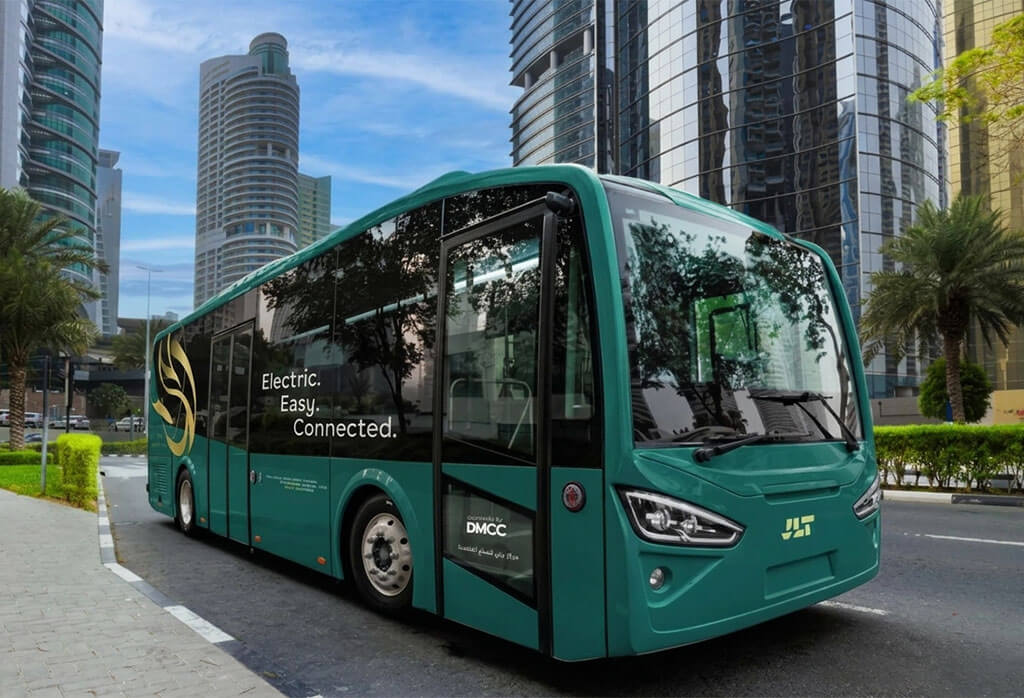
  • DMCC launches JLT Link, a fully electric bus service, on 1 August 2026.
  • The service replaces the current RTA-run bus route with no gap in the schedule.
  • 18 stops link riders to DMCC Metro Station and Sobha Realty Metro Station.
  • The electric fleet supports Dubai’s Net Zero 2050 clean mobility goals.

The JLT Link electric bus service starts on 1 August 2026, giving people who live, work, or visit Jumeirah Lakes Towers a cleaner way to get around. DMCC, the free zone that runs the district, built the service to replace the current RTA-run JLT bus route. The switch happens with no break in the schedule, so your usual trips stay intact.

The fleet runs on electric power alone. It mixes 16-, 23-, and 31-seat buses. Each one sits low to the curb, fits a wheelchair, and leaves room for standing riders. That design opens the service to more people, including anyone who found older buses hard to board.

What the JLT Link electric bus service changes

The JLT Link electric bus service covers 18 stops across JLT and Uptown Dubai. Two of those stops carry the most weight for connections. Riders can link to DMCC Metro Station and Sobha Realty Metro Station, which tie the area into the wider Dubai Metro network. If you commute by train, that link trims the walk and the wait.

Ahmed Bin Sulayem, Executive Chairman and CEO of DMCC, said: “JLT Link is a further investment in the infrastructure that underpins our long-term vision for JLT and Uptown Dubai as one integrated destination. With fully electric buses, 18 stops, direct metro station links, and accessible, high-frequency services, we are creating a more connected, sustainable and convenient urban experience. As we continue to grow as a global business destination, initiatives like JLT Link enable seamless travel for our community and reinforce Dubai’s position as one of the world’s most competitive places to live, work and do business.”

Routes and timings you can plan around

Two circular routes run inside JLT. Each one arrives every 20 minutes. A third route connects Uptown Dubai with DMCC Metro Station every 30 minutes. Your wait depends on where you board and where you are headed.

The JLT internal routes run Monday through Saturday, from 6:30 AM to 9:30 PM. Last buses leave at 9:24 PM and pull in by 9:37 PM. On Sundays, those routes run later, from 9:30 AM to 12:30 AM. The Uptown Dubai route from JLT runs from 6:55 AM to 8:00 PM. Check the clock before a late trip, because the cutoffs shift by route and by day.

Why the JLT Link electric bus service matters for you

Dubai wants to cut transport emissions and reach its Net Zero 2050 goals. The electric fleet moves the district toward that target. It sits beside other JLT projects like solar power, Dubai Can water stations, and recycling points. For riders, the payoff is plain. You get quieter buses, cleaner air near the stops, and a service that keeps pace as the area grows.

Photo Credit: DMCC

TAGS

EXPLORE MORE ON:

Abu Dhabi Grand Prix is sold out

Abu Dhabi Grand Prix tickets are already gone, and Formula 1 says the season finale will run on schedule despite unrest across the Middle East. Stefano Domenicali, the sport’s President and CEO, told reporters the race stays on the calendar. A final decision, he added, comes by the middle of September.

What Domenicali confirmed

He said: “For us today, the races in Qatar and Abu Dhabi are confirmed. By the way, they are already sold out. That is an incredible sign of how much the sport is bigger than the problem that our world is living.”

Speaking after the Hungarian Grand Prix, with the season now in its one-month break, Domenicali said Formula 1 stays in contact with other championships about the end of the year. The plan is simple. Take the maximum time, watch how the situation develops, then decide at the right moment. That call will not come before mid-September.

For now, the races in Qatar and Abu Dhabi are confirmed. Abu Dhabi is set for 3-6 December, with the main race on Sunday, 6th of December 2026. Both have sold out. Domenicali called that a sign of how the sport has grown bigger than the trouble the world faces right now. Demand tells its own story. Fans searching for Abu Dhabi Grand Prix ticket prices found nothing left to buy.

The Abu Dhabi Grand Prix tickets question

Yas Marina Circuit has closed the F1 season almost every year since 2009. The track runs a twilight race that starts in daylight and finishes under floodlights. That finale slot is exactly what the September decision puts in question.

If tensions do not ease the way Formula 1 expects before mid-September, the plan changes. Domenicali was clear on the backup. The end of the season would move to Europe instead. Such a shift would reshape the closing weeks of the F1 calendar and pull the traditional finale away from Yas Marina Circuit.

Worth knowing if you hold a seat for the Formula 1 Abu Dhabi Grand Prix: a sold-out race gives the event weight, but the September check still decides where the year ends. So the Abu Dhabi Grand Prix tickets you already hold come with a date the sport has yet to lock fully.

Bahrain race finds a new home

One race has already moved. The Bahrain Grand Prix, cancelled after unrest in the region, will now run at the Sepang International Circuit in Malaysia from October 2 to 4. It slots between the Azerbaijan and Singapore rounds.

Bahrain’s race was meant to be the fourth stop of the year, set for April 10 to 12 at the Bahrain International Circuit in Sakhir. That plan fell through, and Formula 1 also dropped the Saudi Arabian Grand Prix in Jeddah the week after.

Domenicali thanked the Kingdom of Bahrain and Malaysia for making the switch work. He framed it as cooperation and as thinking wider than others might. Malaysia brings back a track that carried the championship in years past.

What it means for the F1 season finale

For fans, the picture is clear enough. The F1 season finale in Abu Dhabi is confirmed and sold out, and so is Qatar. Yet the mid-September call could still send the year’s final rounds to Europe. Anyone holding Abu Dhabi Grand Prix tickets should watch that date. Your seat stays valid for the day printed on it, but that day is not yet fully fixed. Formula 1 says it will decide when the time is right, and not a moment sooner.

JLT Link electric bus service
Elon Musk's X Money

Elon Musk’s X Money went live in the US in late July, and the headline number is a 6% yield. The rate looks generous. Getting it is another matter. X selects who joins, limits the service to US residents, and sets an age floor of 18. You also need a paid X account before the door opens at all. The catch sits in the fine print. Premium+ subscribers qualify for the 6% APY through their tier. Anyone on Premium reaches the same rate only after a qualifying direct deposit, which means at least $1,000 landing in the account. X calls the rate variable and warns fees can eat into what you earn.

What you actually pay to earn 6%

Run the math, and the shine dulls. X Premium starts at $8 a month, or $84 a year on the annual plan. Premium+ costs $40 a month, or $395 a year. Those fees do not vanish. They come straight out of your interest. Say you pay $8 monthly. Over a year that is $96. A 6% return on $1,600 also comes to $96 before tax. Your yield and your subscription cancel out. On the annual $84 plan, you would need roughly $1,400 sitting in the account to break even. Premium+ raises the bar hard. Its $395 annual fee needs about $6,583 at 6% to cover the cost. Pay monthly, and the total climbs to $480, pushing the break-even balance near $8,000. If you already buy Premium for verification, ads, or Grok, that changes the sum. Someone who signed up only for the yield sees a much smaller net return.

How Elon Musk’s X Money is built

Underneath Elon Musk’s X Money sits a bank partnership. X Payments runs the front end, but it is not a bank. Cross River Bank holds the deposits and provides the regulated banking underneath. X also spreads eligible balances across partner banks through a cash sweep program. That structure lets the published terms advertise up to $10 million in aggregate FDIC coverage. Standard protection stays at $250,000 per depositor, per insured bank, per ownership category. X Payments itself carries no FDIC insurance. The product does more than pay interest. An X Money Visa debit card gives 3% cashback on eligible purchases, with no foreign transaction fees. X refunds ATM charges within three days. Because Visa accepts the card everywhere, you can spend outside the app. Peer-to-peer transfers, bill pay, wires, mailed checks, and early direct deposit round out the account.

Who gets in, and who waits

Elon Musk’s X Money eligibility comes down to three gates. First, an X Premium+ subscription or a qualifying Premium account. Second, an invitation from X. Third, for Premium members, the direct deposit condition. Free accounts get nothing yet. People outside the US stay locked out too. Invitation control lets X manage how many users flood in during the first phase, while Cross River handles deposits, payments, and compliance.

My read on the 6% hook

Here is my read. The 6% is a customer acquisition hook, and a sharp one. It pulls attention and gets people talking about Elon Musk’s X Money as a bank rival. But the number you see is not the number you keep. Premium+ users pay the most for direct access. Those on regular Premium pay less and work for it. Whether X holds this rate once the crowd arrives is the real question, and I would not bet on 6% lasting forever.

Share this post

on your favourite social platforms

or copy the link