
icnlive

ICN.live

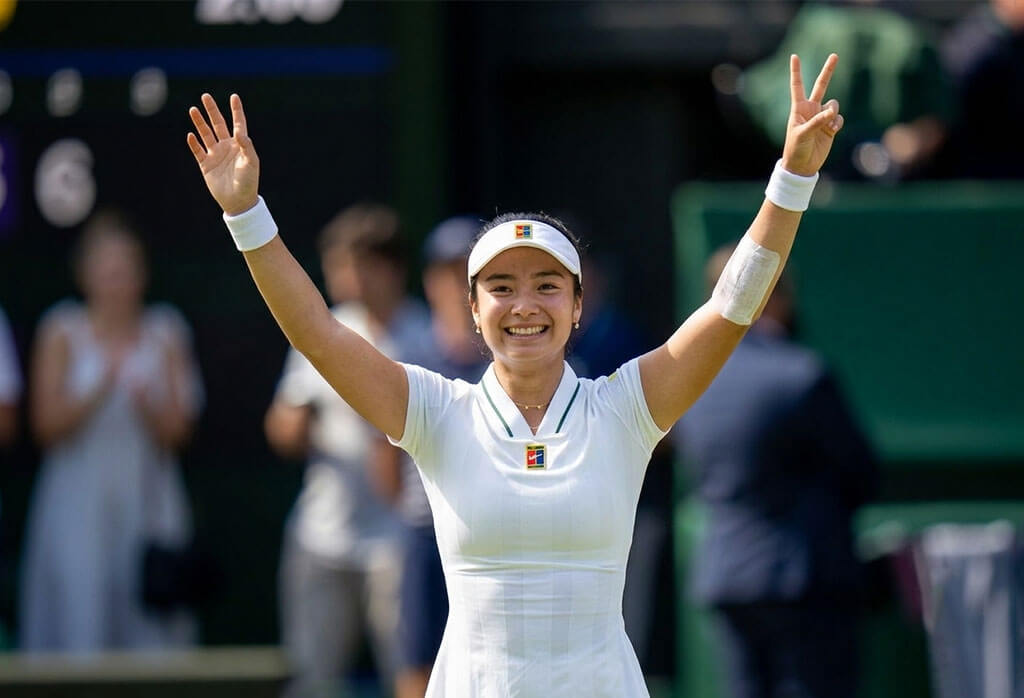
  • Alex Eala beat defending champion Iga Swiatek 7-6(11-9), 6-2 on Centre Court Saturday.
  • She becomes the first Filipina to reach a Grand Slam second week.
  • Eala faces Jasmine Paolini next in the fourth round on Monday.
  • The victory gives her a seventh career win over top-ten players.

Alex Eala beats Swiatek at Wimbledon, and the Filipina now stands in the last sixteen. The 21-year-old won 7-6(11-9), 6-2 against the defending champion on the famous Centre Court. Iga Swiatek arrived as a six-time Grand Slam champion and the clear pre-match favorite. You might expect nerves from a young player facing a champion of this size. Eala instead played with calm hands and sharp aggression from the opening game onward. She saved two set points inside a tense first-set tiebreak lasting well past normal. The first set alone ran 84 minutes before Eala closed it on Centre Court.

Momentum then swung her way as she raced to a 4-0 second-set lead quickly. Aggressive returns and clean passing shots kept the defending champion under steady constant pressure. Eala finished with 24 winners against only 21 unforced errors across the whole match. Swiatek struck 32 winners but leaked 44 unforced errors under the constant Filipina pressure. The numbers show why this win reads as a full statement and not luck. For fans across the Philippines, the result carried real weight beyond one tennis scoreline. No player from her country had ever reached the second week of a major.

How Alex Eala beats Swiatek at Wimbledon with fearless tennis

This big win did not come from nowhere for the rising Filipina tennis star. She first beat Iga Swiatek at the 2025 Miami Open during her breakout season. Grass gave the rivalry a fresh and far bigger stage in front of millions. Alex Eala beat Swiatek at Wimbledon partly on the growing strength of her serve. She struck four aces and protected her second delivery far better than her rival. Eala won 55 percent of her second-serve points to the champion’s weaker 32 percent. You can see her steady mindset in the way she handled the break points. She saved eight of the eleven break points the champion earned across the match. Eala also converted five of her seven break chances against a fading former winner. Numbers like these show why the upset felt fully earned and not pure chance. The young winner fought back tears during a raw and heartfelt Centre Court interview. “It’s an honour to be able to pave the way for young girls,” Eala said.

The road to the last eight

Alex Eala beats Swiatek at Wimbledon, and now a tougher second-week test clearly awaits. The Eala vs Paolini match opens Centre Court on Monday at 13:30 London time. Jasmine Paolini reached the 2024 final and later won Olympic doubles gold in Paris. You should not dismiss her, yet Eala already owns a clear win over her. Eala beat Paolini in Dubai earlier this year on a hard court, 6-1, 7-6. Grass now tests both players in a new setting at Wimbledon 2026 this week. As I see it, her serve and steady nerve travel well onto quicker surfaces. The young star now holds a strong 7-4 record against the world’s top-ten players. On grass this season, Alexandra Eala has won all three of her top meetings. Alex Eala beats Swiatek at Wimbledon, and her home nation keeps dreaming much bigger. Tennis great Billie Jean King even spent time with her after the historic win. You can watch her next step live from Centre Court this coming Monday afternoon.

Player Profile: The Rise of the Filipina Sensation

Alexandra “Alex” Eala’s triumph at Wimbledon is the crowning achievement of a career defined by rapid progression and historic milestones.

  • Country: Philippines 🇵🇭 (Making history as the first-ever Filipino player to win a senior Grand Slam singles title).

  • Age: 21 years old (Born May 23, 2005).

  • WTA Ranking: Having broken into the Top 30 earlier this year, her live ranking has soared to a career-high No. 28.

  • Grand Slam Tally: This victory marks her first senior Grand Slam singles title. It adds to her phenomenal junior record, where she claimed the 2020 Australian Open Girls’ Doubles, the 2021 French Open Girls’ Doubles, and the historic 2022 US Open Girls’ Singles title.

  • 2026 Season Highlights: Prior to arriving at SW19, Eala put together an exceptionally strong year, reaching the semifinals at the ASB Classic in Auckland, the quarterfinals in Abu Dhabi and Dubai, and the Round of 16 at the WTA 1000 events in Indian Wells and Miami.

The Legacy of Wimbledon: History & Icons

Founded in 1877, the Championships at Wimbledon is the oldest and most widely respected tennis tournament in the world. Played on the meticulously manicured lawns of the All England Lawn Tennis and Croquet Club, it remains the ultimate test of grass-court tennis.

While Eala’s match was a thrilling sprint, Wimbledon history is paved with marathons. The longest singles final ever played occurred in 2019, when Novak Djokovic defeated Roger Federer in an epic block-buster lasting 4 hours and 57 minutes, ultimately decided by a historic 12–12 final-set tiebreak.

Roll of Champions (Last 5 Years)

Year Gentlemen’s Singles Champion Ladies’ Singles Champion
2025 Jannik Sinner Iga Świątek
2024 Carlos Alcaraz Barbora Krejčíková
2023 Carlos Alcaraz Markéta Vondroušová
2022 Novak Djokovic Elena Rybakina
2021 Novak Djokovic Ashleigh Barty

Inside SW19: Fascinating Wimbledon Traditions

Wimbledon’s unparalleled prestige is maintained through strict customs that separate it from any other sporting event on earth:

  • The All-White Dress Code: The tournament enforces an uncompromising dress code. Players must be outfitted almost entirely in clean white from the moment they step onto the court precinct—even off-white or cream tones are strictly forbidden.

  • Strawberries and Cream: The quintessential tournament treat. Spectators consume upwards of 38 tons of English strawberries paired with over 10,000 liters of fresh cream over the course of the fortnight.

  • 8mm Grass Precision: The courts are sown entirely with perennial ryegrass. To maintain the perfect balance of speed, ball bounce, and ground durability, the grass is trimmed to an exact height of 8mm every single day of the tournament.

  • The Purist Aesthetic: In a world dominated by modern sports sponsorships, Wimbledon strictly prohibits commercial advertising banners or digital backdrops around the court boundaries, ensuring the traditional green-and-purple timeless aesthetic remains pristine.

TAGS

EXPLORE MORE ON:

Dubai Named World's Most Instagrammed City

Dubai is the most photographed city in the world, according to a new ranking of how often destinations appear on social media and in search results.

The study comes from Players Time, which built a scoring system it calls an Instagrammability Score. It combines hashtag counts on Instagram and TikTok with monthly Google search volume, then scales the result from 0 to 100.

Dubai scored a perfect 100. The city has been tagged 147 million times on Instagram and more than 43 million times on TikTok. It draws 3.43 million Google searches a month.

The Burj Khalifa took first place in the separate landmarks ranking. The tower has 10.1 million tagged posts and 1.1 million monthly searches. That puts it well ahead of the Grand Canyon at 696,000 searches and the Eiffel Tower at 662,000.

That result is worth sitting with. The Burj Khalifa opened in 2010. It is now photographed and searched more than monuments that have been standing for centuries. The Eiffel Tower came second with a score of 73.22. The Taj Mahal and Machu Picchu both landed in the top group, with search volumes between roughly 854,000 and 928,000 a month.

Europe holds 8 of the top 20 landmark places. The Sagrada Familia and the Colosseum sit in that group, with monthly searches running from about 313,000 to 737,000.

Some places are ranked for the experience, not the building

A few entries in the landmarks list are not really buildings at all.

Shibuya Scramble Crossing in Tokyo generated more than 6.57 million posts. Up to 3,000 people cross at once, and most of the photos are taken from inside the crowd rather than from a viewing point. Times Square in New York works the same way, with 5.82 million posts.

The oddest entry is the DUMBO viewpoint near the Brooklyn Bridge, which has passed 4 million Instagram posts on its own. Search demand for it is modest. People are not planning trips there. They walk past, take the photo, and the number keeps climbing.

London posts more, Barcelona searches more

Among cities, London and Paris follow Dubai. London recorded the highest raw hashtag volume in the study at 192.2 million posts. New York City reached 165.6 million and Istanbul 153.7 million.

Barcelona is the outlier. The city recorded 97 million tagged posts and 23 million monthly Google searches, which is close to seven times Dubai’s search volume.

That figure deserves a caveat the study does not offer. “Barcelona” is also the name of one of the most followed football clubs on the planet. A raw keyword count cannot tell a fan looking for match results apart from a traveller looking for a hotel. The same problem may explain why San Diego, Santiago and Kochi appear in a ranking of visual destinations despite far lower travel profiles.

Players Time has not published the weighting behind its score, so the gap between hashtag volume and search demand is difficult to check independently. Hashtag counts are also self-reported by the platforms and change constantly.

The Dubai finding survives those questions better than most. The city leads on both measures at once, and it does so against capitals that have had a hundred years’ head start on accumulating images. The Burj Khalifa did the same thing at landmark level in sixteen years.

Kuwait $6 billion bond sale

The Kuwait $6 billion bond sale closed this week with an order book the finance ministry calls one of the largest for a multi-tranche sovereign deal in 2026. Three tranches went out. Investors took $3 billion in three-year paper, $1.5 billion in five-year notes and $1.5 billion at 10 years. Final spreads landed at 70, 75 and 85 basis points over US Treasuries. It was the country’s first international issuance since October last year.

Pricing tells you more here than the headline number does. Kuwait tightened 25 basis points across all three tranches from its opening levels, according to a person familiar with the deal cited by Bloomberg. Buyers do not give up that much yield to a borrower they distrust.

Demand for the Kuwait $6 billion bond sale came in two versions. The finance ministry put total orders above $18 billion, more than three times the issue size. Bloomberg reported books near $14.8 billion at final terms. Peak interest and final interest are different numbers, and both can be accurate.

Who bought the Kuwait $6 billion bond sale?

American accounts took 48 percent of the allocation. The UK and Europe followed with 28 percent, then the Middle East and North Africa at 16 percent. Asia took 4 percent, and other international markets took the rest. Finance minister Yaqoub Al-Refaei said the result shows investor confidence in Kuwait’s credit position and financial standing.

The short end did the heavy lifting. Half the total sat in the three-year tranche, which points to buyers who want yield without long duration risk. Five- and 10-year paper gives other Kuwaiti borrowers a benchmark to price against.

Geography matters more than usual on this one. JPMorgan reclassified Kuwait as a developed market in February 2025 and removed it from its emerging market bond index. That move stripped out index-driven demand the country once attracted by default. Pulling almost half the book from the Americas without that support is a real result for a Kuwait sovereign bond issuance.

War risk barely moved the price

Iranian attacks have hit US military assets in Kuwait and Bahrain in recent weeks. Fixed income desks priced the three-tranche bond sale anyway. Gulf sovereign bonds already went through this test once, falling to lows in mid-March before climbing back through late April. Traders have a reference point now, and they used it.

Why Kuwait keeps borrowing

The arithmetic is plain. Kuwait’s 2026-27 budget forecasts revenue of KD16.3 billion against spending of KD26.1 billion. That leaves a Kuwait budget deficit of KD9.8 billion, up from KD6.3 billion the year before. Oil was expected to supply close to 80 percent of budgeted revenue, so disruption around Hormuz cuts straight into the top line.

Access came back through legislation. The Kuwait public debt law, approved in March 2025, set the borrowing ceiling at KD30 billion, roughly $97.4 billion, and allowed maturities out to 50 years. Political gridlock had kept the country out of the sovereign market for eight years before that. Since the law passed, Kuwait raised $11.25 billion in October 2025 and another $2 billion in May.

Kuwait is building a yield curve, and curves need repeat business. Each deal hands domestic banks and corporate borrowers a pricing reference they did not have. I read the Kuwait $6 billion bond sale as a curve-building exercise first and a cash-raising one second. The deficit is real. So is the sovereign wealth sitting behind it. What global investors bought this week was the legal framework and the balance sheet, not the news cycle.

DXB launched new Smart Gates service

Dubai Airports launched a new Smart Gates service on Friday, letting travellers run a Smart Gates eligibility check before they reach passport control. Dubai Airports developed the tool with the General Directorate of Identity and Foreigners Affairs in Dubai. The operator calls it the Smart Gates Eligibility Pre-Check. Passengers reach it through the Pocket Flights app or by scanning QR codes placed across every terminal and gate.

A traveller scans a passport and gets an answer in seconds. Those who clear it can head straight for the automated lanes. Anyone who does not can plan for a staffed counter instead. Dubai Airports said the point of the change is “making the journey through the airport more seamless for our guests.”

GDRFA runs the gates themselves. Dubai International Airport biometric gates read facial and passport data at the barrier, so there is no stamp and no officer check. Eligible groups include UAE and GCC citizens, UAE residents, and visa-on-arrival guests with biometric passports. Many travellers are enrolled the first time they pass through immigration at DXB, which means some queue at the counters without knowing they already qualify. Anyone wanting a second confirmation can use the GDRFA Dubai smart gate registration inquiry on the directorate website, entering an Emirates ID, a file number, or a passport number with nationality.

Why Dubai Airports launched new Smart Gates services

Record volume explains why DXB launched new Smart Gates service now. Dubai International handled 95.2 million passengers in 2025, up 3.1 percent year on year, the highest annual international traffic recorded at any airport. The operator forecasts 99.5 million for 2026. By the end of last year, the airport connected to 291 destinations across 110 countries, served by 108 international airlines.

DXB passport control has held up so far. In 2025, 99.35 percent of departing passengers cleared it in under ten minutes, and 98.8 percent of arriving passengers were processed within 15 minutes. Paul Griffiths, chief executive of Dubai Airports, said in February that record traffic had become part of the airport’s operating reality rather than an exception.

What the pre-check is meant to solve

Passport control is one of the parts of an airport that cannot be widened quickly. Halls are fixed, gate counts are fixed, and staffing has limits. So the operator is working on how passengers sort themselves before they arrive at the hall. A traveller who knows the answer in advance picks the right lane the first time. Across close to 100 million journeys a year, small gains of that kind carry weight.

Capacity beyond DXB

The larger answer sits at Al Maktoum International, where Dubai is building a terminal project valued at about 35 billion dollars. First-phase capacity is expected by 2032, at 150 million passengers a year. Full build-out would take the site to 260 million. Until that capacity arrives, DXB has to find room inside the space it already uses.

DXB launched a new Smart Gates service as part of that pattern. The operator has spent recent years moving checks earlier in the journey and cutting the number of decisions a passenger makes inside the terminal. DXB launched the new Smart Gates service without changing the gates, the enrolment rules, or the biometric system behind them. It changed what the traveller knows before walking up to them.

Adnan Al-Jaziri covers the Gulf economy for ICN.live, with nearly a decade of reporting on finance and economic transformation across the region.

Share this post

on your favourite social platforms

or copy the link