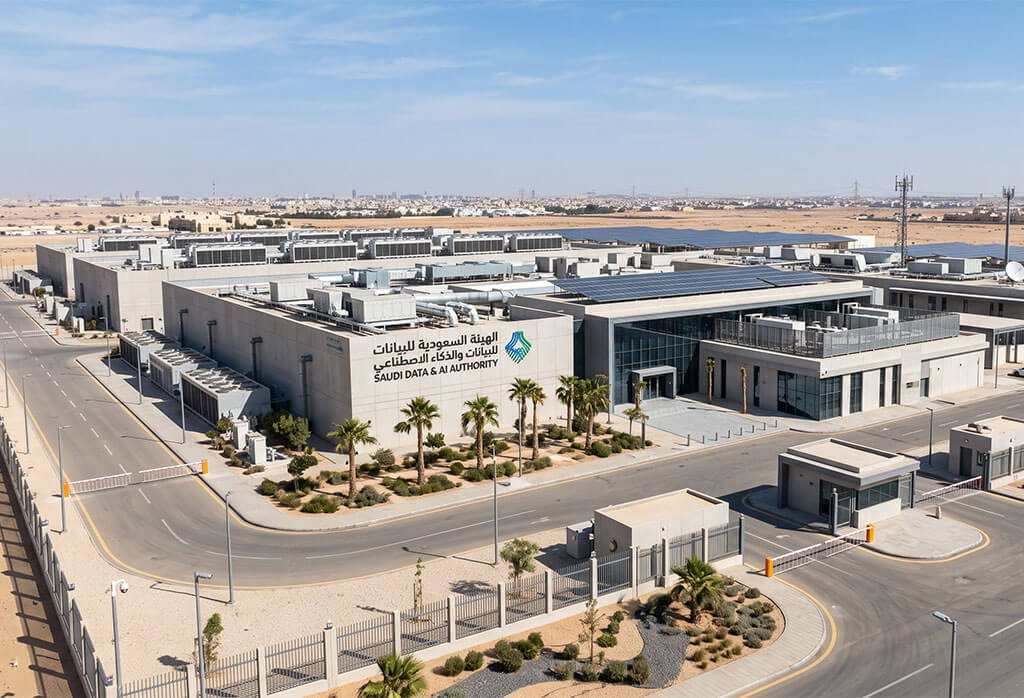


SDAIA Academy summer bootcamps return this August with 18 specialized training programs in data and artificial intelligence. The Saudi Data and Artificial Intelligence Authority announced the lineup on July 20 under what it calls the future summer initiative. Two groups are in scope. Specialists already working in the field and people trying to break into it.
Think of it as a compressed apprenticeship. Rather than a semester of theory, participants spend the days building.
What the 18 tracks cover
The curriculum leans technical. Programs run across generative programming, AI agent systems engineering, AI agent development, and modern data engineering for AI applications. Computer vision for developers is on the list. So are prompt engineering, responsible AI use, and applying artificial intelligence to raise productivity and tighten business processes.
Those titles map closely to what companies are hiring for right now. An AI agent that books, checks, and escalates on its own needs someone who can wire it together and keep it from going off the rails. That is a job, not a concept.
Data governance gets equal billing. A second cluster of programs handles data management, governance, quality, and integration. It sounds less glamorous than agent engineering. It usually decides whether the agent works at all. A model reads whatever you feed it. Feed it duplicated records and stale fields, and the output looks confident and wrong. SDAIA has spent years building the rules around national data use, so training people to apply those rules is part of the same project.
How the SDAIA Academy summer bootcamps run
The format is intensive. Short, dense, hands-on. The academy focuses on practical skills, smart solution development, application design, and best practices in responsible AI deployment and data management. Participants are meant to walk out with work they built rather than notes they will lose.
That design says something about the hiring market. Shipping an AI agent or repairing a broken pipeline is demonstrable. Reading about either is not.
Registration and the AthkaX platform
Registration for the SDAIA Academy summer bootcamps runs through the AthkaX platform at athkax.sdaia.gov.sa. AthkaX is SDAIA’s national platform for capacity building in data and AI, launched during the International Conference on Data and AI Capacity Building. Program details and schedules are on the same platform.
Where the bootcamps fit in Saudi Vision 2030
August is the second wave of the season. In early July, SDAIA Academy launched eight training programs and bootcamps under a July summer initiative, mixing professional tracks with beginner courses on prompt engineering and AI at work. Eighteen bootcamps are more than double that count, in a single month.
The SDAIA training bootcamps sit within the Year of Artificial Intelligence and the workforce ambitions of Saudi Vision 2030, which calls for a globally competitive digital workforce. AthkaX connects to the Human Capability Development Program, one of the Vision 2030 programs.
AI training programs in Saudi Arabia have turned into a steady pipeline rather than scattered one-off events. Over the past year, SDAIA Academy has run a quantum computing camp and a professional program in large language models built toward NVIDIA certification. The SDAIA Academy summer bootcamps extend that cadence into the summer months, when students and job seekers have time to commit.
If a move into data or AI work is on your list, August is the window.
Saudi Arabia’s AI market, 2025–2032
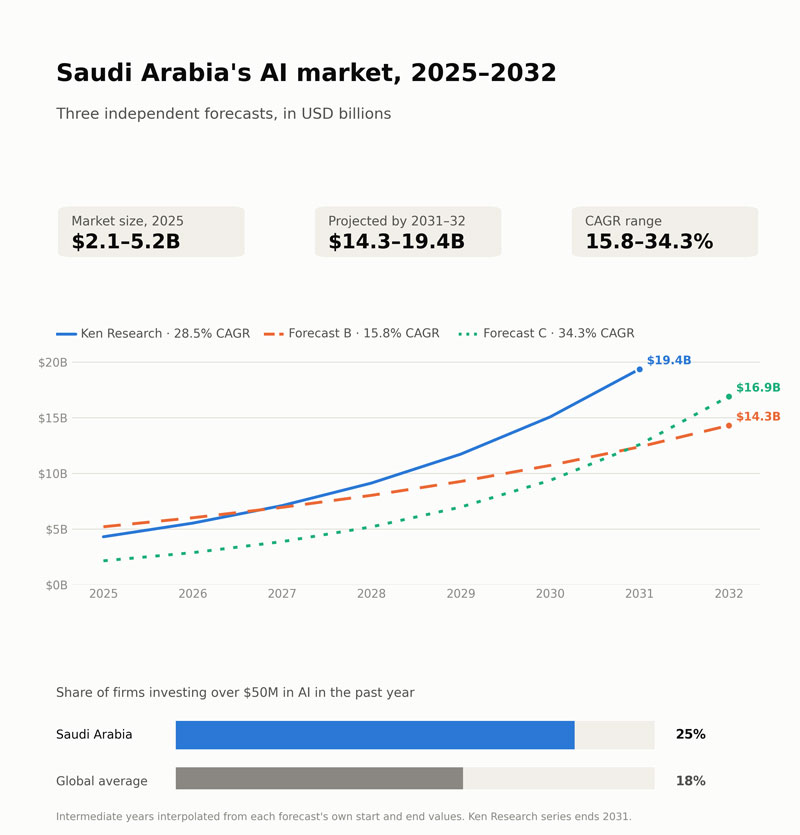
Three houses looked at the same market and came back with numbers that barely overlap. Ken Research starts Saudi AI at $4.3 billion in 2025 and takes it to $19.36 billion by 2031. A second forecast begins higher, at $5.2 billion, but grows more slowly and lands at $14.3 billion. A third starts at just $2.14 billion and nearly matches the top line by 2032.
The base year is where they disagree most: the highest estimate is more than double the lowest. That gap is a definitional problem, not a forecasting one. What all three agree on is direction, and Saudi enterprise spending backs it up.