Dubai free zones all advertise the same headline benefits: 100 percent foreign ownership, zero corporate and personal tax, and full repatriation of profits. Price and sector fit are where Dubai free zones differ. A founder paying AED 25,000 for a DIFC license and a founder paying AED 12,900 for an IFZA package are buying two different products, and both are called a free zone license.
Dubai has positioned itself between East and West, supported by advanced infrastructure, pro-business regulation, and a globally connected economy. Over the past two decades, the emirate has engineered an ecosystem built to attract international capital, entrepreneurs, and high-growth companies across sectors from finance and technology to logistics and media. Dubai free zones sit at the center of that strategy. They are specialized economic areas offering 100 percent foreign ownership, tax incentives, streamlined licensing, and sector-specific support.
These zones are not fixed entities. They compete, and they revise their offerings every year to win new businesses. That competition has sharpened the value proposition on the buyer side. Regulations have loosened, setup has accelerated, and incentives have become more tailored to specific activities.
Serve Global Finance and Capital Markets
Not all free zones are created equal. Each is designed with a distinct strategic focus, aligning infrastructure, licensing frameworks, and regulatory support with specific industries. Some are built to serve global finance and capital markets. Others accelerate innovation in technology and AI. Several are optimized for trade, logistics, or creative industries. That specialization lets a company plug directly into an ecosystem matched to its operational needs and growth ambitions.
In this report, ICN Media examines the top 10 free zones in Dubai, evaluating their competitive advantages, sector alignment, and strategic positioning within the wider economy. The objective is clear: to identify where opportunity, efficiency, and long-term value converge for companies entering or expanding within the UAE market.
How to read this list of Dubai free zones
Each entry carries the same five data points: year of establishment, official website, registered companies, registration prices, and major business types. Pros and cons follow. Registration prices are entry points, not total business setup costs in Dubai, and they move with license type, visa count, and office solution.
1. Jebel Ali Free Zone (JAFZA)
Year of establishment: 1985
Official website: www.jafza.ae
Registered companies: 11,000 plus
Registration prices: from AED 15,000 (FZCO), FZE from AED 10,000; office and warehouse rentals vary.
Major business types: logistics, trading, manufacturing, food and beverage.
Pros: prime location near Jebel Ali Port, strong global connectivity, wide range of facility options.
Cons: higher setup and rental costs, more regulated compliance requirements.
Established in 1985, Jebel Ali Free Zone is the UAE’s oldest and largest free trade zone, spanning over 57 square kilometers next to Jebel Ali Port. More than 11,000 companies from over 150 countries operate here, including over 100 Fortune Global 500 firms. JAFZA is a logistics and trade supernode handling billions in annual trade. Its integration with the port, proximity to Al Maktoum and Dubai International Airports, and access to 150 global ports suit manufacturing, warehousing, distribution, and re-export businesses. The zone offers 100 percent foreign ownership, full repatriation of profits, zero corporate or personal taxes, and ready-made industrial facilities. Setup costs and compliance run higher than newer zones. For businesses built on international trade, logistics, and industrial operations, the global connectivity, established infrastructure, and location are unmatched.
2. Dubai Multi Commodities Centre (DMCC)
Year of establishment: 2002
Official website: www.dmcc.ae
Registered companies: 26,000 plus
Registration prices: from AED 20,265 (specific trading), flexi-desk from AED 16,000 per year.
Major business types: commodities trading, fintech, consulting, crypto, tech.
Pros: globally recognized free zone, active business community in JLT, supports up to 6 activities per license.
Cons: higher licensing and office costs, competitive market saturation.
Founded in 2002, DMCC is Dubai’s premier free zone for commodities trading, fintech, and professional services, based in Jumeirah Lakes Towers. Over 26,000 registered companies and more than 90,000 professionals make it one of the world’s fastest-growing free zones. Licensing is flexible enough to carry six activities on a single free zone license, covering trading, consulting, crypto, AI, and gaming. Premium office space and strong government backing draw entrepreneurs and multinationals alike. Members also get access to the DMCC Crypto Centre, commodity trading platforms, and an extensive networking calendar. Licensing and office costs sit above average. What DMCC sells in return is credibility, and for traders, fintech firms, and service businesses that trade on reputation, the global standing and business-friendly regulations justify the premium.
3. Dubai Airport Free Zone (DAFZA)
Year of establishment: 1996
Official website: www.dafza.ae
Registered companies: 2,300 plus
Registration prices: from AED 15,000 and up; varies by activity.
Major business types: aviation, logistics, IT, pharmaceuticals, trading.
Pros: located within Dubai International Airport, fast customs clearance, 100 percent foreign ownership and tax exemptions.
Cons: limited office space availability, premium pricing for facilities.
Launched in 1996, Dubai Airport Free Zone sits inside Dubai International Airport, with direct access to global air cargo and passenger networks. Over 2,300 companies from more than 120 countries operate here, concentrated in aviation, logistics, IT, pharmaceuticals, and high-value trading. Businesses receive 100 percent foreign ownership, zero corporate or personal taxes, full profit repatriation, and streamlined customs clearance. Office, warehouse, and land options are flexible, licensing is fast, and bureaucracy is minimal. Proximity to the runway matters most for time-sensitive industries: e-commerce, perishable goods, and express logistics. Facility costs are premium and space availability is limited. For any operation that lives or dies on speed, international reach, and clean import and export flows, DAFZA’s connectivity and regulatory efficiency carry the case.
4. Dubai Internet City (DIC)
Year of establishment: 2000
Official website: www.dic.ae
Registered companies: 1,600 plus
Registration prices: from AED 15,000 and up; service and license fees vary.
Major business types: IT, software, digital marketing, tech startups.
Pros: tech-focused ecosystem, proximity to talent and investors, strong government support for innovation.
Cons: higher office rental costs, competitive environment.
Established in 2000, Dubai Internet City is the Middle East’s leading technology and innovation hub, hosting over 1,600 tech companies and more than 25,000 professionals. Part of the TECOM Group, DIC houses Microsoft, Google, IBM, and Meta, alongside a long tail of startups and digital agencies. IT, software development, digital marketing, e-commerce, and tech innovation all have a home here, with access to talent, investors, and government support programs. Licensing is flexible, and the property mix runs from co-working desks to premium offices in a collaborative setting. Sitting near Dubai Marina and the main business districts helps with networking and recruitment. Office rents and licensing fees run above average. For technology firms, digital entrepreneurs, and innovation-driven businesses chasing scale and credibility, the concentration of tech talent settles the argument.
5. Dubai Media City (DMC)
Year of establishment: 2000
Official website: www.dmc.ae
Registered companies: 3,000 plus
Registration prices: from AED 15,000 and up; varies by activity.
Major business types: media production, advertising, PR, content creation.
Pros: dedicated media ecosystem, access to studios and production facilities, strong industry networking.
Cons: higher costs for premium facilities, focused primarily on media sectors.
Founded in 2000 alongside DIC, Dubai Media City is the region’s largest and most influential media-focused free zone, with over 3,000 companies and more than 34,500 professionals. Also part of the TECOM Group, DMC hosts CNN, BBC, Reuters, and Sony, plus advertising agencies, production houses, and content creators. Facilities include broadcast-grade production spaces, studios, and retail, set inside a working creative community. Media, advertising, PR, publishing, and digital content businesses license flexibly, with 100 percent foreign ownership and zero taxes. Location near Dubai Marina and next to DIC makes collaboration between tech and media companies straightforward. Premium facilities cost more, and the sector focus is narrow by design. For media, entertainment, and creative businesses building reach and influence, the ecosystem and industry support have no regional equivalent.
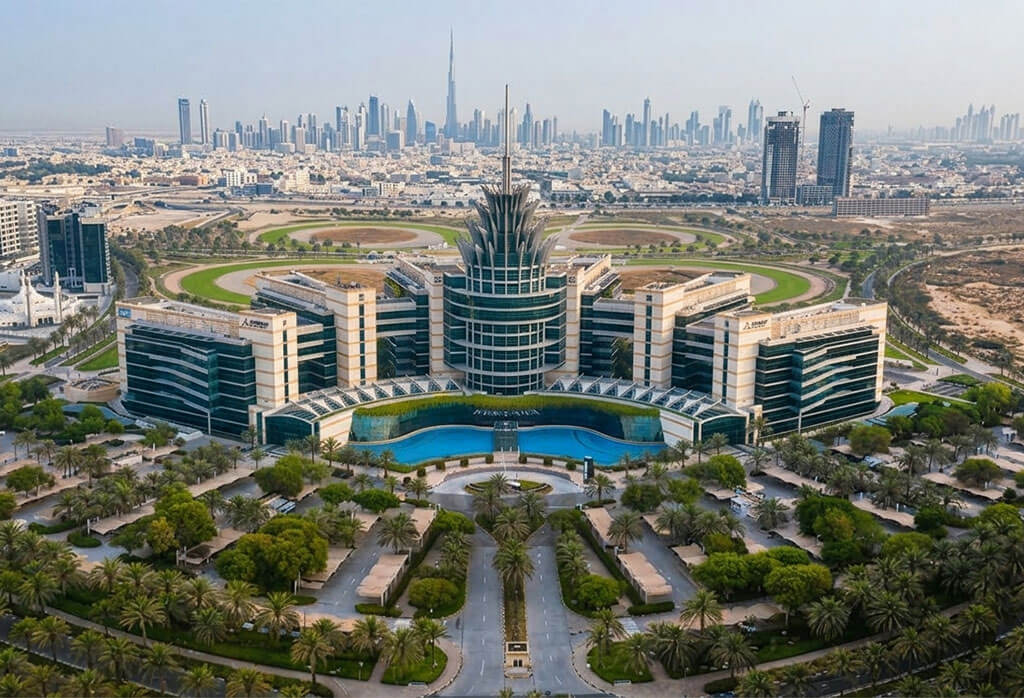
6. Dubai Silicon Oasis (DSO)
Year of establishment: 2003
Official website: www.dso.ae
Registered companies: 28,000 plus, including tech parks.
Registration prices: from AED 12,000 and up; flexi options available.
Major business types: IT, electronics, manufacturing, e-commerce.
Pros: affordable licensing and office options, strong focus on tech and light manufacturing, integrated residential and commercial community.
Cons: slightly farther from central Dubai, less prestige compared to DMCC or DIFC.
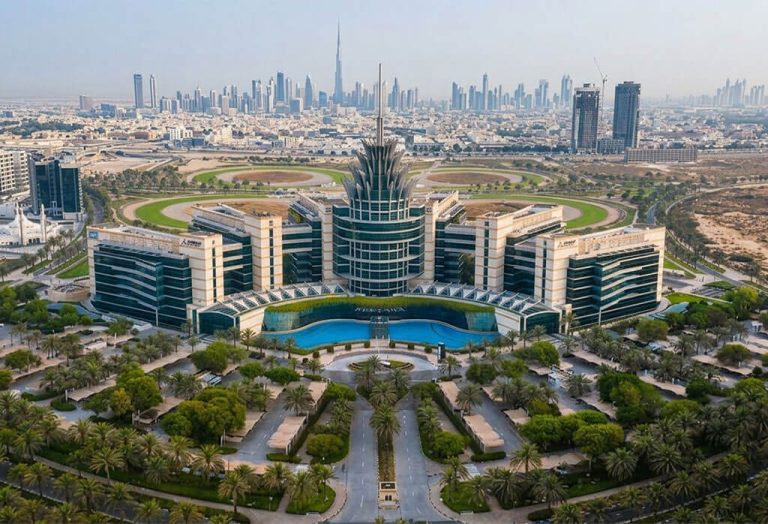
Launched in 2003, Dubai Silicon Oasis is a technology and industrial free zone with over 28,000 companies and more than 90,000 professionals. The site combines residential, commercial, and industrial facilities across one integrated community, which suits tech firms, e-commerce operators, electronics makers, and light manufacturers. Licensing is affordable, office and warehouse options are flexible, and government support for innovation and SMEs is active. Eleven industry clusters encourage collaboration across IT, healthcare, clean tech, and advanced manufacturing. Access to central Dubai and Abu Dhabi runs through Sheikh Mohammed Bin Zayed Road. Prestige is the gap: DSO does not carry the name recognition of DMCC or DIFC. Startups, SMEs, and tech-driven businesses that need affordability and room to scale tend to accept that trade willingly.
7. Dubai International Financial Centre (DIFC)
Year of establishment: 2004
Official website: www.difc.ae
Registered companies: 3,000 plus, estimated.
Registration prices: from AED 25,000 and up; varies by license type.
Major business types: finance, fintech, professional services, legal.
Pros: common law regulatory framework, global financial hub reputation, access to institutional investors.
Cons: high setup and operational costs, strict compliance and regulatory requirements.
Established in 2004, DIFC is the Middle East’s leading financial free zone, operating under a common law regulatory framework independent of UAE civil law. Over 5,000 registered companies and more than 500 billion dollars in assets under management sit inside it, spanning global banks, fintech startups, asset managers, and professional service firms. The centre offers 100 percent foreign ownership, zero corporate taxes, and a DFSA-regulated environment that carries real weight with investors. Its Gate District holds premium offices, retail, and dining, while the DIFC Courts provide international dispute resolution. Setup and operational costs run significantly higher than every other zone on this list. Financial institutions, fintech innovators, and professional services firms targeting regional and global capital pay that premium for regulatory excellence and access to institutional money.
8. Dubai Design District (d3)
Year of establishment: 2013
Official website: www.d3.ae
Registered companies: 4,600 plus
Registration prices: from AED 15,000 and up; varies by activity.
Major business types: fashion, design, architecture, creative agencies.
Pros: creative-focused ecosystem, access to studios, retail, and event spaces, strong branding and networking opportunities.
Cons: higher costs for premium spaces, niche focus limits non-creative businesses.
Founded in 2013, Dubai Design District is the Middle East’s dedicated creative hub for fashion, design, architecture, and innovation. Over 4,600 companies operate from purpose-built studios, retail spaces, galleries, and event venues across a walkable community. Fashion labels, design agencies, architects, and creative entrepreneurs get flexible licensing, 100 percent foreign ownership, and zero taxes. Dubai Design Week and Dubai Fashion Week both run here, which puts exposure and networking on the calendar rather than leaving them to chance. Downtown Dubai and Dubai Creek are minutes away. Premium space costs more, and the niche focus rules out most non-creative businesses. Design-driven companies looking for collaboration, visibility, and growth in the regional and global creative economy get an infrastructure and government backing combination that no other zone replicates.
9. Meydan Free Zone
Year of establishment: 2014
Official website: www.meydanfreezone.com
Registered companies: not publicly disclosed, growing rapidly.
Registration prices: from AED 13,000 and up; flexi packages available.
Major business types: consulting, e-commerce, digital services, trading.
Pros: fully digital setup process, affordable licensing options, flexible business activities.
Cons: less established reputation, limited physical infrastructure.
Launched in 2014, Meydan Free Zone is the UAE’s first fully digital free zone, built for entrepreneurs and SMEs who want setup to be fast, cheap, and flexible. Located near Meydan Racecourse, it runs 100 percent online licensing with zero paperwork, and companies can operate remotely or from flexible office space. Consulting, e-commerce, digital services, and trading are all supported, with packages starting at AED 13,000. Members receive 100 percent foreign ownership, zero taxes, and entry into Dubai’s business ecosystem without renting a physical office. Infrastructure and prestige are thinner than at the larger zones. Rapid setup, often within 24 hours, plus the digital-first process and low cost, make Meydan a fit for startups, freelancers, and digital entrepreneurs who value agility inside a reputable Dubai jurisdiction.
10. International Free Zone Authority (IFZA)
Year of establishment: 2019
Official website: www.ifza.com
Registered companies: not publicly disclosed; rapid growth.
Registration prices: from AED 12,900 and up, includes 3 activities.
Major business types: consulting, e-commerce, trading, services.
Pros: low-cost setup with flexible packages, fast licensing in 3 to 5 days, allows combination of trading and consulting.
Cons: newer zone with less brand recognition, limited physical office options.
Established in 2019, IFZA is one of Dubai’s fastest-growing free zones, aimed squarely at startups and SMEs that need an affordable, flexible setup. Based in the heart of Dubai, it provides 100 percent foreign ownership, zero corporate taxes, and full profit repatriation, with packages from AED 12,900 covering up to three business activities. Consulting, e-commerce, trading, and professional services are all supported, and approvals often land within 3 to 5 days. Virtual offices and co-working spaces cover the facility requirement, which keeps entry costs low while still connecting members to Dubai’s business network. IFZA is newer and less established than DMCC or DIFC. Entrepreneurs, digital businesses, and SMEs who want a credible Dubai presence on minimum capital and maximum agility make up most of its base.
What the price spread across Dubai free zones buys
Entry pricing across these ten runs from AED 12,900 at IFZA to AED 25,000 and up at DIFC. The gap is not arbitrary. IFZA sells speed and low cost. DIFC sells a common law court system and a regulator that institutional investors already trust. JAFZA sells 57 square kilometers of port-adjacent land. DMCC sells six activities on one license and a name that opens bank accounts.
A company optimizing for the lowest Dubai free zone company setup cost will land at IFZA, Meydan, or DSO. A company that will raise institutional capital or holds client money belongs in DIFC regardless of the invoice. Trading physical goods points to JAFZA or DAFZA. Media, design, and technology each have a purpose-built address in DMC, d3, and DIC.
The question is not which is the best free zone in Dubai. It is which zone charges for something a specific business will use. Everything else is overhead with a good address.