
icnlive

WATCH LIVE. THINK BUSINESS.

© 2026 ICN.LIVE

ICN.live

PUBLISHED BY ICN PRESS

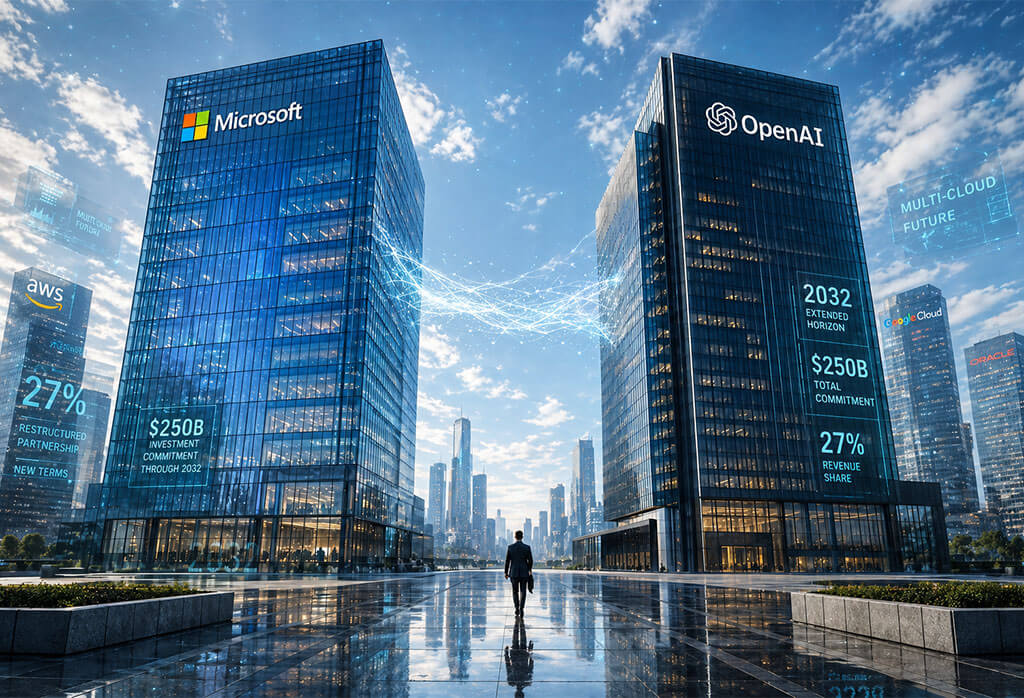
  • Microsoft OpenAI amended agreement removes exclusive rights to OpenAI’s models and intellectual property.
  • OpenAI can now sell products through AWS, Google Cloud, and other rival providers.
  • Microsoft stops paying revenue share to OpenAI, while OpenAI still pays through 2030.
  • The controversial AGI clause is gone, replaced by a clean 2032 license expiration.

Microsoft – OpenAI amended agreement signals a sharp turn in one of tech’s most-watched corporate partnerships. Microsoft confirmed the new terms on Monday, days before its quarterly earnings report. Under the prior deal, Microsoft held exclusive rights to OpenAI’s models until the company reached artificial general intelligence. The new contract removes that trigger and replaces it with a fixed 2032 license expiration date.

Sam Altman and Satya Nadella reportedly negotiated the changes themselves over recent weeks. Their goal was to bring clarity to a relationship that grew tangled as OpenAI courted Microsoft’s rivals. Microsoft OpenAI exclusivity ends with this restructuring, opening the door for AWS, Google Cloud, and Oracle. From my standpoint, this shift reflects OpenAI’s growing leverage and its push for multi-cloud freedom.

What the new deal changes for cloud rivals

Microsoft – OpenAI partnership restructured terms now allow OpenAI to serve products on competing cloud platforms. Azure remains the primary cloud partner, and OpenAI products still ship there first under most conditions. Yet OpenAI can offer its full catalog through any provider it chooses going forward. Amazon CEO Andy Jassy welcomed the news, confirming OpenAI models will reach AWS Bedrock within weeks.

You should note that Microsoft shares fell roughly 3% after the announcement on Monday. Amazon and Alphabet stock posted small gains as investors priced in a fresh competitive opportunity. The shift comes after OpenAI signed a $38 billion AWS deal last November. OpenAI later expanded that commitment by another $100 billion across eight years.

Microsoft – OpenAI amended agreement rewrites the money flow

The financial structure also changed in important ways for both sides of the table. Microsoft will no longer pay OpenAI a revenue share on AI model sales through Azure. OpenAI continues paying Microsoft a 20% revenue share, capped and ending in 2030. Microsoft loses OpenAI’s exclusive access in trade for cleaner terms and reduced legal risk.

Microsoft keeps its 27% stake in OpenAI, valued at roughly $135 billion last October. The OpenAI – Microsoft revenue-sharing deal now runs on a fixed schedule rather than open-ended triggers. Both companies framed the update around flexibility, certainty, and broader AI adoption across markets. As I see it, the deal trades short-term advantage for long-term predictability and cleaner governance.

Why investors are watching closely

The Microsoft OpenAI amended agreement also removes the controversial AGI clause from the contract. The original provision gave OpenAI’s board power to declare AGI and shift the partnership terms. Investors viewed this as a structural risk hanging over Microsoft’s $13 billion cumulative investment. Removing it brings predictability to a contract once tied to a vague technical milestone.

Enterprise buyers benefit most from this change because they gain real choice across clouds and models. Microsoft now competes for OpenAI workloads rather than owning them by default. The Microsoft – OpenAI amended agreement reshapes the cloud market for the next six years.

TAGS

EXPLORE MORE ON:

Museum of the Future closure

Dubai’s Museum of the Future closure takes effect on September 1, when the landmark torus on Sheikh Zayed Road shuts its current galleries for the biggest overhaul since it opened in February 2022. Reopening is planned for the first quarter of 2027, timed to the museum’s fifth anniversary. The site sits in the city’s financial district, near Emirates Towers. Visitors have a short window left. Current exhibits stay open until the closure, after which work begins on an entirely new set of galleries.

What the Museum of the Future closure means for visitors

Timed-entry passes remain the only way in, and Museum of the Future tickets tend to sell out days ahead even in normal months. Word of the Museum of the Future closure has driven a late rush for slots. Free entry applies to some categories of visitors, who collect passes at the customer service desk rather than booking online. Emirates Towers station on the Dubai Metro Red Line sits closest, linked to the building by a direct bridge. Most guests spend two to three hours moving through the floors, so a fixed entry time and an early arrival help on busy days.

The building as the first exhibit

Its structure draws crowds before anyone steps inside. A stainless steel shell wraps around a hollow center, shaped as a ring with no columns and no conventional facade. Arabic calligraphy covers the exterior, drawn from words written by Sheikh Mohammed bin Rashid Al Maktoum, Vice President and Ruler of Dubai, with the windows formed by the letters themselves. Seven floors sit inside, and the visitor route runs from the top down, opening at a near-future space station theme.

Unlike traditional institutions built around permanent collections, the Museum of the Future Dubai was designed to reinvent itself. Its exhibitions refresh in step with advances in technology, science and global innovation. That model explains the current shutdown. Rather than an interruption, the Museum of the Future renovation follows the plan the venue set from the start. Run by the Dubai Future Foundation, the site treats reinvention as routine.

New experiences due in 2027

Specific exhibits have not been detailed yet. Museum staff say the refreshed content will draw on ideas from more than 1,000 contributors worldwide, gathered through an earlier global call for input. Current galleries cover artificial intelligence, space exploration, climate, health and sustainability, themes that track the UAE’s push into innovation and economic diversification. Plans for the Museum of the Future reopening in 2027 remain limited in public detail, and further information is expected through official channels closer to the relaunch. Museum leaders have framed the work as the start of a new chapter rather than a farewell.

Final days before the shutdown

September 1 stands as the Museum of the Future’s closing date for current galleries. Some earlier reports pointed to a mid-September closure, but the museum’s late-August campaign, titled See it before the 1st, supports the earlier date. Once the doors shut, the Museum of the Future closure will run for months while crews install the next generation of interactive spaces. Millions have passed through since 2022, drawn by one of Dubai’s most photographed buildings. For Dubai, the timing lands as the emirate pushes its standing as a hub for tourism, innovation and future-facing investment. That run pauses now, with a reinvented experience promised for 2027.

Emirati Women's Day 2026

Emirati Women’s Day 2026 arrives on 28 August with a change of format, as the UAE extends a single date into a month of national programming that ends on 28 September. The country fixed the date in 2015, choosing 28 August because the General Women’s Union was founded that day in 1975. Sheikha Fatima bint Mubarak, who chairs the union, announced the extension in July.

State news agency WAM gives this year’s Emirati Women’s Day theme as “We Emerge Stronger and Better”. The office of the Mother of the Nation renders the same Arabic slogan as “Together, We Rise Stronger and Better”. Either wording points the same way. Both readings treat achievement as collective rather than exceptional.

What Emirati Women’s Month 2026 changes

Format matters more here than it might appear. A single day produces ceremonies. Emirati Women’s Month 2026 hands federal bodies, emirate authorities and private employers a four-week window to launch programmes and report against them. WAM describes the extended period as a platform for action, recognition and new initiatives. Emirati Women’s Day 2026 therefore opens the season rather than containing it.

The record in numbers

Public claims around Emirati Women’s Day 2026 rest on published indicators. Women hold 50 percent of seats in the Federal National Council and about 63 percent of leadership positions across the government sector. Participation by women in the labour market rose 101.92 percent between 2021 and 2025. Nafis, the federal programme placing Emiratis in private-sector work, counted women as 74 percent of its beneficiaries. The World Economic Forum’s Global Gender Gap Report 2025 ranked the UAE first in the region. IMD’s 2026 World Competitiveness Ranking placed the country second globally on women’s representation in parliament.

Where Emirati businesswomen sit

WAM’s 2025 data counts more than 25,000 Emirati businesswomen holding over 50,000 commercial licences, with combined investment above AED 60 billion. Ministry of Economy and Tourism figures put the number of small and medium enterprises owned or co-owned by Emirati women at 114,050 by the end of February 2026, alongside 48,257 women entrepreneurs. The two sets measure different things, which is worth stating rather than blending. Scale gives them weight either way. Minister Abdulla bin Touq Al Marri has put the UAE’s SME count at roughly 1.33 million, close to 95 percent of operating companies and more than 85 percent of private-sector jobs.

Science, technology and the next brief

Women make up around 50 percent of employees in the UAE National Space Programme and close to 80 percent of the Hope Probe’s scientific team. More than 46 percent of STEM graduates are women, as are roughly 70 percent of all university graduates. Current programmes include the Cyber Pulse Initiative for Women and Family and the Empowering Women Farmers initiative, alongside training in artificial intelligence and programming. The Mother of the Nation 50:50 Vision sets a longer horizon, pointing at technology, artificial intelligence and renewable energy.

Emirati Women’s Day 2026

Emirati Women’s Day 2026 lands at a point where the UAE can cite outcomes rather than intentions. Federal law already covers equal pay. Half the seats in the Federal National Council go to women by rule, not by trend. What the month-long format has yet to prove is whether it delivers follow-through or a longer season of announcements. That answer comes after 28 September. For a country that has built its standing on published indicators, the benchmark it set for itself is the one that applies.

Syria's Global Financial System Return

Syria’s global financial system return took visible shape this week, and it happened over a cup of coffee. President Ahmed Al-Sharaa used a Visa card to pay a Damascus vendor in a video released early Thursday, a small transaction carrying outsized symbolism for a country locked out of global banking networks for nearly five decades.

Al-Sharaa made the payment sitting beside Safwat Raslan, governor of Syria’s central bank. Raslan posted the footage on X. He described watching the president complete the country’s first Visa card payment in the capital as a feeling difficult to put into words. He noted it came one day after Syria’s removal from the list of state sponsors of terrorism, a designation that had shaped the country’s economic isolation since 1979.

A Decades-Old Label Comes Off

The United States removed Syria from its state sponsors of terrorism list on Monday, a step Damascus had pushed for since the fall of the Assad government. The change took effect after a 45-day congressional review period that began when President Donald Trump formally notified Congress in July of his intention to rescind the designation.

US Secretary of State Marco Rubio authorized the formal rescission once that review period ended, and also delisted Hay’at Tahrir al-Sham, the group Al-Sharaa once led, as a Specially Designated Global Terrorist. Rubio framed the decision as recognition of steps Damascus had taken over the past year, saying the government of Syria had joined the global coalition against ISIS and conducted operations against terror networks including ISIS, al-Qaeda, Hezbollah, and Iran-aligned groups. He called the move another historic step by President Trump to give the Syrian people a path to prosperity.

Rebels led by Al-Sharaa overthrew longtime ruler Bashar Assad in December 2024, ending a civil war that had run for more than a decade. The terrorism designation had blocked most forms of American trade, investment, and financial contact with Syria for that entire period and long before it.

What the Designation Removal Unlocks

US Treasury Secretary Scott Bessent said the move would help foster additional investment in Syria to promote political and economic stability, adding that it followed through on a promise Trump made to deliver sanctions relief to the country. Treasury was careful to draw a line around the scope of the change. The department stressed that removing the restrictions did not change its posture on countering global terrorism or its commitment to hold bad actors in Syria accountable.

The timing lines up with a broader push already underway. In May, the Central Bank of Syria authorized local banks and electronic payment companies to work directly with international payment providers such as Visa and Mastercard, part of a plan to move the country past its reliance on cash. That decision followed a December 2025 roadmap agreement between the central bank and Visa focused on building a modern payment system. The coffee payment in Damascus put a face on work that had been building for months.

Raslan, who took over as central bank governor in May, has said publicly that Syria’s financial reforms only matter if people feel them in daily life. His remarks alongside the president echoed that theme. He described the terrorism list removal as returning Syria to its natural place in the global economic system, a framing that positions the Visa payment as proof of concept rather than a one-off gesture.

Reconstruction Money Still Has to Show Up

Syria’s global financial system return carries weight because the country needs outside capital badly. Syria’s banking industry held just $12 billion in assets as of November 2024, with state-owned banks holding 69 percent of that total. The World Bank has described those state lenders as likely distressed. Analysts covering the sector have warned that lifting sanctions does not automatically fix a banking system this weak, and that reconstruction financing depends on more than a delisting.

Lebanese, Jordanian, Bahraini, and Qatari banks that kept minimal operations running in Syria during the war are positioned to scale up activity as restrictions ease, with early focus expected on retail banking, cross-border payments, and remittances from Syrians living abroad. Gulf states including Saudi Arabia, the UAE, and Qatar have already pledged multibillion-dollar investments tied to reconstruction.

Al-Sharaa addressed the terrorism list removal directly in a recorded statement, saying Syria was shaking off a dark stain and tearing away a painful chapter of its past to embark on a path of development, reconstruction, and rebuilding. The Visa payment gave that language a physical moment attached to it.

Why the Optics Matter

A single card payment does not rebuild a banking sector. But for a government trying to convince investors, banks, and ordinary Syrians that the country is open again, small public proofs carry real weight. Syria’s global financial system’s return will ultimately be measured in trade volumes, correspondent banking relationships, and IMF assessments, not video clips. Still, the choice to stage that first Visa transaction with the central bank governor sitting next to the president was deliberate. It told a story the government wanted told, at the exact moment the story became true.

The next test comes from institutions rather than optics. Syria’s government has the remainder of 2026 and 2027 to convert this moment into durable outcomes, including restored correspondent banking relationships and completed regulatory reviews. Whether Syria’s global financial system return holds depends on those steps landing on schedule.

Share this post

on your favourite social platforms

or copy the link