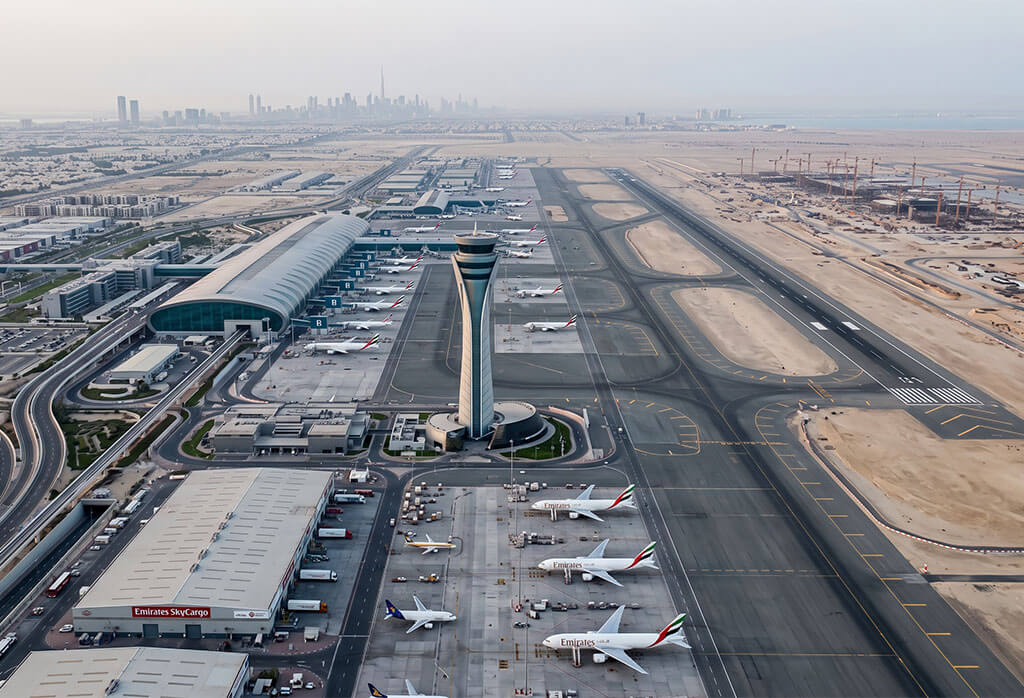



Al Maktoum International Airport (DWC) targets 260 million passengers a year, and Dubai has now decided how most of them will move once they are inside the gates. Dubai Aviation City Corporation, a government entity, awarded the contract for a 50-kilometre automated people mover system to a consortium led by Mitsubishi Heavy Industries. The Japanese group describes the network as the largest of its kind at any airport. Nine stations are planned, served by 165 driverless vehicles. Completion is scheduled for December 2031, a year ahead of the airport’s planned opening.
Who governs the award?
Dubai Aviation City Corporation sits inside the emirate’s government, which means the money and the accountability are public. Joining MHI are MHI Mobility Engineering Services and the Indian engineering group Larsen and Toubro. The Japanese partners lead design, procurement and testing of the vehicles and signalling, plus overall system integration. L&T takes the remaining subsystems, from design through on-site construction.
Neither the corporation nor MHI has published a price. L&T has classified its portion as a large order under its own reporting bands, a range of 2,500 crore to 5,000 crore rupees, or somewhere between 280 million and 560 million dollars. The precise figure stays undisclosed. Delivery is being implemented through Dubai Aviation Engineering Projects. MHI is not a stranger here, having built the Dubai Metro, which opened in 2011.
The first phase is set at 150 million passengers
Capacity is the reason. Al Maktoum International Airport (DWC) targets 260 million passengers a year in its final form, alongside 12 million tonnes of cargo, across a site of about 70 square kilometres with five parallel runways. Reaching that figure would make it the world’s largest airport by design capacity. The first phase is set at 150 million passengers, and the higher number is a long-term ceiling rather than an opening-day promise.
Dubai International handled 95.2 million passengers in 2025, its busiest year on record, and has almost no room left to stretch. Sheikh Mohammed bin Rashid Al Maktoum approved the new passenger terminal and a 128 billion dirham budget in April 2024, about 35 billion dollars. The Al Maktoum International Airport expansion has been running through a series of contract awards since.
A benchmark set well above Dallas
The 50-kilometre network would run more than six times the length of the current leader, the roughly 8-kilometre SkyLink at Dallas Fort Worth International Airport. Atlanta’s Hartsfield-Jackson, the most heavily travelled airport in the world, carries around 91 million passengers a year and moves them internally on its Plane Train. Al Maktoum International Airport (DWC) targets 260 million passengers over time, close to three times Atlanta’s present traffic. Transfers become the binding constraint at that scale. MHI says the system is meant to cut journey times inside the Dubai World Central airport, improve convenience and keep operations efficient as volumes climb.
Technology decisions held open
Paul Griffiths, chief executive of Dubai Airports, has said the second phase is being designed around new technology and around convenience for travellers. He has spoken of building an airport experience like none other, and has indicated some equipment choices will be taken late in the programme, so newer systems can still be adopted. Keeping options open guards against obsolescence. It also loads risk onto the schedule, and on a public project of this size the timetable is the one measure outsiders can check without access to the books. The Mitsubishi Heavy Industries contract fixes one of the larger pieces early. Al Maktoum International Airport (DWC) targets 260 million passengers, and the people mover decides whether an airport of that size works from the inside.