

icnlive

ICN.live

The Ajman Arbitration Centre at the Ajman Chamber has signed a Memorandum of Understanding (MoU) with the Emirates Association for Lawyers and Legal Professionals and its training arm, the Higher Institute for Legal Training, to foster scientific and professional cooperation in legal fields, enhance joint efforts in developing the arbitration system and alternative Dispute Resolution methods, promote legal awareness, and qualify national competencies in the fields of arbitration.

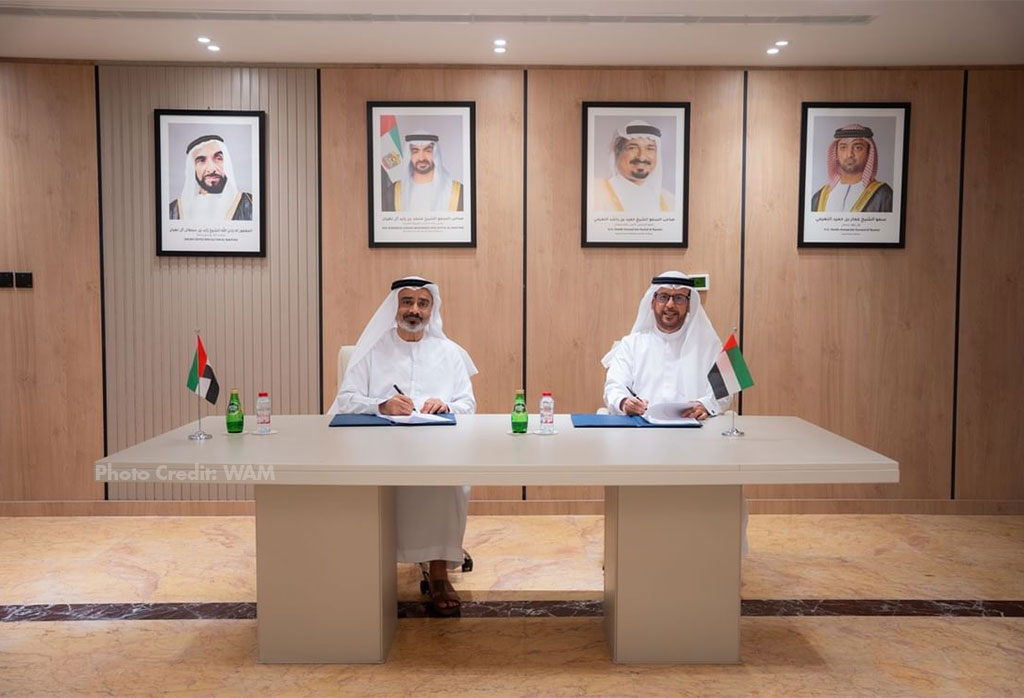
The MoU was signed by Eng. Abdullah bin Mohammed Al Muwaiji, Chairman of the Board of Directors of the Ajman Chamber, and Counsellor Zayed Saeed Al Shamsi, Chairman of the Board of Directors of the Emirates Association for Lawyers and Legal Professionals, at the chamber’s headquarters.

The signing ceremony was attended by Mahmoud Othman Abu Al Shawareb, Member of the Board of Directors of the Ajman Chamber; Hindi Obaid Al Matrooshi, Secretary-General of the Ajman Arbitration Centre; and Dr. Salam Al Issa, Director General of the Higher Institute for Legal Training.

Al Muwaiji commended the efforts of arbitrators and legal professionals in bolstering the competitiveness of the national economy. He also praised their pioneering role in delivering effective legal and arbitral solutions that accelerate commercial Dispute Resolution, thereby instilling confidence within the business community and fostering a secure and stable investment environment.

He emphasised that the Ajman Arbitration Centre is committed to broadening its partnerships and enhancing cooperation with various entities. This aims to reinforce its role as a sustainable and reliable arbitration platform for commercial and economic Dispute Resolution, keeping pace with the rapid growth across various economic sectors in accordance with the latest arbitration practices.

He commended the existing partnership between the Ajman Arbitration Centre and the Emirates Association for Lawyers and Legal Professionals, which contributes to raising awareness of the importance of arbitration and promoting its culture as an effective tool for facilitating business operations and Dispute Resolution with efficiency and flexibility.

Counsellor Al Shamsi provided an overview of the efforts and services of the Emirates Association for Lawyers and Legal Professionals, and the entities affiliated with the Association, including “the Higher Institute for Legal Training, the Emirates Centre for Legal Studies, the Emirates Centre for Human Rights Studies, and the Media Centre.”

The MoU stipulated enhancing joint cooperation between the two parties in legal training and qualification, and arbitration; cooperating in developing the professional capacities of legal professionals; enhancing awareness of relevant local and international best practices and standards; organising specialised legal conferences, seminars, and forums; preparing and implementing qualification programmes for arbitrators and experts; and exchanging scientific and practical expertise in the legal and arbitration fields.

The partnership will also introduce professional and specialised arbitration diploma programmes, qualification courses for arbitrators and experts, specialised workshops, and legal conferences and seminars. These programmes will target lawyers, legal advisers, arbitrators, experts, employees in the public and private sectors, academics, researchers, law students and others interested in arbitration and alternative dispute resolution.

The two sides exchanged commemorative shields following the signing ceremony.


IMPORTANT: CONTENT SUBMITTED BY THE CLIENT. THIS IS A PRESS RELEASE ARTICLE. PLEASE READ THE INFORMATION BELOW.

ICN.live neither validates nor guarantees the accuracy, reliability, or quality of the information, promotional materials, or products mentioned herein. Readers are encouraged to conduct independent due diligence before making any decisions related to the featured company. ICN.live bears no responsibility, directly or indirectly, for any harm, loss, or consequences that may result from reliance on or interaction with the content, services, or offerings described in this release.

The details shared in this announcement do not constitute financial, trading, or investment guidance. Readers are strongly advised to carry out independent research and seek advice from a qualified financial professional before making any investment or cryptocurrency-related decisions.


TAGS

EXPLORE MORE ON:

DXB launched new Smart Gates service

Dubai Airports launched a new Smart Gates service on Friday, letting travellers run a Smart Gates eligibility check before they reach passport control. Dubai Airports developed the tool with the General Directorate of Identity and Foreigners Affairs in Dubai. The operator calls it the Smart Gates Eligibility Pre-Check. Passengers reach it through the Pocket Flights app or by scanning QR codes placed across every terminal and gate.

A traveller scans a passport and gets an answer in seconds. Those who clear it can head straight for the automated lanes. Anyone who does not can plan for a staffed counter instead. Dubai Airports said the point of the change is “making the journey through the airport more seamless for our guests.”

GDRFA runs the gates themselves. Dubai International Airport biometric gates read facial and passport data at the barrier, so there is no stamp and no officer check. Eligible groups include UAE and GCC citizens, UAE residents, and visa-on-arrival guests with biometric passports. Many travellers are enrolled the first time they pass through immigration at DXB, which means some queue at the counters without knowing they already qualify. Anyone wanting a second confirmation can use the GDRFA Dubai smart gate registration inquiry on the directorate website, entering an Emirates ID, a file number, or a passport number with nationality.

Why Dubai Airports launched new Smart Gates services

Record volume explains why DXB launched new Smart Gates service now. Dubai International handled 95.2 million passengers in 2025, up 3.1 percent year on year, the highest annual international traffic recorded at any airport. The operator forecasts 99.5 million for 2026. By the end of last year, the airport connected to 291 destinations across 110 countries, served by 108 international airlines.

DXB passport control has held up so far. In 2025, 99.35 percent of departing passengers cleared it in under ten minutes, and 98.8 percent of arriving passengers were processed within 15 minutes. Paul Griffiths, chief executive of Dubai Airports, said in February that record traffic had become part of the airport’s operating reality rather than an exception.

What the pre-check is meant to solve

Passport control is one of the parts of an airport that cannot be widened quickly. Halls are fixed, gate counts are fixed, and staffing has limits. So the operator is working on how passengers sort themselves before they arrive at the hall. A traveller who knows the answer in advance picks the right lane the first time. Across close to 100 million journeys a year, small gains of that kind carry weight.

Capacity beyond DXB

The larger answer sits at Al Maktoum International, where Dubai is building a terminal project valued at about 35 billion dollars. First-phase capacity is expected by 2032, at 150 million passengers a year. Full build-out would take the site to 260 million. Until that capacity arrives, DXB has to find room inside the space it already uses.

DXB launched a new Smart Gates service as part of that pattern. The operator has spent recent years moving checks earlier in the journey and cutting the number of decisions a passenger makes inside the terminal. DXB launched the new Smart Gates service without changing the gates, the enrolment rules, or the biometric system behind them. It changed what the traveller knows before walking up to them.

Adnan Al-Jaziri covers the Gulf economy for ICN.live, with nearly a decade of reporting on finance and economic transformation across the region.

Ajman-Arbitration-Centre
Adani Group eyes a new airline

Adani Group eyes a new airline in India, and the plan could change what you pay for a domestic ticket. Two people with direct knowledge of the matter told Reuters the ports-to-cement conglomerate is studying an entry into flying. Nothing is settled. The group runs eight airports, carries an $11 billion expansion plan, and had said earlier it wanted no part of running a carrier.

That reversal did not come from nowhere. India’s government has quietly encouraged business groups, Adani included, to look at starting an airline. Two failures drove the nudge. Air India has faced heavy safety scrutiny since last year’s Dreamliner crash that killed 260 people. IndiGo cancelled thousands of flights in December after running short of pilots, stranding passengers and forcing officials to act on a sharp rise in fares.

What an Adani airline launch would mean for fares

For passengers, the question is simple. A third large carrier gives you somewhere to go when one airline breaks down. Right now the exit is narrow. IndiGo holds 65.4 per cent of domestic traffic and Air India about 25 per cent. Regulator data for June 2026 put IndiGo’s share at a record 66.3 per cent, while the Air India group slipped to 23.9 per cent. That IndiGo market share number is the whole argument for a new entrant. An Indian aviation duopoly leaves ticket prices exposed every time one operator stumbles.

Why Adani Group eyes a new airline now

One source framed the thinking as duty rather than profit, saying the group wants to weigh it “in national interest” despite the difficulty of the business. The second source said buying a stake in an existing airline is also under review, with all options open.

A rule stands in the way. Adani has approached the government seeking to dilute a clause that restricts certain airport operators from holding stakes in scheduled airlines, the Economic Times reported. The clause dates to the 2006 privatisation of the Delhi and Mumbai airports and bars their operators from holding more than 10 per cent of a scheduled carrier. The civil aviation ministry has sought the Solicitor General’s opinion on whether the clause can be amended retrospectively, and any change would need cabinet approval. Adani holds 74 per cent of Mumbai International Airport.

Adani Airports built the ground floor first

Jeet Adani, a director at Adani Airports, told Reuters in December the group had no appetite for flying. Margins were thin, and the group lacked the “mindset” for it. Its strength, he said, lay in building “hard assets on the ground” and running them efficiently. Spending on that side has not slowed. Adani Airports said last month it would put more than $2 billion into airport-linked commercial districts across six locations, covering hotels, retail centres and office space.

The risk sitting inside the Indian aviation market

Money has been hard to keep in Indian skies. High taxes, fierce competition and supply-chain problems pushed Kingfisher, Jet Airways and Go First into bankruptcy over the last 15 years. SpiceJet is still working through financial strain. Adani is Asia’s second-richest person, with a net worth of around $89 billion, so funding is not the obstacle. History says funding alone has never been enough.

Rival carriers have a separate worry. Independent aviation analyst Brendan Sobie said airports owning airlines exist in markets such as Kyrgyzstan, Thailand and Vietnam, but a government allowing the operator of a major airport like Mumbai to hold an airline stake would be surprising. Other Indian airlines, he said, would “rightfully be concerned about a possible conflict of interest.”

Adani and the civil aviation ministry did not immediately respond to queries from Reuters. For now, any move depends on a rule change that has not happened.

Share this post

on your favourite social platforms

or copy the link