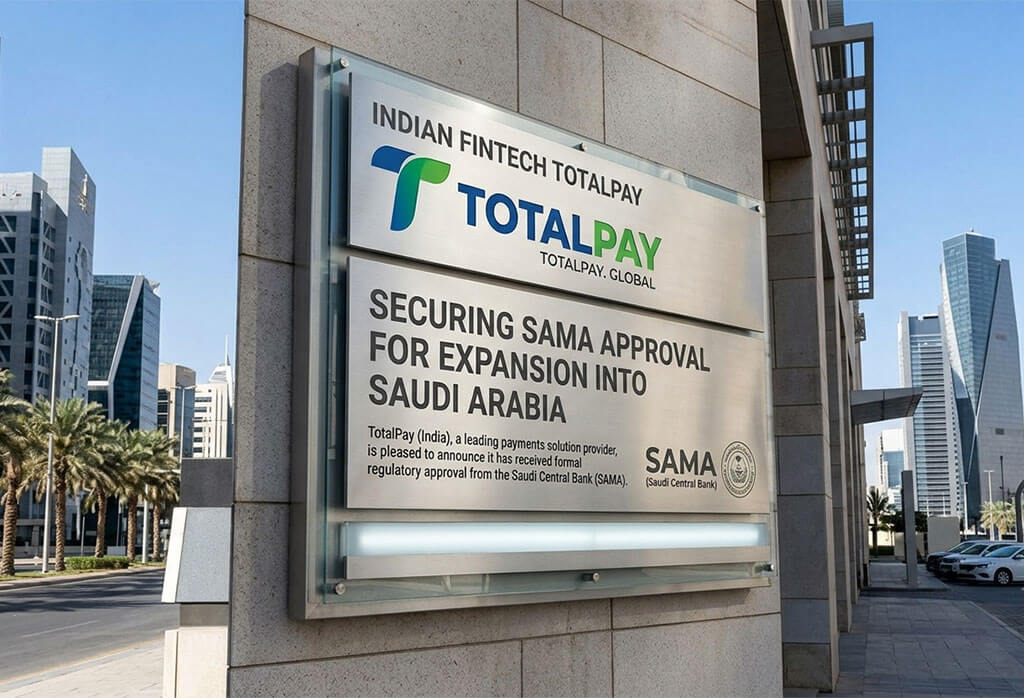


TotalPay becomes the first Indian firm cleared by SAMA as an e-commerce payment technical service provider in Saudi Arabia.
The license lets the company launch payment gateway and orchestration services for merchants across the Kingdom.
Saudi Arabia reached 85 percent electronic retail payments in 2025, up from 79 percent the prior year.
Founded in 2022, TotalPay has served over 1,500 businesses and processed more than one billion dollars.
TotalPay obtains SAMA approval to become the first Indian firm cleared for this role in the Kingdom. The Saudi Central Bank granted the license so the company can serve merchants across Saudi Arabia. You now watch an Indian fintech enter one of the region’s fastest digital payment markets. Regulators approved TotalPay as an e-commerce payment service provider under strict local compliance rules. The clearance lets the firm run payment gateway and orchestration tools for local businesses. Merchants gain a single platform to manage and improve their Saudi Arabia digital payments each day. The firm works closely with banks, financial institutions, and technology partners across the Kingdom. Payment orchestration lets a single platform route transactions through several providers with less daily friction. Local businesses save time when one system handles cards, wallets, and bank rails together.
Why TotalPay obtained SAMA approval at the right time
TotalPay obtains SAMA approval at a moment when the Kingdom pushes hard toward a cashless economy. Electronic payments reached 85 percent of all retail transactions in 2025 across the country. You can see the rise from 79 percent recorded during the previous full year. The Kingdom targets 80 percent non-cash transactions by 2030 under its Vision 2030 plan. Point-of-sale terminals across the country reached close to two million active units by 2025. Digital wallet users across the Kingdom grew past 14 million people during the same year. E-commerce sales keep climbing as more Saudi shoppers pick cards and wallets over cash. This rising demand gives new payment firms a strong reason to enter the Kingdom. Co-founders Akif Mohsin and Rahim Pattarkadavan said they feel “incredibly proud of our team.” They also thanked SAMA for its clear guidance across the entire approval review process. The founders described the license win as a milestone in their broader regional growth plan.
A first for Indian fintech in the Kingdom
Founded back in 2022, TotalPay has already served more than 1,500 businesses to date. The firm has processed over one billion dollars in total customer transactions since its launch. You gain a clear sense of scale from these numbers before the Saudi rollout. The company plans fresh spending on new technology, strategic partnerships, and scalable payment systems. Growth targets reach across Saudi Arabia and the wider Middle East and Africa region. The wider Middle East and Africa market gives the firm room to scale further. Strong transaction volumes give the young team a solid base to attract new merchant clients.
What the clearance means for merchants
TotalPay obtains SAMA approval as the fintech Saudi Arabia hosts grows more crowded each year. The Kingdom moved from 10 sandbox fintechs in 2018 to more than 280 licensed firms. Progressive rules and steady demand keep pulling global players toward this market every single season. Foreign payment firms must secure a SAMA license before they serve Saudi customers directly. Compliance strength therefore separates approved players from the firms still stuck in early testing. From my standpoint, the license shows how open regulation rewards firms with strong compliance. You should watch how quickly TotalPay turns this approval into active live merchant accounts. TotalPay obtains SAMA approval now, and the coming months will test its Saudi execution.

TAGS
Business, Digital Payments, Finance, Global Markets, Saudi Arabia, Tech
Muse Spark artificial intelligence model pricing undercuts top AI rivals
Muse Spark artificial intelligence model now carries a price tag, and developers must pay for access. Meta released the upgraded version on Thursday, opening a public preview to United States developers. The company charges $1.25 per million input tokens and $4.25 per million output tokens. Every new account receives twenty dollars in free credits before pay-as-you-go billing starts. You can read this move as Meta finally selling access instead of giving models away.
Alexandr Wang leads the effort, and he calls the pricing aggressive next to rival lab offerings. His team built the model to handle coding work and long chains of agent tasks. Meta Superintelligence Labs trained it on real-world software problems across large enterprise code bases. Wang told CNBC the update marks the best coding and agent performance Meta has shipped. Rivals now face a cheaper option built by a company with enormous computing capacity.
The Meta Model API sits at the center of this shift toward paid developer access. Developers sign up through a portal, test prompts, compare outputs, and prototype their own integrations. Meta limits access to its own properties for now, skipping third-party marketplaces like OpenRouter. Some early partners already hold API keys, and new users enter a waitlist for entry. Replit, Cline, and Box rank among the first companies building on the new system.
Muse Spark artificial intelligence model sets a new price floor
Muse Spark 1.1 pricing lands below Anthropic’s Claude Sonnet 4.6 on both input and output. The rate still runs above cheaper tiers such as GPT 5 mini and Claude Haiku 4.5. Zuckerberg framed the cost as one of the lowest available to developers right now. In my assessment, price alone will not decide which lab wins the coding market. Quality, reliability, and developer trust matter as much as the number on the invoice.
Meta claims strong benchmark results, including wins over Google’s Gemini 3.1 Pro in some areas. The AI coding model handles bug diagnosis, feature builds, and large-scale code migrations. It supports a context window of one million tokens for long-running technical sessions. Engineers can run it as a lead agent or as a subagent inside larger systems. Mark Zuckerberg said, “Muse Spark 1.1 is strongest at agentic performance, tool use, and computer use.”
Wall Street keeps pressing Mark Zuckerberg for returns on enormous artificial intelligence spending commitments. The company spends like its hyperscaler peers, yet it owns no cloud infrastructure business. Meta plans to launch one, and paid model access opens a second revenue line. Earlier Llama releases went to the open source community without any charge to users. Wang says an open source variant remains in development, though he gave no release date.
What Muse Spark artificial intelligence model means for your stack
Muse Spark artificial intelligence model gives you another vendor inside a crowded developer market. Meta trained the release to work with popular agent harnesses developers already run daily. Wang points to health research as one use case, from web searches to academic papers. Your team should test output quality against cost before moving any production workload over. Meta faces a hard climb, and the Muse Spark artificial intelligence model carries heavy expectations. Developers now decide whether the Muse Spark artificial intelligence model earns a permanent slot.
By
Yousef Haddad
3 min read
$49 billion AI fund by Abu Dhabi’s MGX closes above its $45 billion target
$49 billion AI fund by Abu Dhabi’s MGX closed this week above its original target. The firm set out to raise $45 billion and finished the round with $49 billion. Investors from the Gulf, North America, Asia, and Europe supplied the new pool of capital. MGX said the fund gives backers exposure across the whole artificial intelligence technology stack. Since launch, the vehicle has taken positions in 14 separate companies around the world. You should read the size of this raise as a signal about capital concentration. Abu Dhabi AI investment now sits near the centre of the global technology finance system.
MGX Fund I holds stakes in OpenAI, Anthropic, xAI, Binance, SpaceX and TikTok USDS. Mubadala Investment Company and technology group G42 established the firm back in March 2024. Sheikh Tahnoon bin Zayed, Deputy Ruler of Abu Dhabi, chairs the MGX board of directors. He works at the same time as national security adviser for the United Arab Emirates. At launch, the company named AI infrastructure, semiconductors and core AI applications as targets. Fund I follows the same three-part plan with a much larger pool of money.
Inside the biggest dedicated AI vehicle on record
Bloomberg reported the raise puts the two-year-old firm among the sector’s most consequential investors. MGX plans to deploy up to $10 billion each year for the coming years. Executives have set a goal of more than $100 billion in assets under management. A sovereign wealth fund normally deploys state savings and avoids outside limited partners entirely. MGX broke with the pattern and raised institutional money from investors on four continents. Reports put the minimum ticket size for entry at around $500 million per investor.
From my standpoint, the structure matters more than the headline number attached to it. Sheikh Tahnoon described the company’s purpose when Abu Dhabi first announced the venture in 2024. He said the emirate was “establishing a UAE national champion focused on AI and advanced technologies”. The $49 billion AI fund by Abu Dhabi’s MGX now gives weight to the claim. United States senators have already asked MGX to preserve documents tied to its Binance stake.
What the $49 billion AI fund by Abu Dhabi’s MGX buys next
Fund I spreads its capital across three layers of the artificial intelligence supply chain. AI infrastructure occupies the middle layer, covering data centres, power access and compute platforms. Power access, land and construction timelines shape every serious wager on AI infrastructure today. In October 2025, MGX helped acquire Aligned Data Centres in a $40 billion deal. BlackRock’s Global Infrastructure Partners joined the consortium behind one of the largest infrastructure deals. MGX, Nvidia, Bpifrance and Mistral AI back a French campus targeting three gigawatts of compute. The $49 billion AI fund by Abu Dhabi’s MGX buys time as much as assets.
MGX co-led Anthropic’s $30 billion round in February and joined its $65 billion Series H. Dealroom counts a record $416.6 billion flowing into AI companies during this calendar year. Anthropic and OpenAI absorbed most of the capital, and MGX holds stakes in both. S&P puts Abu Dhabi’s net asset position near 358 per cent of national output. The $49 billion AI fund by Abu Dhabi’s MGX will face its test through deployment. Watch the pace of spending, the choice of chips, and the location of new compute.
By
Mariam Al-Yazidi
3 min read
Entertainment
Top 10 Upcoming Movies to Watch in 2026
The global film slate is shifting toward high-conviction IP, director-led tentpoles, and franchise extensions with built-in audiences. Studios are concentrating capital into fewer, larger bets while using streaming windows to de-risk distribution. The result: a pipeline dominated by established universes, prestige adaptations, and cross-generational animated properties.
This list isolates ten projects with the highest probability of cultural impact and box office traction based on IP strength, talent attached, and release positioning. Each entry includes confirmed or widely reported lead talent, target release timing, and a concise synopsis to frame audience appeal and commercial upside.
ICN RED Top 10 Upcoming Movies to Watch in 2026
1) Spider-Man: Brand New Day
Hero Cast: Tom Holland, Zendaya Release Date: July 31, 2026
A reset-era Spider-Man chapter that leans into isolation, consequence, and street-level stakes after the multiverse fallout. Peter Parker operates without public identity support, rebuilding relationships while confronting a grounded antagonist ecosystem in New York. Tonally closer to early Spider-Man arcs, the film prioritizes character rehabilitation and moral tension over spectacle overload. Expect tighter action geography, emotional continuity with prior arcs, and a reintroduction of core allies under new circumstances. Commercially, it’s positioned to re-anchor the franchise with broader accessibility while preserving continuity hooks for future crossover events.
2) Resident Evil (Reboot)
Hero Cast: TBA Release Date: Late 2026 (expected)
A full reboot targeting fidelity to the original survival-horror tone of the games. The narrative centers on the outbreak’s initial containment failure, emphasizing claustrophobic environments, limited resources, and investigative progression through a corrupted corporate apparatus. Practical effects and restrained pacing are expected to replace prior action-heavy interpretations. The project aims to capture genre purists while onboarding new audiences through a cleaner entry point. If executed with discipline, it can re-establish the brand as a horror-first franchise with strong ancillary potential across streaming series and interactive tie-ins.
3) Avengers: Doomsday
Hero Cast: Ensemble (MCU core roster; details TBA) Release Date: May 1, 2026
A convergence event designed to recalibrate the Marvel narrative after phase fragmentation. The film reportedly introduces a high-threat antagonist with systemic impact, forcing alliances across legacy and newer heroes. Expect multi-thread storytelling, synchronized set pieces, and a decisive tonal shift toward stakes and permanence. From a business standpoint, this is a franchise stabilizer: high marketing spend, global rollout, and merchandise tailwinds. Success depends on narrative clarity and character prioritization after recent audience fatigue with diffuse arcs.
4) Digger
Hero Cast: TBA Release Date: 2026 (TBA)
A character-driven drama with thriller undertones, centered on a protagonist navigating moral compromise within a high-pressure environment (details under wraps). The project is positioned for festival traction, leveraging performance depth and a tightly controlled narrative scope. It targets awards-season pathways rather than tentpole metrics, with downstream value in streaming acquisition and critical prestige. If anchored by a breakout performance, it can convert modest production budgets into outsized cultural relevance and long-tail viewership.
5) Street Fighter
Hero Cast: TBA Release Date: 2026 (TBA)
A rebooted adaptation of the iconic fighting franchise, structured around an ensemble of global fighters converging in a high-stakes tournament. The film aims to balance fan service—signature moves, rivalries, and character archetypes—with coherent storytelling and modern action choreography. The commercial thesis hinges on international appeal and brand recognition, particularly in Asia and Latin America. Execution risk centers on tonal consistency and casting credibility. A disciplined approach can unlock sequel potential and cross-media expansion.
6) The Odyssey
Hero Cast: Matt Damon, Anne Hathaway (reported) Release Date: 2026 (TBA)
A large-scale adaptation of Homer’s epic, reframed for contemporary audiences while preserving mythological scope. The narrative follows Odysseus’ prolonged return journey, confronting divine intervention, psychological endurance, and leadership under adversity. Production value is expected to emphasize practical locations and controlled VFX to sustain immersion. This is a prestige play with global resonance, targeting both awards circuits and wide audiences. Success depends on balancing fidelity to source material with narrative accessibility and pacing.
Hero Cast: TBA Release Date: November 2026 (expected)
A prequel set during the Second Quarter Quell, focusing on a younger Haymitch Abernathy and the systemic brutality of the Games. The film leans into political allegory, survival strategy, and character formation under extreme conditions. Franchise familiarity reduces marketing friction, while the darker tone targets both legacy fans and new viewers. Box office upside is tied to casting strength and the ability to differentiate from prior installments while maintaining thematic continuity.
9) Moana (Live-Action)
Hero Cast: Dwayne Johnson, Auli’i Cravalho (reported) Release Date: July 10, 2026
A live-action reimagining of the animated hit, retaining core narrative beats—identity, heritage, and environmental balance—while expanding cultural and visual scope. The film prioritizes authenticity in Polynesian representation alongside large-scale oceanic set pieces. Family audience dominance and brand recognition underpin a strong revenue floor. Upside depends on musical execution and visual fidelity that justifies the live-action transition. Expect robust merchandising and cross-platform synergy.
10) Coyote vs. Acme
Hero Cast: John Cena, Will Forte (reported) Release Date: 2026 (TBA)
A hybrid live-action/animation courtroom comedy where Wile E. Coyote sues Acme Corporation for defective products. The premise leverages Looney Tunes nostalgia with a modern legal-comedy framework, enabling meta-humor and broad demographic appeal. Production risk is moderate; success hinges on script sharpness and tonal balance between slapstick and satire. If positioned correctly, it can perform strongly in family segments and streaming windows, with high rewatch value.