

icnlive

WATCH LIVE. THINK BUSINESS.

© 2026 ICN.LIVE

ICN.live

PUBLISHED BY ICN PRESS

  • UAE passport ranks first globally in 2026, recording a Mobility Score of 182 and worldwide access of 91.9 percent, per Passport Reports’ September ranking.
  • The score covers 128 visa-free destinations, 44 visa-on-arrival or simplified-entry destinations, and 10 reachable through an eTA.
  • Europe, the Gulf and the Middle East each show 100 percent overall access for UAE passport holders.
  • Only 16 destinations remain visa-required, and the UAE itself ranks 91st out of 199 for inbound travel.

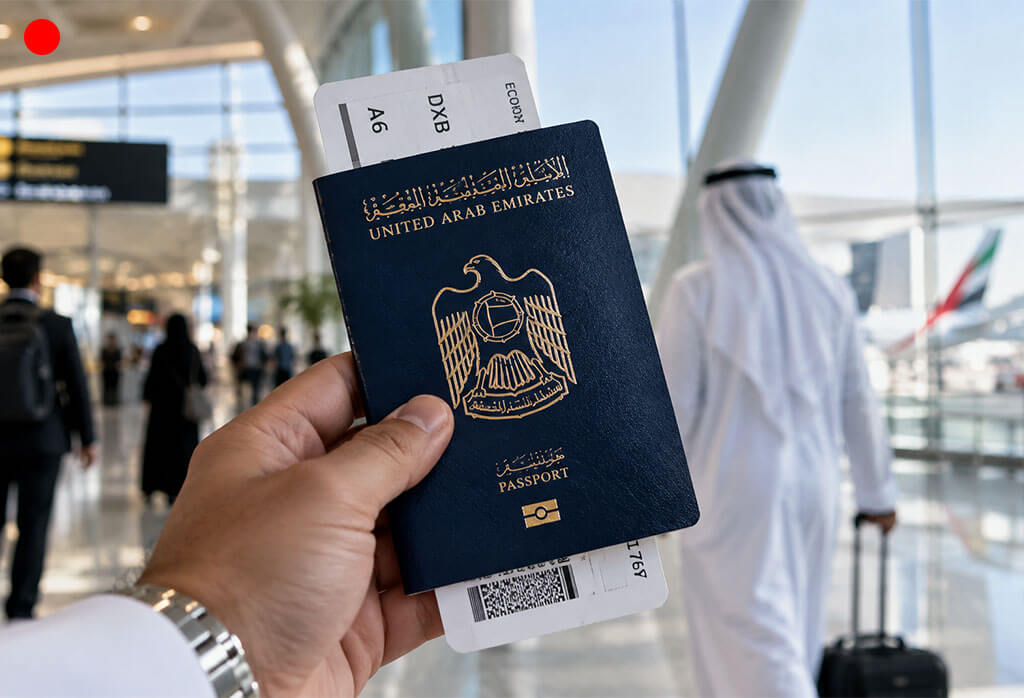
Passport Reports says the UAE passport ranks first globally in 2026, recording a Mobility Score of 182 and worldwide access of 91.9 percent. Holders can reach that many destinations through visa-free entry, visa on arrival, other simplified entry arrangements, or an eTA. This particular measure places the document among those commonly called the world’s most powerful passport. That UAE passport ranking 2026 update also breaks down access by region, tier, and reciprocity, across all 199 tracked destinations.

UAE passport mobility score breaks into three tiers. Visa-free access covers 128 destinations. UAE passport visa-on-arrival access applies to 44 more. An eTA opens the remaining 10.

Sixteen destinations still require a visa arranged in advance. Those include Afghanistan, the United States, Australia, Belize, Bhutan, Algeria, Eritrea, Cameroon, North Korea, Lesotho, Libya, Myanmar, Nicaragua, Somalia, Turkmenistan and Venezuela. Several of them still offer an electronic-visa option. Australia provides a fast-track eVisa. Bhutan, Cameroon, Libya, Nicaragua, Somalia and Venezuela also list eVisa access, though each stays classified as visa-required.


Business Intelligence & News

  • Tabby raised $233 million from existing investors in a Series F round led by Blue Pool Capital, at a $6.5 billion valuation.
  • The figure rises from $4.5 billion in October and, by Bloomberg’s account, now exceeds Klarna’s market value.
  • New Saudi and UAE licences let Tabby move beyond buy now pay later into longer-term credit and a cash account product.
  • The round still needs regulatory sign-off, including from the Saudi Central Bank, and the company has not set a listing timetable.

UAE passport ranks first globally across Europe, Gulf and Middle East

UAE passport ranks first globally in Europe, where access reaches 100 percent overall. Visa-free entry accounts for 97.9 percent of the region, spanning 46 destinations, with the remainder reached through the eTA category.

Gulf access also reaches 100 percent. UAE passport holders travel visa-free to Bahrain, Qatar, Kuwait, Saudi Arabia and Oman, the five other GCC states.

Middle East access also reaches 100 percent overall. Visa-free entry makes up 75 percent of that region. Visa on arrival or simplified entry adds 18.8 percent, and an eTA covers the final 6.3 percent. No Middle Eastern destination sits in the visa-required column.

Access outside these three regions varies by geography. Caribbean access stands at 93.8 percent. Oceania reaches 92.9 percent, South America 91.7 percent, Asia 89.8 percent, Africa 88.9 percent, North America 87 percent, and Central Asia 80 percent.

UAE passport visa-free countries and wider rankings

Per Passport Reports, the UAE passport ranks first globally among 50 Asian countries, 17 Middle Eastern countries, and six Gulf countries. It also leads among 24 Arabic-official-language countries, 159 World Trade Organization members, 57 Organisation of Islamic Cooperation countries, 22 Arab League countries, 11 BRICS countries and 132 G77 countries.

Per the same report, UAE passport visa-free countries do not all share the same entry process. Dominica, El Salvador and Armenia allow visa-free stays of up to 180 days. United Kingdom and Canada eTA entries carry the same allowance. Additional steps apply elsewhere. Dominican Republic entry calls for an e-ticket ahead of a 30-day stay. Malaysia requires an arrival card for 90 days. Suriname uses a tourist card, also for 90 days. Seychelles calls for tourist registration, and Côte d’Ivoire for pre-registration, both covering 90-day stays.

UAE ranks 91st for inbound travel

UAE passport ranks first globally for outbound travel, but inbound access works differently. Passport Reports also measures how easily foreign nationals can enter the UAE, a separate welcoming-country ranking. On that scale, the UAE places 91st out of 199, a figure distinct from its own passport’s Mobility Score and not to be confused with it.

Two reciprocity gaps stand out in the data. United States and Australian passport holders can enter the UAE visa-free, electronically, or on arrival, while UAE passport holders need a visa to enter either country. A longer list runs the other way. India, Pakistan, Kenya, Thailand, Türkiye, and South Africa all require their own citizens to secure a visa for the UAE, even as UAE passport holders receive visa-free, electronic, on-arrival, or otherwise simplified entry to each of those destinations.

TAGS

EXPLORE MORE ON:

Etihad launches Etihad Escapes

Etihad Airways has unveiled Etihad Escapes, a new travel platform designed to extend the Etihad experience beyond the flight and make it easier for guests to plan and book more of their journey in one place.

Announced at Arabian Travel Market (ATM) 2026 in Dubai, Etihad Escapes will launch in October, initially allowing guests with an Etihad flight booking to add hotel accommodation directly through etihad.com.

The platform is the first step towards a broader integrated travel offering that Etihad plans to develop through 2027, bringing together flights, hotels and additional travel services within a single digital experience, with further integration into the Etihad app and Etihad Guest.

Antonoaldo Neves, Chief Executive Officer of Etihad Airways, said, “Our guests already choose Etihad to take them to some of the world’s most exciting destinations. With Etihad Escapes, we want to make the rest of their journey just as easy.”

He added that the platform aims to build a deeper relationship with guests beyond the flight, eventually bringing together flights, hotels, Etihad Guest and other travel experiences in one place to provide a simpler and more personalised journey.

Neves said Etihad Escapes also creates a new growth opportunity for Etihad and Abu Dhabi by connecting the airline’s network with a wider travel offering and some of the emirate’s leading visitor experiences.

He added that the platform can help attract more visitors to Abu Dhabi, encourage them to explore more of the emirate and support its ambition to welcome 39.3 million visitors and raise tourism’s contribution to GDP to AED90 billion by 2030.

At launch, Etihad Escapes will allow guests to add a hotel after booking their flight, giving them access to accommodation through etihad.com without needing to plan different elements of their journey across multiple platforms.

The platform will gradually expand to allow customers to search and book hotels independently and later combine flights and hotel accommodation within an integrated booking experience.

Future phases will extend Etihad Escapes to the Etihad app and introduce greater personalisation, enhanced Etihad Guest integration and a wider range of travel experiences and additional services.

Etihad Escapes targets a significant commercial opportunity in the global holiday market, valued at approximately US$2.7 trillion and forecast to grow by 6.5 percent through 2030, with a substantial share of travel spending taking place beyond the cost of the flight.

UAE passport ranks first globally
Saudi Arabia's Inflation Rate

Saudi Arabia’s annual inflation rate remained unchanged at 1.8 percent in August, according to the General Authority for Statistics, known as GASTAT. It is the fourth consecutive month the figure has held there, matching the pace recorded in May, June and July. Consumer prices rose just 0.1 percent from July, pointing to a month of largely uneventful price movement across the Kingdom.

For a household in Riyadh or Jeddah, a headline number like 1.8 percent can feel abstract. What matters more is what is actually getting more expensive, and by how much.

Housing remains the main pressure point

Housing, water, electricity, gas and other fuel prices rose 3.9 percent year over year in August, making housing the single largest contributor to the overall inflation rate. Actual rents climbed by the same 3.9 percent. That is still a meaningful annual increase for anyone renewing a lease, but it marks a slowdown from July, when housing costs rose 4.2 percent and rents climbed 4.3 percent.

Housing alone contributed 0.8 percentage points to Saudi Arabia’s inflation rate in August, more than double the 0.3 percentage points each attributed to food and beverages and to transport. The category has been the most persistent source of price pressure in the Kingdom, driven largely by strong demand for housing in major cities.

Saudi Arabia introduced a five-year freeze on rent increases for new and existing residential and commercial contracts within Riyadh’s urban boundaries. Rental prices tend to respond to policy shifts slowly, since many tenants are locked into existing contracts with their own renewal timelines. That means the freeze’s full effect on Saudi Arabia’s inflation rate may not show up clearly for another few quarters yet.

Business Intelligence & News

  • UAE passport ranks first globally in 2026, recording a Mobility Score of 182 and worldwide access of 91.9 percent, per Passport Reports’ September ranking.
  • The score covers 128 visa-free destinations, 44 visa-on-arrival or simplified-entry destinations, and 10 reachable through an eTA.
  • Europe, the Gulf, and the Middle East each show 100 percent overall access for UAE passport holders.
  • Only 16 destinations remain visa-required, and the UAE itself ranks 91st out of 199 for inbound travel.

Food, transport and the categories that moved

Food and beverage prices rose 1.4 percent from a year earlier, while transport costs increased 2 percent. Personal care, social protection and other miscellaneous goods and services posted a sharper 3.5 percent annual rise. Inside that category, prices for personal effects other than clothing jumped 13.3 percent, pushed up by a 14.4 percent rise in jewelry and watch prices. Recreation, sport and culture prices rose 2.8 percent, helped along by a 4.7 percent increase in holiday package costs.

Not every category moved higher. Furnishings and household equipment prices fell 0.6 percent year over year, and clothing and footwear dropped 0.5 percent. On a monthly basis, personal care and miscellaneous goods posted the largest rise at 0.8 percent, while restaurants and accommodation services fell 0.4 percent, the steepest monthly decline among the main CPI groups.

Wholesale prices tell a different story

Away from the checkout counter, price pressure looks stronger. Saudi Arabia’s Wholesale Price Index rose 4.6 percent year over year in August, though that pace eased from 5 percent in July. An 8.2 percent rise in other transportable goods drove much of the increase. Basic chemical prices jumped 51.4 percent annually, a striking outlier within the wholesale data, while refined petroleum products rose 4 percent. Agriculture and fishery products increased 4.8 percent, and metal products, machinery and equipment rose 2.2 percent. Ores and minerals were the exception, falling 1.8 percent. Monthly wholesale prices slipped 0.2 percent, with ores and minerals down 2 percent.

What the IMF expects next

The International Monetary Fund projects Saudi Arabia’s inflation rate will average 2.2 percent across 2026, up from 2 percent in 2025, according to its most recent Article IV assessment. The Fund pointed to higher shipping and insurance costs as a source of upward pressure, but expects those to be partly offset by softer rent inflation and price caps on some fuel and food items. So far, the Kingdom’s actual monthly readings have stayed below that full-year forecast, and the housing slowdown gives some early support to the IMF’s view that rents will help keep prices in check.

For now, Saudi Arabia’s inflation rate sits comfortably below global norms, and the fourth straight month of stability suggests the Kingdom’s price environment has settled into a predictable rhythm, at least until the rent freeze’s effects become fully visible.

Share this post

on your favourite social platforms

or copy the link