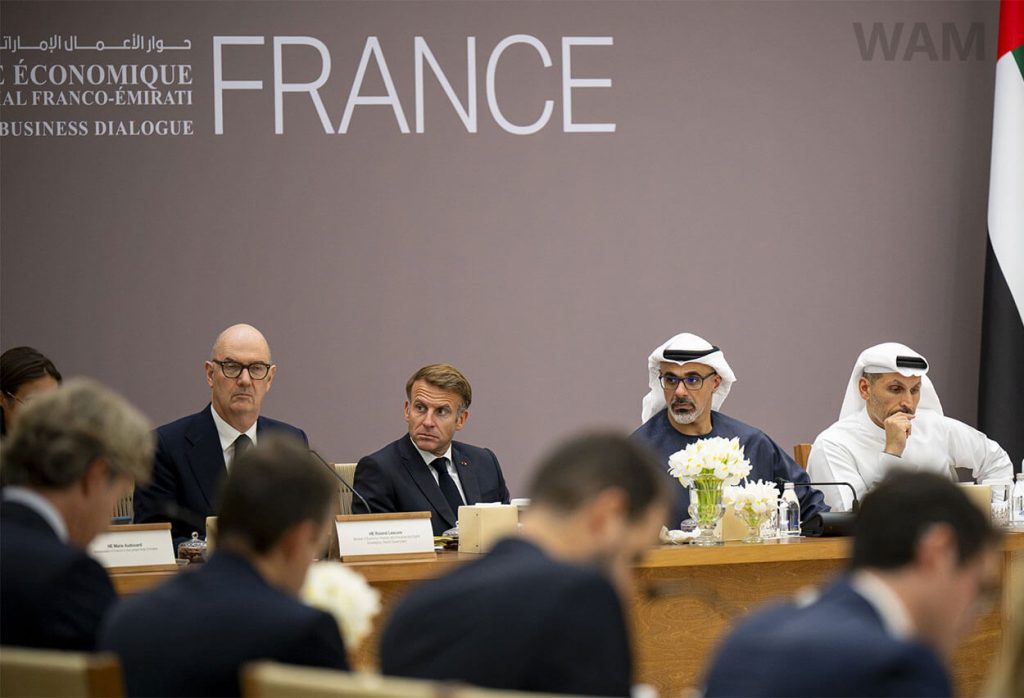
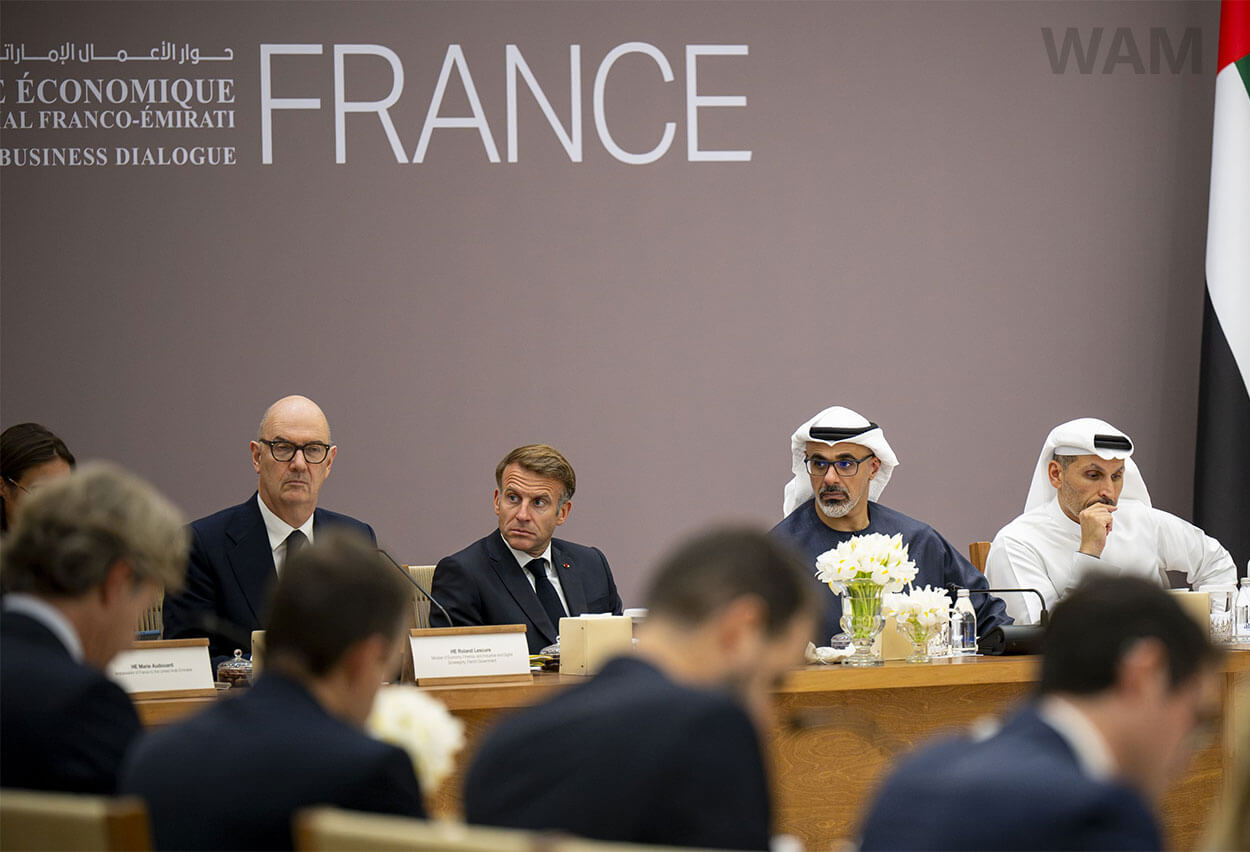


H.H. Sheikh Khaled bin Mohamed bin Zayed Al Nahyan, Crown Prince of Abu Dhabi, and Emmanuel Macron, President of the French Republic, have attended the UAE-France Business Dialogue at Qasr Al Watan in Abu Dhabi.
The UAE-France Business Dialogue gave both governments a platform to convert long-stated ambitions into concrete commitments across energy, artificial intelligence and advanced technology. Leaders used the gathering to review existing partnerships and open discussion on where cooperation could widen next. The framing throughout was practical. Ministers and business leaders sat together to weigh future priorities and name the sectors likely to anchor growth on both sides.
Sheikh Khaled bin Mohamed bin Zayed Al Nahyan opened the proceedings by welcoming the French President and his delegation. He described a relationship that has held for more than five decades, resting on trust, mutual respect and a shared view of what progress should look like. That history matters here because it sets the terms of accountability. A partnership this old is measured less by declarations and more by what gets delivered.
Sheikh Khaled said the strategic partnership has changed shape to track shifts in the wider world. Global economic pressure, he noted, raises the stakes on reliable energy supply and supply chains that can absorb shocks. Cooperation in AI and advanced technology sits alongside that aim rather than apart from it.
Two panels frame the agenda
The Crown Prince of Abu Dhabi and the French President attended two panel discussions that set the intellectual frame for the day. The first, titled “The Power of Resilience: Shaping the Future of Energy and Beyond”, looked at how the energy sector is changing and why resilience, innovation and sustainable supply now sit at the centre of planning. The questions raised there reflect a broader anxiety about who controls energy flows and how states keep them secure.
The second panel, “Beyond Compute: AI Shaping the Future”, turned to the economic weight of artificial intelligence. Participants examined how advanced technology could reshape industry and create fresh models for growth. The session also looked at practical ways Emirati and French institutions might work together rather than in parallel. Both panels drew ministers and company heads into the same room, which is where the UAE-France strategic partnership tends to move from talk to arrangement.
The dialogue underlined how far investment ties already run, especially in conventional and clean energy and in AI. Leading UAE companies, including ADNOC, Masdar, MGX and G42 carry much of that weight. Their involvement signals that the commitments are backed by firms with the capital and operational reach to see them through.
Energy cooperation anchors the older ties
Energy cooperation formed the sturdier half of the agenda, drawing on decades of industrial contact. The talks covered liquefied natural gas, energy infrastructure, low-emission solutions and renewable projects. That range reflects a deliberate spread, with both sides keeping a foot in established hydrocarbons while building toward cleaner systems.
Who governs that transition is the live question. Both countries framed their work as a push for energy security and for systems that run more efficiently over time. The signed agreements put names to the ambition. ADNOC Gas and Schneider Electric agreed to assess advanced technologies and look for operational improvements, with the stated aim of lifting efficiency across energy systems through digital tools.
ADNOC Refining and Technip Energies went further, signing two contracts. One covers a refining capacity enhancement project. The other addresses sustainable aviation fuel, an area drawing growing attention as aviation looks for ways to cut emissions without grounding fleets. These deals show industrial cooperation continuing in a measured way, with each side bringing capability the other can use.
AI agreements point to the Campus AI build
The AI side of the dialogue leaned heavily on the Campus AI France project, a joint effort to develop advanced computing and AI infrastructure on French soil. The initiative brings MGX together with French and international partners, and it sits alongside G42’s own investments in advanced computing. For France, the appeal is a measure of AI sovereignty. For the UAE, it extends economic reach into a sector that will define the coming decade.
The MGX G42 AI data centre ambitions give the partnership scale that few bilateral arrangements can match. Both firms answer to some of the most active dealmakers in global technology finance, and their presence raises the governance stakes. Large compute infrastructure carries questions about control, access and oversight that neither government can leave unaddressed.
Three AI agreements were signed with AMI Labs. Mohamed bin Zayed University of Artificial Intelligence agreed to strengthen cooperation in AI research and development and to exchange scientific and technological expertise. G42 signed to set a framework for cooperation in cloud computing infrastructure and AI models, with room to explore practical applications. Analog signed to look at integrating AI models into robotics and physical AI, a field that could extend intelligent systems into industrial settings.
What the agreements set in motion
The AI investment commitments made here form part of a larger pattern in which Abu Dhabi places capital across several global technology markets at once. The dialogue showed that pattern taking firmer shape in France, backed by research links and infrastructure rather than announcements alone.
Taken together, the agreements point to deeper integration between the two countries’ industrial, technological and research capabilities. They also open room for public-private partnerships in sectors both governments have named as priorities. The UAE-France Business Dialogue, measured by what leaders signed rather than what they said, moved the relationship onto firmer ground.
The harder work comes next. Memoranda of understanding set intent, not outcomes, and the value of these arrangements will depend on delivery, oversight and the discipline to hold each project to its stated aims. The UAE-France Business Dialogue gave both sides a clear agenda. Whether it produces the growth and competitiveness promised is a question for the years ahead, and for the institutions now charged with carrying the commitments forward.