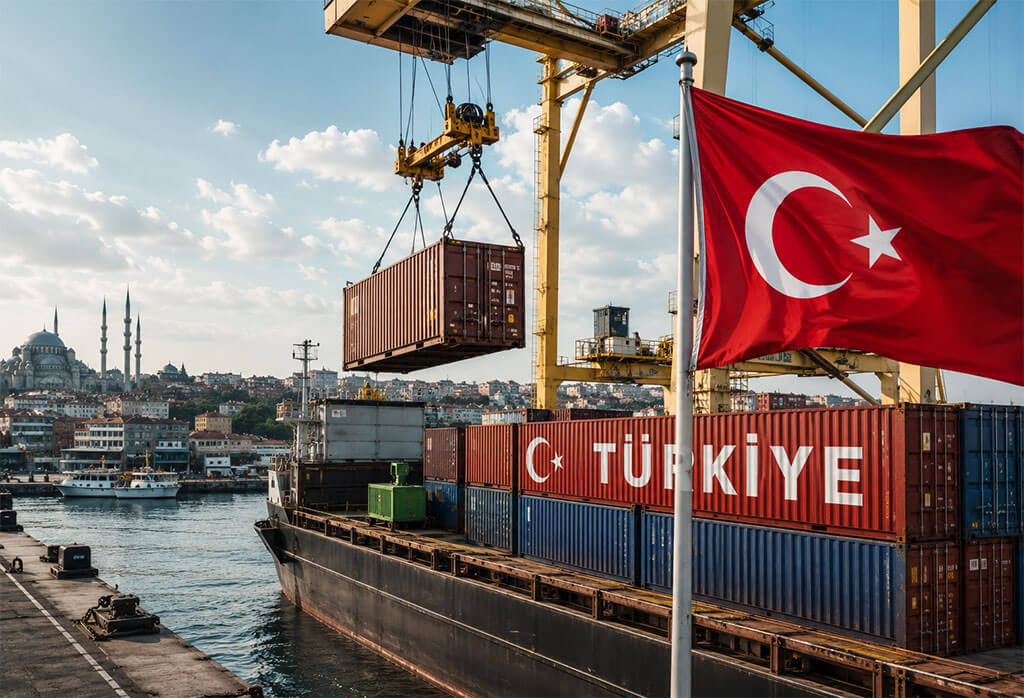



Turkey’s exports to Islamic countries reached $41.5 billion in the January to July period of 2026, according to figures released by the Trade Ministry on Monday. The total marks a rise of $345.7 million, or 0.8%, from the same period a year earlier. Growth was modest in percentage terms, but the underlying trade relationship with the Organization of Islamic Cooperation continues to widen.
Total foreign trade volume between Turkiye and OIC member states climbed 2.2% year over year to $69.2 billion over the same seven months. That figure includes both exports and imports, and it points to a broader commercial relationship than exports alone suggest. The ministry framed the numbers as part of a longer structural push rather than a single seasonal gain.
A strategy years in the making
The export growth sits inside a formal government plan. The Trade Ministry’s Strategy for Developing Exports with OIC Members is built into Turkiye’s 2026-2028 Medium-Term Program, and it sets a specific target. Ankara wants the share of OIC countries in Turkiye’s total exports to rise from 27% today to 30% by 2028. That is not a large jump in percentage points, but it represents billions of dollars in additional trade if achieved on the current export base.
To get there, the ministry studied the economic and commercial data of OIC members and picked out 21 countries for first-phase focus. The list spans Azerbaijan, Bahrain, Bangladesh, the United Arab Emirates, Algeria, Indonesia, Morocco, Ivory Coast, Qatar, Kuwait, Libya, Malaysia, Egypt, Nigeria, Uzbekistan, Pakistan, Senegal, Saudi Arabia, Tunisia, Jordan and Oman. These markets were chosen because ministry analysis flagged them as holding the strongest near-term commercial potential for Turkish exporters, based on existing trade patterns and demand signals in each economy.
The OIC itself provides the backdrop for why this matters at scale. Founded in 1969 to strengthen cooperation and solidarity among Islamic countries, the organization now counts 57 members. Together they represent close to a quarter of the world’s population, yet only about one-tenth of global income. That gap between population share and income share is the commercial opportunity Ankara’s strategy is built around.
A decade of steady expansion
Turkiye’s trade volume with OIC countries has followed a long upward path. It stood at $87.6 billion in 2013 and reached $119.1 billion by 2025, an increase of roughly 1.4 times over twelve years. That is gradual growth rather than a sudden surge, consistent with a trade relationship built on expanding market access and diplomatic engagement rather than one-off deals.
In 2025, three countries anchored Turkiye’s OIC trade. The United Arab Emirates led at about $19 billion, followed by Iraq at $14.3 billion. Egypt and Kazakhstan each accounted for roughly $7.9 billion. Those four relationships alone made up a substantial share of Turkiye’s total commercial activity with the OIC bloc last year.
Where 2026 gains concentrated
The first seven months of 2026 showed uneven movement across individual markets, with some countries posting sharp increases even as the overall growth rate stayed modest. Egypt recorded the largest rise in Turkish exports by value, climbing $522.2 million to reach $2.8 billion. Libya followed with an increase of $438.5 million, bringing its total to $2.2 billion.
Exports to Syria rose $296.8 million to $2.1 billion, a notable figure given the country’s ongoing reconstruction needs. Jordan rounded out the top gainers, with exports climbing $227.5 million to $1.3 billion. These four markets, Egypt, Libya, Syria and Jordan, drove much of the incremental growth in Turkiye’s exports to Islamic countries this year, even as the aggregate 0.8% rise reflects a more mixed picture across the full 21-country list.
The pattern fits the wider structural shift the ministry has been describing. Turkiye is not chasing volume in its largest existing markets alone. It is building depth across a broader set of economies, betting that population growth and rising income across the Muslim world will keep expanding demand for Turkish goods through the rest of this decade.