
 Bitcoin
  Ethereum
  Tether
  BNB
BNB  Solana
  XRP
XRP  USDC
USDC  Lido Staked Ether
  Cardano
  Avalanche


Key Points
-
Institutional demand for digital assets is reshaping traditional finance.
-
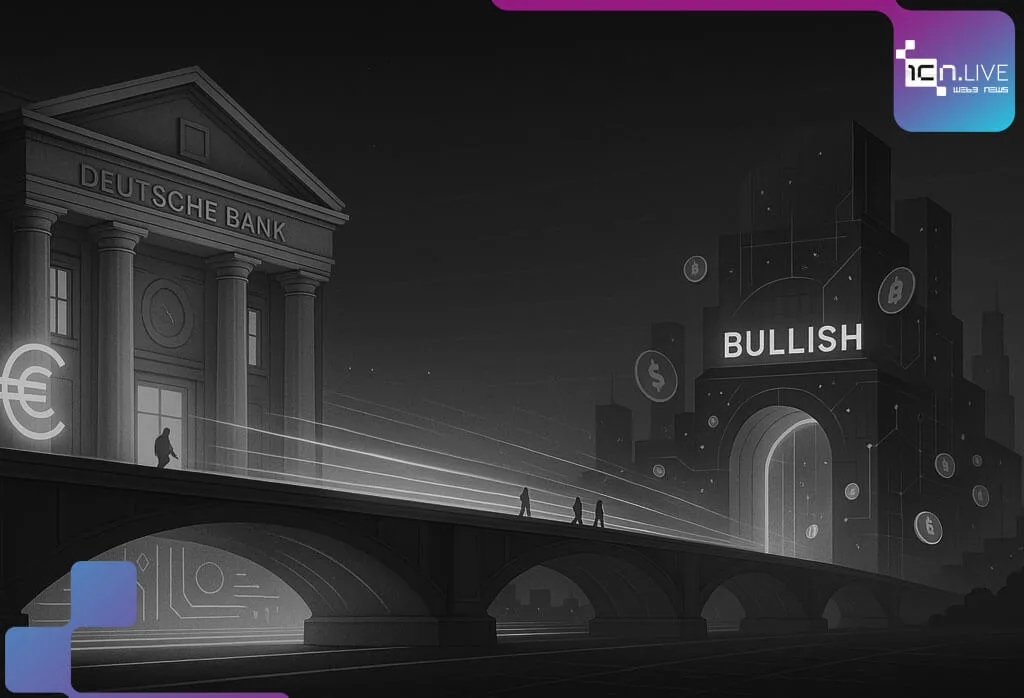
Bullish and Deutsche Bank create efficient fiat-to-crypto pathways.
-
Established banks expand infrastructure to support institutional crypto trading.
-
Partnerships signal growing blockchain adoption and financial integration.
Traditional fiat currencies and digital assets are converging faster than ever, as leading financial institutions step into crypto markets with stronger commitments.
The recent collaboration between Bullish, a regulated digital asset exchange, and Deutsche Bank, one of the world’s largest banks, marks another milestone in merging traditional finance with blockchain-driven innovation.
This partnership allows institutional clients to move funds between traditional fiat currencies and digital assets seamlessly, using trusted banking infrastructure. It represents a practical bridge between two worlds that have often operated in parallel rather than in sync.
Institutional crypto trading has grown beyond the experimental phase. Large financial players now demand regulated, secure, and integrated systems. Deutsche Bank’s role in providing fiat integration on the Bullish platform directly addresses that need. This partnership is not about hype, but about reliability and access.
Traditional banks open the door to institutional crypto access
As financial markets mature, established banks are moving beyond observation and into participation. Deutsche Bank’s strategic partnership with Bullish signals how financial institutions are prioritizing financial integration over fragmentation.
Through this setup, institutional investors can now move funds across crypto exchanges with the same ease as traditional market transactions. It simplifies risk management, increases transaction speed, and strengthens compliance — three essential elements for institutions managing large-scale portfolios.
Bullish’s exchange is known for its regulated framework and liquidity depth, while Deutsche Bank brings global credibility and operational stability. Together, they are shaping a system that merges the precision of traditional finance with the efficiency of blockchain technology.
ANOTHER MUST-READ ON ICN.LIVE:
ESMA Crypto Regulation Plan Could Reshape Europe’s Supervision of Digital Assets
Blockchain adoption expands through practical partnerships
The move also represents a larger shift in blockchain adoption among global financial institutions. Deutsche Bank’s involvement with Taurus for crypto custody, alongside its work with Bullish, highlights a strategic trend — banks no longer see crypto as competition, but as an extension of their own services.
By combining digital asset custody with fiat settlement and liquidity services, Deutsche Bank strengthens its institutional offering. The integration reduces complexity for clients, who no longer need multiple intermediaries for crypto exposure. It simplifies their path to compliance while improving transaction visibility and cost efficiency.
From my standpoint, this collaboration reflects how traditional finance adapts when innovation proves its stability. The market is not moving away from banks; it is moving with them into a digital structure that enhances both transparency and trust.
The future of digital asset infrastructure is hybrid
Bullish’s partnership with Deutsche Bank also underlines the future of digital asset infrastructure — a hybrid system where fiat and crypto coexist rather than compete. As institutional volumes grow, exchanges will need reliable fiat rails to support demand.
This hybrid approach is crucial for the next stage of institutional crypto trading. It balances regulatory requirements with innovation, ensuring clients can operate securely across markets. By integrating fiat services directly into the exchange environment, Bullish simplifies liquidity management and removes friction from trading workflows.
Traditional finance and crypto innovation are no longer on opposite sides of the table. They are collaborating to build a more resilient system that supports both established and emerging asset classes.
Financial integration will define the next decade
The success of these partnerships will depend on ongoing financial integration and regulation. Banks that invest early in these infrastructures will be better positioned to manage tokenized assets, on-chain settlements, and digital payments in the future.
As institutions increase their exposure to crypto markets, efficiency, compliance, and liquidity will define the winners. The Bullish and Deutsche Bank model provides a blueprint for how traditional fiat systems and digital platforms can work together effectively.
The era of separation between banks and blockchain is ending. What comes next is cooperation — and the results are already reshaping how markets function globally.