 Bitcoin
  Ethereum
  Tether
  BNB
BNB  Solana
  XRP
XRP  USDC
USDC  Lido Staked Ether
  Cardano
  Avalanche


Key Points
-
BBVA launched 24/7 Bitcoin trading for Spanish retail clients under MiCA regulation.
-
Mobile crypto trading includes Bitcoin and Ethereum directly in the BBVA banking app.
-
European banks are watching closely as BBVA leads the way.
-
BBVA’s stock price nearly doubled in 2025, reflecting investor confidence.
BBVA launched 24/7 Bitcoin trading on October 2, making history in Spanish banking.
The service allows retail customers to buy, sell, and hold Bitcoin and Ethereum through the bank’s mobile app. It is the first move of its kind by a major lender under MiCA regulation in Spain.
Spain’s CNMV approved the project earlier this year. This marks one of the first large-scale applications of Europe’s new digital asset rules. The move shows how regulated banks are starting to bring cryptocurrency into mainstream finance.
A milestone for MiCA regulation
MiCA regulation was created to give banks and investors clear rules for digital assets. BBVA’s early adoption shows how these rules are now shaping real services. By offering mobile crypto trading, the bank sets an example for European banks that have held back from launching retail crypto products.
Luis Martins, BBVA’s global head of macro trading, explained that clients wanted access through systems they already trust. In his words, “Digital assets are rapidly becoming part of global finance. Our clients expect to access them through the same trusted systems they already use.”
Singapore’s SGX FX technology supports the service. This system provides pricing, aggregation, and risk tools. It lets banks add crypto services without replacing their core infrastructure, lowering barriers for other European banks to follow.
BBVA mobile crypto trading
Its mobile app now allows full crypto integration. Customers can trade Bitcoin and Ethereum 24 hours a day, seven days a week. Orders and custody are kept within the bank’s digital stack, giving users a familiar experience with added security.
The bank began testing the service with a pilot group of several thousand users. By July, it had opened the service to all eligible Spanish retail clients. This steady rollout helped the bank monitor demand and system performance before expanding.
BBVA’s move puts pressure on other European banks like KBC and Deutsche Bank. Both have studied blockchain but have not yet introduced round-the-clock crypto trading.
ANOTHER MUST-READ ON ICN.LIVE:
Stablecoin market cap surpasses $300 billion with Bitcoin price rise and Ethereum gains
Ethereum joins Bitcoin in BBVA’s offering
Ethereum trading was included from day one. This gives users more than a single crypto option and adds credibility to the service. Ethereum is widely used in smart contracts and decentralized applications, making it a logical choice to sit next to Bitcoin in the app.
Earlier in 2025, BBVA Switzerland had advised wealthy clients to consider a 3% to 7% crypto allocation. This advice aligned with the broader strategy that later extended into Spain’s retail market.
Stock price reflects investor trust
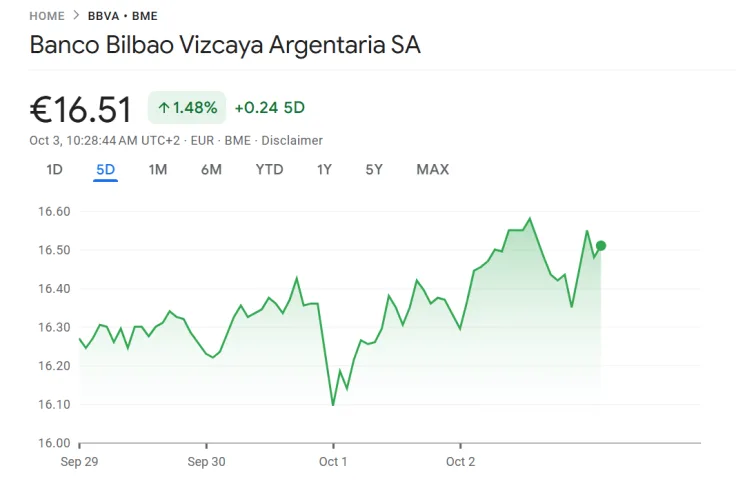
The impact of BBVA launched 24/7 Bitcoin trading is also visible in the stock market. BBVA stock price surged 96% this year, climbing from $9.50 to $19.08. Daily trading volume has passed one million shares, showing rising investor activity.
This growth signals optimism about BBVA’s digital strategy. Investors see the bank as ahead of its peers in bringing cryptocurrency into regulated banking. From my perspective, the near-doubling of the stock confirms the market’s trust in BBVA’s leadership in this sector.
The rollout has clear implications for European banks. MiCA regulation gives them a legal base, but many remain cautious. BBVA’s success may push it to act faster. Customers are demanding access, and banks risk losing relevance if they delay.
BBVA’s early move proves that regulated mobile crypto trading is possible at scale. It also shows that offering Bitcoin and Ethereum inside trusted apps may strengthen client loyalty and attract new investors.