
 Bitcoin
  Ethereum
  Tether
  BNB
BNB  Solana
  XRP
XRP  USDC
USDC  Lido Staked Ether
  Cardano
  Avalanche


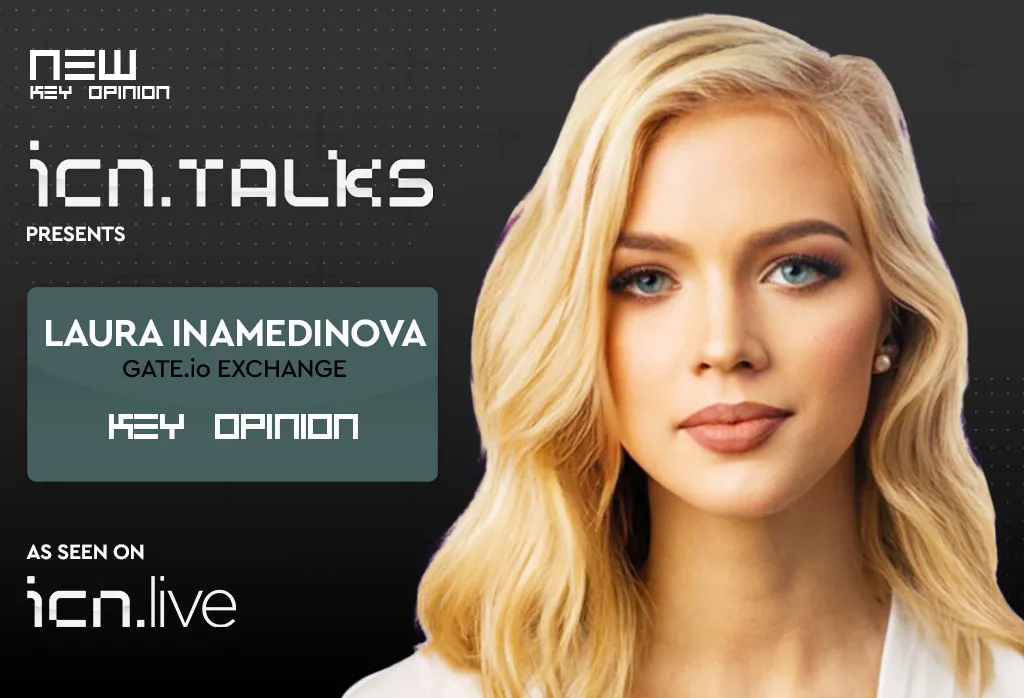
ICN.live KEY OPINION, Exclusive Interview with Laura Inamedinova.
Laura K. Inamedinova is one of the most influential voices in the Web3 and venture capital space. From founding LKI Consulting, a leading crypto marketing agency, to her current role as Chief Ecosystem Officer at Gate.io Exchange, she has been driving growth and innovation across blockchain, DeFi, and digital assets since 2016. Named among the top women entrepreneurs worldwide, Laura combines sharp business acumen with deep industry insight, making her a sought-after leader, speaker, and investor. Today, she continues to shape the future of Web3, empowering founders and institutions to thrive in the decentralized economy.
Users of Crypto Exchanges
The crypto exchange market looks increasingly saturated, with each platform cultivating its own audience and community. As part of Gate.io’s management, where do you see the next wave of new users coming from, and how are you engaging them during the onboarding process?
The exchange space is crowded, but I see plenty of new users still entering the market, especially from regions and narratives where crypto is solving real needs. The next wave is coming from emerging markets like LATAM, MENA, and SEA, where stablecoins and trading access directly improve daily life.
At Gate, we approach onboarding with more care for these new users. Instead of broad outreach, we are trying to build entry points that make the first experience meaningful, for example:
• We launched Alpha Points, our loyalty program that rewards trading, referrals, and ecosystem activity. This creates a clear sense of progress and recognition from day one.
• We distributed over $3M in airdrops through Launchpool and HODL & Earn campaigns in June, making sure we help new users participate and earn more rewards.
• Moreover, Gate Ventures pledged $20M to the BNB Incubation Alliance, positioning us alongside some of the strongest builders in the industry and attracting founders who bring entire user communities with them.
• We also joined the Morph VC Collective, supporting consumer-focused projects that create new ways for people to interact with crypto beyond speculation.
I believe onboarding should be simple, rewarding, and connected to real opportunities. When users feel that alignment from the very beginning, they stay. For me, that’s the key to the next ten million users by building loyalty, trust, and momentum through clear and simple actions.
Crypto Token Re-cycle Strategy
Avalanche Foundation is raising $1B to recycle into its own token. Should ecosystems be allowed to self-finance like this, or is it market manipulation with extra steps? It looks like there is no shortage of imagination out there in this industry.
I think this is one of the most interesting moves we’ve seen recently, because it shows how creative ecosystems are becoming in financing themselves. Raising $1B to recycle into their own token may look unusual, but I see it as part of a bigger trend. Instead of relying only on external capital or market cycles, blockchains will build self-sustaining treasuries.
From my perspective, the real question is whether this will help create long-term trust and utility for users and builders. If an ecosystem is using capital to strengthen its token, fund projects, and grow adoption, then it can be a powerful signal of commitment. If it becomes only financial engineering, then the market will eventually punish it.
We’ve seen similar experiments before, public companies turning into “crypto treasuries” with Bitcoin, or foundations running buyback programs. Some worked, some didn’t. But what matters is execution. Users today are smarter; they will look for clear value creation around liquidity, developer incentives, and ecosystem growth.
At Gate Ventures, I see treasury experiments as a second phase of ecosystem maturity. First, you bootstrap. Then, you create structures to sustain. I feel these treasury plays will become more common, especially as Layer 1s compete for attention and try to show sustainable growth beyond bull market rallies.
ETH Treasury Wars
In the past six months, we’ve seen an aggressive race for Ethereum reserves via ETFs, BitMine’s $201M ETH purchase through BitGo being the latest example. But does it really make sense for institutions to chase an asset with no capped supply, compared to Bitcoin’s fixed 21M? What are we overlooking in this institutional rush for ETH?
In the last six months, we’ve seen ETH become the center of institutional interest. Exchange reserves have fallen to a three-year low, ETFs have attracted more than $13 billion in inflows, and corporate treasuries are now holding millions of ETH. The latest BitMine purchase of $201 million worth of ETH is just one more sign of this momentum.
I think it makes sense, even though ETH doesn’t have a hard cap like Bitcoin. Institutions are not only chasing scarcity, they’re chasing utility plus yield. Ethereum is unique because it is both a macro asset and a productivity asset. It secures over $100 billion in tokenized assets, powers the majority of DeFi and stablecoins, and generates staking yield for holders. That means institutions can treat ETH as both a reserve and an income-producing asset.
For me, the overlooked point is that Ethereum’s supply is not unlimited in practice. With staking and rising demand from ETFs and treasuries, the liquid supply available on exchanges is dropping really fast. That’s why price and demand are moving away from the basic ‘supply cap’ idea.
The institutional rush into ETH is less about copying Bitcoin’s model and more about building a diversified treasury with productive exposure. As more ETFs integrate staking, it makes the case even stronger. This is why I believe ETH is positioned to sit alongside Bitcoin as a core institutional holding, but for very different reasons.
Experience vs Market conditions
You lead ecosystem strategy at Gate.io, one of the top-ranked exchanges, a Principal in investment funds, and have built one of the best-known Web3 marketing agencies. With that mix of experience, you’ve seen this industry from every angle, knowing pretty much every single corner of it. What’s the biggest lie in crypto that still shocks you today?
For me, the biggest lie would be that “communities are built, not bought.”
I hear it everywhere, founders saying they’ll grow “organically,” investors claiming a project’s Telegram numbers prove traction, and marketers promising that airdrops or KOLs will deliver a loyal base. After seeing this for all these years, I know that’s simply not true.
Communities in crypto are earned through value. Users don’t show up because you opened a Discord or gave them free tokens. They show up because you solved a problem. Everything else is temporary.
What still shocks me is how much money gets wasted chasing the illusion. Millions are invested into inflated groups, short-term hype, and campaigns that look good in a report but collapse once there are no incentives for the users. The cycle repeats every bull market, and yet we all know deep down it doesn’t work.
I feel the projects that last are the ones that are designed for long-term alignment from day one. They mix incentives with purpose, so the community doesn’t just hold the token; they live in the ecosystem. That’s the real edge and the only way you can get the community is by earning it, through product, trust, and consistency.
Retail Liquidity
As both a crypto-community expert and an investor, how can a founder, in 2025, still launch a token that matters? Launchpads are dead, retail is numb to any conversation, hype, and, certainly, has abandoned the dream of overnight returns, while VCs are trapped in defensive positions. For those trying to build seriously, what’s the uncompromising path forward to avoid a dead token in month one?
The problem is that most TGEs are designed backwards. Founders chase a big raise, set FDV at $100M+, and hope marketing can cover the gap. It never does, and tokens with no traction collapse in the first weeks. I still see founders inflating Telegram groups, paying for listicles, or pitching every VC under the sun, thinking it shows momentum, but it only communicates desperation.
So now the real question is, how do you launch a token in 2025? First, the most important thing is showing traction. That means daily active users, on-chain activity, and real revenue. These are the only signals that matter. If there is no traction, the launch is just speculation, and users will leave as fast as they join.
Second, you need to put FDV below $20M. Tokens launched at $15–20M FDV give themselves room to grow. When founders push for $50M+ valuations without proof, they set the stage for failure. Keeping expenses reasonable and showing efficiency builds much more trust with investors and communities.
Third, the founder’s edge. In 2025, credentials matter. Either you bring experience from building in Web3 before, or you add a co-founder with that track record. Investors and users want to know you can execute, not just that you have an idea.
Open Mic: Your Thoughts on the Market
We’d love to give you the floor for an open-ended response. What are your personal thoughts on current market conditions, and do you have any insights on the future of the industry you’d like to share?
When I look at today’s market, I see strong foundations being built. Institutions are committing capital at a level we have never seen before. Spot ETFs for Bitcoin and Ethereum have attracted billions, stablecoins are now moving more money than PayPal, and treasuries are actively adding crypto to their balance sheets. These are signals that the industry has reached a new stage.
I think the current market is pushing everyone, founders, investors, and users, to focus on credibility. As I said earlier, founders who launch tokens now must prove traction, set fair valuations, and connect their product to real use cases. Since investors are backing founders who show smart execution and a clear sense of timing. While users want products that actually solve problems, not just marketing. I see this as a healthy reset that makes the industry stronger.
Looking ahead, I believe the biggest drivers will be crypto’s role in payments, Bitcoin-based DeFi, and infrastructure that connects with AI and stable assets. These are not just narratives; they are solutions that people already use and need.
For me, the most exciting part is that the noise is filtering out. The next generation of leaders will be the projects that show traction from day one, create tokens that last, and build communities rooted in trust and value. That’s where the real opportunity lies today.