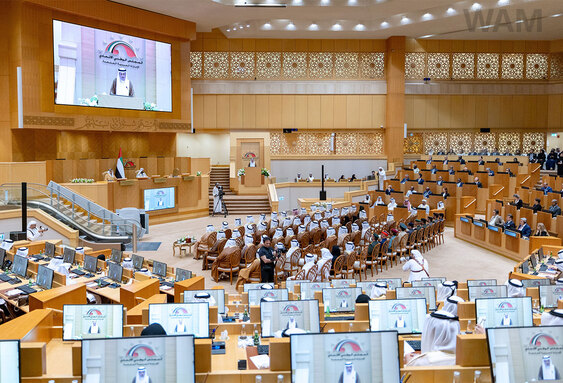



The UAE’s federal budget 2027 has cleared the Federal National Council, which approved total spending of AED 90.1 billion ($24.53 billion). Members voted at a sitting in Abu Dhabi on Tuesday, November 24. More than a third of the money is set aside for social development and pensions.
Members also passed a draft federal law linking the Union General Budget with the budgets of independent federal entities for the 2027 fiscal year. Saqr Ghobash, Speaker of the FNC, chaired the session at Zayed Hall in the Council’s headquarters. Mohamed bin Hadi Al Hussaini, Minister of State for Financial Affairs, attended for the government.
The vote came during the second sitting of the fourth ordinary session of the Council’s 18th legislative chapter. Both sittings of the new session took place on the same day.
How the UAE’s federal budget 2027 reached the Council
Its figures did not start in the chamber. The UAE Cabinet, chaired by Sheikh Mohammed bin Rashid Al Maktoum, Vice President, Prime Minister and Ruler of Dubai, approved the 2027 spending plan on October 12. It forms the first year of an AED 292.5 billion federal budget covering 2027 to 2029. That three-year total is 28.3 percent higher than the plan for 2024 to 2026.
When the Cabinet signed off, Sheikh Mohammed said the government’s priorities had not changed. He named education, healthcare, housing, social services, and the quality of life and stability of citizens.
The Council acts after that executive decision. Members review the draft law, put questions to the minister, and then vote. This gives the chamber a formal voice over federal spending, even when the headline numbers are already settled.
The budget also follows a change in method. In July 2025, the Ministry of Finance launched the 2027 to 2029 cycle. It described a shift from a yearly planning exercise toward a strategic, performance-based tool. Artificial intelligence was named as a core enabler of that approach. The emphasis on AI in the public services allocation reflects the same thinking, and it gives the Council a clear standard to apply. If the money is meant to make government faster and simpler, members can ask for evidence of both.
The linking law serves the same purpose. Independent federal entities run budgets of their own. Tying them to the Union General Budget places all of them inside one legal framework for the year. In principle, lawmakers then work from a single point of reference.

Where the money goes
The allocations can be read in two ways. Grouped by sector, social development and pensions account for AED34.6 billion, or 38.4 percent of total spending. Broken down by function, public services hold the biggest single line.
Public services receive AED33.3 billion. The money is meant to develop digital government services, simplify procedures, and widen the use of artificial intelligence across federal work. Efficiency is the stated goal.
Education comes next with AED 16.8 billion for public and higher education. Funding covers curriculum development, technical education pathways and the readiness of teachers and students for changing global demands.
Each of these lines names an outcome as well as an amount. For a legislature, that distinction carries weight. A stated outcome gives members a measure against which ministries can be questioned in later sessions.
Health, housing and family support
Healthcare is allocated AED 5.9 billion. The plan points to more advanced, preventive and proactive medical services, wider use of smart solutions in how care is delivered, and preparation for future needs.
Housing receives AED 3.9 billion. Support programs, grants and housing facilities are the main tools for providing suitable homes for citizens.
A further AED3.3 billion goes to social affairs. This covers support for families, development of the social support system and closer coordination among the entities involved.
Taken together, these three lines show where the state places its direct obligations to citizens. They are smaller than the education and public services budgets, yet they touch households most directly.
Security, the economy and culture
Public order and public safety take AED10.7 billion. National readiness and defense receive AED7 billion, with both lines framed around the country’s security and stability.
Economic affairs are allocated AED2.1 billion. The funds target competitiveness, innovation, a stronger investment environment and national projects, including work in the space sector.
Culture and the arts receive AED1.1 billion to promote national identity, protect heritage and reinforce the values of Emirati society. Environmental protection gets AED509.2 million for the conservation of natural resources.
Security spending, at AED17.7 billion across the two lines, is more than eight times the economic affairs allocation. Economic development in the UAE is also funded at the emirate level, so the comparison has limits.
A smaller total after a record year
The UAE’s federal budget 2027 is lower than last year’s. For comparison, the UAE federal budget 2026 stood at AED 92.4 billion, the largest in the country’s history. It was about 29 percent above the AED71.5 billion approved for 2025. The 2027 figure is roughly 2.5 percent below that peak.
Recent federal budgets have matched revenue and spending. The 2026 plan, for example, balanced both at AED 92.4 billion. A revenue estimate for 2027 did not form part of the published allocations.
The wider cycle points in a different direction. Subtracting the 2027 figure from the AED292.5 billion federal budget leaves AED202.4 billion for 2028 and 2029. The government has not published how that sum will be split. On a simple average, each of those years would exceed both the 2027 total and the 2026 record.
The federal balance sheet forms the backdrop. Federal public debt stood at AED62.1 billion as of June 2025, and federal government assets reached around AED464.4 billion by the end of 2024.
Oversight and the session ahead
At the first sitting, Ghobash thanked Sheikh Mohammed bin Rashid Al Maktoum on behalf of the Council for inaugurating the new session. He said the inauguration reflected close integration and cooperation among the UAE’s federal authorities.
With the UAE’s federal budget 2027 now through the Council, attention moves to delivery. The allocations for digital services, education and health carry stated aims. Members of the Federal National Council will have the session ahead to ask how those aims are being met.