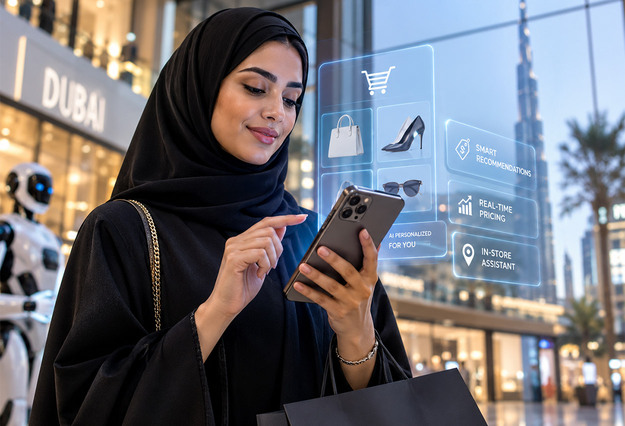



AI-powered shopping in the UAE is moving faster than the stores meant to serve it. New figures from Visa show most shoppers here are willing to hand real buying power to software, while most retailers are not yet built to accept it.
Think of an AI agent as a personal buyer with your bank card. You set the rules; it does the clicking. The research found 82 per cent of UAE shoppers surveyed would let one make a purchase on its own, as long as they could cap how much it spends. That single condition, a spending limit, is what earns their trust.
The numbers behind the shift
The study, called the 2026 Global Digital Shopping Index, was commissioned by Visa Acceptance Solutions and produced by PYMNTS Intelligence. It surveyed both shoppers and merchants, then set the UAE beside Brazil and the United States.
UAE shoppers came out ahead on almost every measure of activity. Around 72 per cent of them used AI somewhere in their most recent purchase. That compares with 53 per cent in Brazil and 46 per cent in the United States. They also logged the most digital shopping moments of the three markets, about 2.3 a day. That pace puts the country at the front for sheer shopping activity.
One distinction matters more than the rest. Using AI to shop is not the same as letting it buy. Reading reviews, comparing prices, asking a chatbot for ideas, all of that is research. Handing over the card to finish the order is a bigger move. People take that step far more readily when they keep control of the budget, which is why autonomous purchases cluster around the promise of a spending cap.
Why retailers are falling behind
Demand is one side of the story. Merchant readiness is the other, and it is the weak point in AI-powered shopping in the UAE right now.
Only 19 per cent of UAE merchants surveyed hold structured product data that an AI agent can read. Without it, an agent cannot reliably see what a store stocks, at what price, in what size. A shelf a person can scan in seconds stays invisible to a machine that needs clean, labelled information.
The blind spot runs deeper. Only 31 per cent of merchants can even tell when a sale came through an AI platform. If a store cannot see the channel, it cannot plan around it. The result is a market where buyers are sprinting and many sellers have not laced up.
Retailers are not shrugging off the trend. Nearly three-quarters, 74 per cent, expect AI agents to drive at least 5 per cent of their sales within two years. A smaller group, 42 per cent, expect those agents to bring in 16 per cent or more. The ambition sits well ahead of the infrastructure.
AI-powered shopping in the UAE still runs on trust
Control is the real currency here. Shoppers will delegate the work, but only on their own terms.
The spending cap is the clearest sign of that. Permission over personal data is another. Asked how they would share shopping and payment details with an agent, most shoppers chose case-by-case consent over open-ended access. They want to approve each time, not once and forever.
Payment choice still pulls weight as well. A notable 86 per cent of UAE shoppers said a retailer accepting their preferred payment method shapes where they shop, the highest share across the three markets. Even when an agent does the buying, the wallet behind it counts. Strip away the control and the comfort goes with it.
The clock is short. About 71 per cent of shoppers expect to use an AI shopping agent within two years. For a store that has not started preparing, that leaves almost no runway. This is the pressure now shaping AI-powered shopping in the UAE, and it falls hardest on merchants.
What merchants need to do next
Mario Makary, UAE Country Manager at Visa, described the task as closing the distance between what shoppers want and what stores can deliver. He said UAE consumers are ready for the next stage of agentic commerce, and that merchants increasingly recognise the growth in it. The job now, as he put it, is readiness.
In practice that means three things. The first is structured product data, so an agent can read a catalogue without guesswork. The second is authenticated and tokenised payment acceptance, so money moves securely without exposing raw card numbers. The third is a set of controls that let shoppers decide how an agent reaches their data and spends their money.
Makary said Visa wants to help stores support secure, authenticated payments while keeping shoppers in charge of how, when and where their money moves.
The message for UAE retailers reads clearly in the data. Shoppers have already made peace with agents at the checkout. The stores that give those agents clean product data, safe payment rails, and visible spending limits will be the ones the agents keep coming back to. The rest risk being skipped by a buyer they never see.