

icnlive

WATCH LIVE. THINK BUSINESS.

© 2026 ICN.LIVE

ICN.live

PUBLISHED BY ICN PRESS

  • Dubai International Airport expects 3 million passengers in July, with most arriving in the first two weeks of the month.
  • July 12 will be the single busiest day, with more than 225,000 travelers expected through DXB.
  • Dubai Airports activated oneDXB summer readiness plans to keep passenger flow smooth during peak periods.
  • Recovering regional flights and new airline routes support continued passenger growth through the summer season.

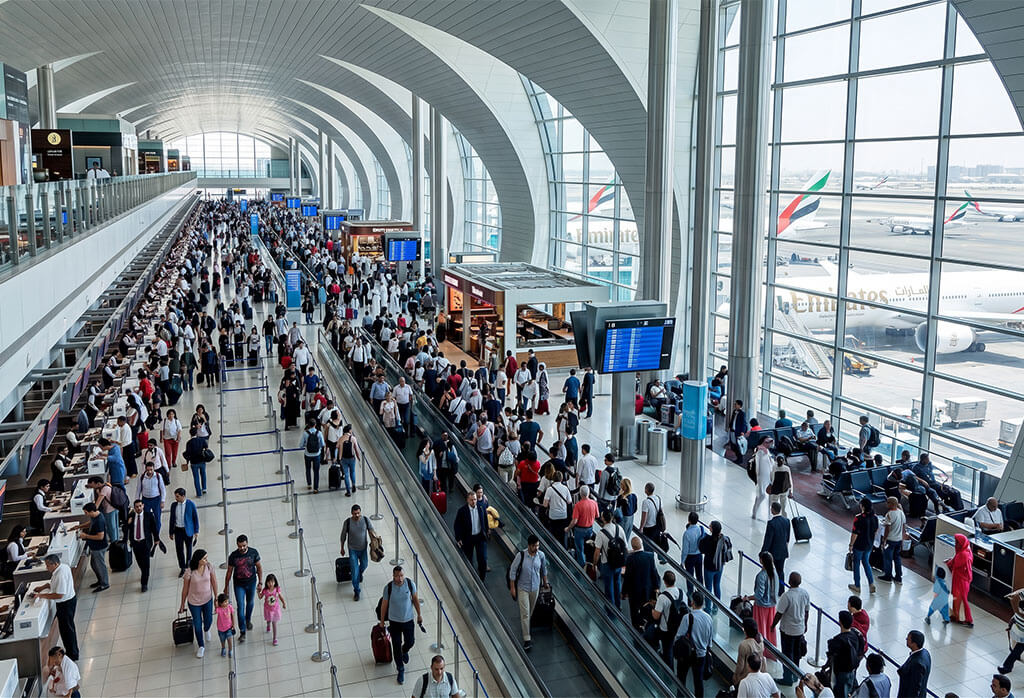
3 million passengers in July will move through Dubai International Airport this month, Dubai Airports data shows. Officials expect the airport to handle the total figure within the first two weeks alone. Daily traffic will cross 200,000 travelers starting on July 2, based on new Dubai Airports figures. July 12 stands out as the single busiest day of the entire month for DXB. Officials expect more than 225,000 travelers to pass through the terminals on July 12. This Dubai International Airport July increase reflects strong demand across several global travel regions this year. Transfer passengers make up almost half of the total traffic moving through Dubai each day.

Regional flight activity keeps recovering steadily after months of disruption earlier this year across the Middle East. A flight from Tehran landed at Dubai International Airport this week for the first time since February. Riyadh Air also launched new routes into Dubai last month, adding fresh regional capacity. These developments point toward a positive outlook for Dubai Airport passenger traffic this summer. Dubai Airports activated summer readiness plans with its oneDXB partner network across every terminal this week. The plan aims to keep passenger flow smooth during the busiest days of the month.

3 million passengers in July put Dubai readiness plans to the test

Officials remind travelers to arrive no earlier than three hours before their flight departure. Online check-in remains the fastest way to skip long lines at busy service counters. Families traveling with children above age 12 can use DXB Smart Gates for faster passport checks. This step shortens wait times at passport control during the busiest hours of the day. Passengers can also pack spare batteries and power banks inside hand luggage only, not checked bags. This rule protects flights from potential battery-related safety risks during every journey this summer.

Smart travel tips for the DXB summer rush

The I Heart DXB installation waits for passengers inside Terminal 3 near Concourse B. Travelers can upload a selfie and join a shared digital portrait of the city. The portrait displays colors from the UAE flag across a large digital wall display. Dubai Airports’ summer travel numbers keep rising steadily into the second half of July. School holidays and family trips continue driving demand across every airport terminal this month.

DXB busiest day 2026 targets and traffic outlook

DXB busiest day 2026 predictions point directly to July 12 as the clear peak. Paul Griffiths, CEO of Dubai Airports, credits strong teamwork for the rising summer demand. He praised “close coordination across the sector and the oneDXB community” for the support. From my standpoint, this readiness reflects months of careful planning across Dubai’s aviation network. 3 million passengers in July confirm Dubai’s position as a leading global travel hub. The airport expects steady growth through the remaining weeks of this busy summer season. Families returning after the school term and residents heading abroad will drive numbers higher. 3 million passengers in July show how strong Dubai’s summer travel recovery has become.

Dubai Airports continues tracking 3 million passengers in July as a key summer benchmark. Travelers should check flight status closely before arriving at either terminal this busy week. Dubai continues strengthening its position as a leading connecting point around the world today.


TAGS

EXPLORE MORE ON:

6G band in the UAE

The case for the 6G band in the UAE rests on a small number: two to five percent. That is how far an Upper 6 GHz signal falls behind today’s 3.5 GHz C-band in reach. The modelling covered city centres, towns, suburbs and open country. Higher frequencies normally travel less far, and shorter reach normally means more towers. A gap this narrow points the other way. An operator can hang the new radios on masts and rooftops it already owns.

The figure comes from a white paper titled “The Golden 6 GHz Band.” Four names sit on it: TDRA, the telecoms regulator, e& UAE, Khalifa University of Science and Technology, and NYU Abu Dhabi. Its release comes with a decision to move the 6G band in the UAE out of trials and into commercial service. The industry calls it the golden spectrum.

Where the threefold figure comes from

Two gains sit behind the headline claim, and they multiply. The first is a gain in spectral efficiency of about 1.5 times. It comes from a 256TRX Giga-MIMO antenna array, which has far more transmit and receive paths than a standard 5G unit. Beamforming and scheduling across the array do the rest. This gain holds regardless of the channel width. The second is width itself. Set 200 MHz of Upper 6 GHz spectrum against a 100 MHz C-band carrier and the channel doubles. One and a half times two comes to roughly triple the capacity per cell. The authors say the result lines up with work by independent analysts.

Coverage comes out of the same hardware. Signals at higher frequencies lose strength faster, and the array’s beamforming makes up for the loss. In the hardest case the team modelled, indoors in a dense city, reach stays within about three percent of C-band.

A caveat travels with every figure. The results come from models, not field tests, and rest on assumptions the paper lists. Live performance, it says, will depend on where the radios go, which spectrum they get and what the devices can do. Bayan Sharif, provost of Khalifa University, called the 1.5 times gain “achievable under well-conditioned assumptions.” The method went out with the findings, he said, so others could check the work.

Business Intelligence & News

  • Meta One in the UAE brings paid tiers from Dh5.99 to Dh1,199 a month across WhatsApp, Instagram, Facebook, and Meta AI.
  • Core versions of all four apps stay free, with subscriptions adding features and heavier AI usage on top.
  • Entry plans start at Dh5.99 for WhatsApp Plus, while creator and business bundles climb into the hundreds.
  • Meta reports more than 15 million subscriptions and trials worldwide, with Edits and AI glasses features still to come.

How regulation shaped the 6G band in the UAE

Policy moved before engineering on the 6G band in the UAE. In 2023, the World Radiocommunication Conference identified 6425 to 7125 MHz for mobile service across ITU Region 1. The Telecommunications and Digital Government Regulatory Authority (TDRA) moved earlier than most of its peers and wrote the whole range into its national frequency plan. Within it, e& UAE holds 6425 to 6775 MHz, as much as 350 MHz in one unbroken block.

With the allocation settled, the operator committed to a commercial Giga-MIMO deployment built for peak downloads of 10 Gbps. Launch is planned between July and December 2026. Tariq Al Awadhi, TDRA’s executive director of spectrum affairs, drew the line himself: “Regulatory certainty is what turns research into infrastructure.”

Money follows the coverage result. The white paper treats Upper 6 GHz as a capacity layer laid over e& UAE’s current 5.5G network. It shares towers, rooftops, power and transport links, and backhaul gets an upgrade where needed. Fewer new sites can mean a lower cost for each bit carried as demand grows. Marwan Bin Shakar, chief technology officer at e& UAE, framed the customer side as higher speeds, more capacity and a steadier connection in crowded areas.

What the network is meant to carry

The paper groups planned uses under three headings: Connect Home, Connect Industry, and Connect Consumer and Vehicle. Those cover home broadband delivered over the air at speeds close to fibre, heavy-bandwidth uses for companies and public bodies, AI-driven services in the home, and connected cars.

The work extends earlier UAE research, including TDRA’s national 6G roadmap and two e& UAE papers written with the same universities. TDRA has described the band as a resource for 5G-Advanced services and a foundation for 6G. Abroad, over 60 companies, from operators and vendors to chipset suppliers and device makers, have signed a GSMA statement on the band’s readiness.

One piece sits beyond any operator’s control. A band is only useful to people whose phones and routers can tune to it. TDRA plans to add Upper 6 GHz, known in standards as n104, to national type-approval rules, with the first devices due from September 2026. How fast those handsets reach shop shelves will decide when the 6G band in the UAE turns from a modelled result into something a customer can measure.

Share this post

on your favourite social platforms

or copy the link