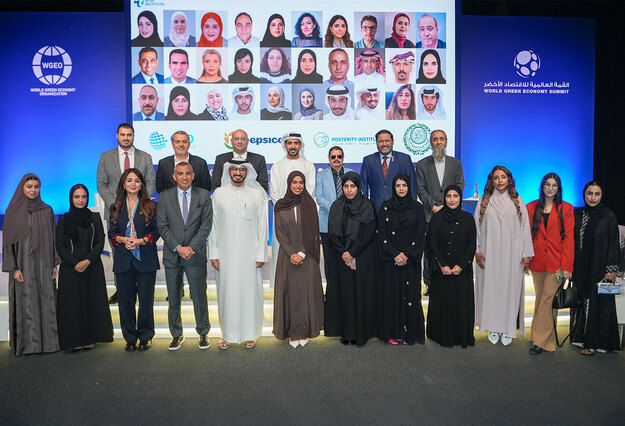



A single statistic sits at the centre of this story. One hundred and twelve government officials have now passed through a programme built to change how Arab states turn climate promises into daily practice. The Arab Governments Sustainability Fellowship closed its second cohort this month, sending 67 officials from 19 countries back to their ministries with a working method rather than a slogan.
Who the fellowship reaches
The newest group came from across the region, each official carrying responsibilities in planning, policy, or service delivery at home. They return with tools meant to fold sustainability into the decisions their institutions make every day. That is the quiet ambition behind the programme. Not a conference that ends when the lights go down, but a set of skills an official can open on a Monday morning and use.
The second cohort ran nearly half again as large as the first. The inaugural group gathered 45 officials from 14 countries. The jump to 67 from 19 suggests the idea is finding takers among governments that often move with caution on new commitments. Growth of that kind, in a single year, says something about demand.
The programme was developed by the Posterity Institute with the Arab Administrative Development Organization and the Chief Sustainability Officers Network, and supported by PepsiCo. Each partner brings a different weight to the table, one in research, one in government reform, one in corporate practice.
“Achieving sustainability on a national level means building it into every aspect of a government’s decision-making,” said Wael Ismail, Vice President of Corporate Affairs at PepsiCo Middle East, North Africa and Pakistan. “In practice, that means factoring sustainability into planning, budgeting and procurement. The private sector has a role to play here by helping government teams to build knowledge and human capacity. Through pep+, we have built extensive experience in integrating sustainability into everyday decisions across our operations, which we are keen to share with our government partners.”
Dr. Yasar Jarrar, Founding Partner of the Posterity Institute and Secretary General of the CSO Network, said: “The success of this fellowship is measured by the change that graduates bring to their institutions’ decision-making processes. Officials who can embed sustainability in their thinking represent what future-ready government leadership looks like. We see much more of this leadership in Arab countries today, and we hope our graduates will build on these efforts in the coming months by inspiring and educating their peers to think more broadly about sustainability.”
What graduates take home
The value lies in application. Graduates leave with methods they can run inside their own institutions and a network of peers to call on when a problem crosses borders, which climate problems tend to do. A water official in one country faces much of what a water official in another already solved. The fellowship gives them a line to each other.
This focus on sustainability in the public sector marks a shift from awareness toward delivery. Many governments across the region have written climate plans. Fewer have the internal capacity to carry them through budgeting, procurement, and the slow machinery of policy. The fellowship aims at that gap.
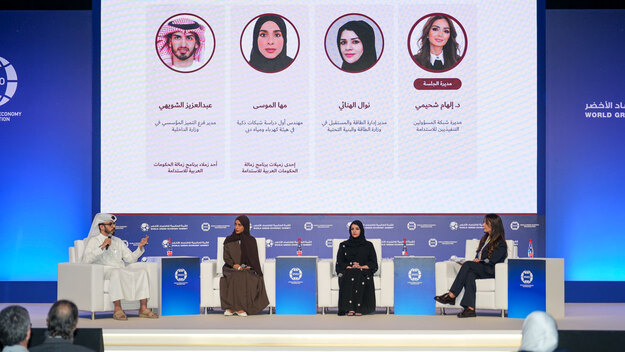
Maha Mousa, Senior Smart Grid Studies Engineer, Dubai Electricity and Water Authority (DEWA), UAE, and Arab Governments Sustainability Fellow, commented: “The fellowship transformed my view of sustainability into a mindset and organizational culture guiding our daily decisions. I emerged with a leadership vision to create sustainable impact, alongside a deeper understanding of how subtle planning shifts yield greater outcomes.”
Another 2026 graduate, Abdulaziz Al Shuwaihi, Director of the Institutional Excellence Branch, Ministry of Interior, UAE, and Arab Governments Sustainability Fellow, said: “Young government employees often bring fresh ideas to improve how things are done. The challenge is turning that energy into institutional change. We need to give people the confidence and opportunity to apply their skills and demonstrate the impact they can create.”
A summit stage for the handover
The graduation unfolded during a session at the World Green Economy Summit 2026 at Dubai World Trade Centre. Government leaders, private sector figures, and young participants came together to work through a single question: how skills, people, and AI can help governments deliver more sustainable outcomes. The setting gave the cohort a regional stage for what might otherwise have been a closed ceremony.
The same session carried a second piece of news. Organisers launched the fourth edition of the Sustainability and Government Action Report, which examines the social impact of AI across Arab countries. The report rests on the views of more than 1,600 government officials in seven Arab countries, a sample large enough to read as a regional signal rather than a handful of opinions.
Why it matters now
Place the fellowship against the wider push for a green transition in Arab governments, and the logic holds. Reports set direction. Summits build momentum. Neither moves a ministry on its own. People inside the system do that, and only if they know how. By training officials who then return to their desks, the programme works on the part of the problem that rarely makes headlines, the part where a policy either gets implemented or quietly stalls.
The count now reads 112. Each one carries a method back into a government that will, in time, be measured on results rather than intentions.