UAE business accelerators no longer sell classroom time, and ICN.live research across Dubai, Abu Dhabi, and Sharjah found that the shift is close to complete. Founder value now sits in four places: market access, institutional balance sheet backing, regulatory permission, and enterprise procurement. Desks and workshops still exist. They stopped being the reason anyone applies.
Why does the distinction matter to you? A founder who picks the wrong program loses a year at the stage when a year is most of the runway.
The ICN.live research team began with 24 active acceleration and incubation programs in the Emirates. Ten advanced to a shortlist, chosen on operational history, cohort transparency, and active venture deployment. Five made the final ranking. Weighting followed a strict evidence order, with audited reports and government registries at the top and self-reported marketing claims at the bottom, discounted unless independent data confirmed them.
If you are comparing startup accelerators in Dubai, three of the five finalists are based there. The other two sit in Abu Dhabi and Sharjah, and they solve different problems.
Where UAE business accelerators rank
Hub71 took first place with an overall score of 9.4 out of 10 in the ICN.live index. DIFC FinTech Hive followed at 9.2, then Dubai Future Accelerators at 8.9, Sheraa in Sharjah at 8.3, and in5 in Dubai at 8.2.
Read that order carefully, because the scores hide the more useful finding. These five do not compete on the same product. One sells sovereign capital. One sells a cheap trade licence. One sells a regulator. Another sells mentorship, and the last sells a government customer.
According to the ICN.live core finding, the strongest program for you is the one whose structural asset removes your immediate commercial blocker, rather than the one with the biggest community. Raw community size showed no reliable link to founder capital success. Concentrated vertical programs with small cohorts produced higher funding per startup and higher pilot conversion than sprawling generalist incubators.
That is a different way to shop. Instead of asking which name carries weight, ask which door the program opens.
Hub71 Abu Dhabi and the sovereign capital route
Hub71 launched in 2019, backed by the Abu Dhabi Government and Mubadala Investment Company, and operates from ADGM on Al Maryah Island. It supports seed to Series A companies across artificial intelligence, climate tech, digital assets and life sciences.
The ICN.live report counts 390 technology ventures supported, with $2.7 billion in cumulative alumni capital, equal to AED 9.9 billion. Startups can receive up to $204,000 in cash and in-kind incentives. That package is worth up to AED 750,000 and is delivered through a SAFE, under which Hub71 takes an equity interest when the startup closes a formal funding round. ICN.live also records more than 40 institutional venture capital partners connected through the program, and $244 million in signed enterprise deals closed by community startups.
For a deep tech founder, that combination is difficult to match anywhere in the Gulf. Mubadala sits a short walk away. So does the regulator.
The cost of joining Abu Dhabi
Every one of the ranked UAE business accelerators carries a trade-off, and Hub71’s is location. Physical relocation to Abu Dhabi is enforced, which loads housing and operating overhead onto international teams. The SAFE structure means you surrender equity at your next round. Sovereign compliance also moves at its own pace, and founders interviewed for the report described administrative friction that fast-moving software teams do not plan for.
Founder feedback collected in the research ran along a single line. Sovereign investor access and large enterprise deals were real, but capturing them required building genuine operations in the capital.
So the question is not whether Hub71 delivers. The research says it does. What you need to weigh is whether your team can physically move, and whether the equity you give up buys more than it costs.
in5 and the case for keeping your cap table
TECOM Group established in5 in 2013, and it now runs four specialised centres: in5 Tech at Dubai Internet City, in5 Media at Dubai Production City, in5 Design at Dubai Design District and in5 Science with Dubai Science Park. More than 1,100 startups have come through since inception.
The model inverts Hub71. in5 writes no cheques at all. Funding offered is zero. What you receive instead is a heavily subsidised Dubai commercial trade licence, prototyping labs and workspace, with no equity taken. ICN.live puts the operational savings at up to 80 percent of annual trade licensing and setup overhead, and records $2.45 billion in alumni capital, equal to AED 9.0 billion.
Treat it as a discount on the cost of existing rather than an investment. For a bootstrapped team, that can be worth more than a small cheque, because it stretches every month you already have.
The catch is attention. With over a thousand alumni, nobody runs your fundraise for you. Founders told ICN.live researchers the low-cost licence protected their early runway while they chased venture capital on their own.
When regulation is the product
DIFC launched FinTech Hive in 2017 with Accenture, as the region’s first fintech accelerator. It runs inside the DIFC Gate District and takes seed to Series A fintech, insurtech, regtech and Islamic finance ventures.
The asset here is permission. The DFSA regulatory sandbox, formally the Innovation Testing Licence, lets qualifying firms develop and test financial products inside DIFC for six to 12 months without meeting the full rules that apply to licensed firms. Capital cannot buy that. A payments startup with money and no licence still cannot trade.
ICN.live counts 220-plus accelerator alumni within the DIFC fintech ecosystem, more than $1.2 billion raised across cohort alumni, a $20,000 non-dilutive grant, access to the $100 million DIFC FinTech Fund, over 60 financial and wealth management partners, and more than 70 proof-of-concept pilots with regional banks each year.
Founders in the research prized one thing above the rest: meetings with banking chief technology officers that would otherwise take years of business development to arrange.
The limits are narrow and stated plainly. This program suits financial services and regulatory technology only. Bank procurement cycles move slowly, and full DFSA compliance carries continuing legal costs.
Sharjah runs an equity-free accelerator model
Sheraa, the Sharjah Entrepreneurship Center, started in 2016 as a government-supported platform, headquartered at the Sharjah Research Technology and Innovation Park with hubs inside the American University of Sharjah and the University of Sharjah. It works with pre-seed and seed companies in sustainability, creative tech, education, and digital services.
ICN.live gives Sheraa the highest program quality score in the ranking at 9.2, ahead of Hub71 on that single measure. Grants and milestone funding reach $50,000, and the report records 600 companies supported since 2016, $310 million in alumni capital equal to AED 1.14 billion, more than 140 public and private ecosystem partners, and a portfolio the report puts at 52 percent female-led.
For a first-time founder or a university researcher, this is the closest thing in the country to hands-on guidance without a cap table cost.
Sharjah’s weakness is capital density. Venture money is thinner than in Dubai or Abu Dhabi, so founders chasing multi-million-dollar follow-on rounds end up commuting to close lead term sheets.
Buying a government customer
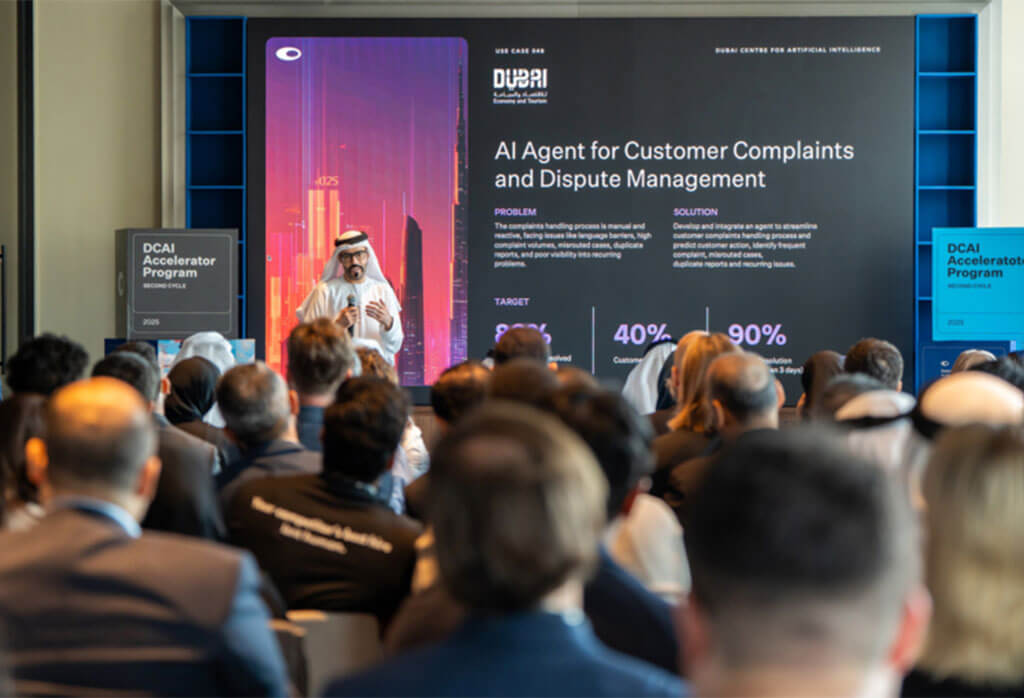
Dubai Future Accelerators works differently again. Operated by the Dubai Future Foundation, it connects startups, private entities and government to position Dubai as a testbed for new technology. The program sits inside Area 2071 at Emirates Towers and matches growth-stage companies with government entities on urban, mobility and AI challenges. Cohorts run roughly nine weeks and are built around pilot contracts with those entities.
Procurement is the value. DFA offers fast-track access to more than 35 Dubai government bodies, including the Roads and Transport Authority, DEWA and Dubai Health Authority, which lets a company skip the standard public tender route. ICN.live records 350-plus scaleups matched, more than $1.5 billion in alumni capital, fully funded pilot deployment grants, and AED 1 billion under management through the Dubai Future District Fund. Conversion from cohort to signed government memoranda of understanding sits at 75 percent in the report.
One founder verdict collected in the research described a live public pilot inside nine weeks, and the international credibility that came with it.
Risk here is binary. DFA is an enterprise challenge platform rather than a school. Miss the pilot contract with your matched entity and the residual value falls sharply.
Equity or runway, the choice you have to make
Strip away the branding, and UAE business accelerators now offer two deals. Sovereign programs hand you balance sheet access and take equity through a SAFE. Zero equity utilities hand you cheap infrastructure and grants, and leave your ownership alone.
Neither wins in the abstract. Your answer depends on what is blocking you this quarter.
If licence and visa costs are draining you, a zero equity program buys months. Should no bank answer your email, a sector program with procurement relationships is worth the dilution. Where you cannot legally operate at all, regulatory permission outranks both.
Three questions before you apply
ICN.live built a decision matrix around three questions, and they work as a filter for whatever program you are weighing.
First, what exactly do you surrender relative to the cash you receive? Set SAFE dilution against the value of a sovereign investment pipeline, then compare that with an equity-free model that protects your ownership outright.
Second, what share of cohort alumni closed institutional capital within twelve months? Ask for audited follow-on funding numbers. Cohort press releases are marketing, and the ICN.live evidence hierarchy discounts them for exactly that reason.
Third, which named enterprise buyers or government procurement directors attend private partner days? A meeting with a decision maker is not the same as a crowded open demo day. The first can close a contract. The second rarely does.
Programs that answer all three cleanly are rare. Programs that dodge one are telling you something.
The market these programs sit in
Context helps you read the numbers. The UAE led MENA startup funding in the first quarter of 2026, with $625.8 million raised across 46 deals, and fintech took 46 percent of total regional investment. Regional capital has tightened since. According to Wamda, MENA startups raised $1.7 billion across 242 rounds in the first half of 2026, an 18 percent decline year on year, with capital concentrating in larger ecosystems and companies with clearer paths to scale.
Selective capital rewards founders who arrive holding something concrete: a signed pilot, a subsidised licence, a regulator’s sign-off. That is what the top UAE business accelerators now sell, and it explains why the ranking rewards structural assets over community size.
Building in the Emirates has stopped being an experiment in regional expansion. Founders who win here treat these programs as springboards to sovereign balance sheets, institutional clients and regional market share, and they choose on structure rather than reputation