icnlive

WATCH LIVE. THINK BUSINESS.

© 2026 ICN.LIVE

ICN.live

PUBLISHED BY ICN PRESS

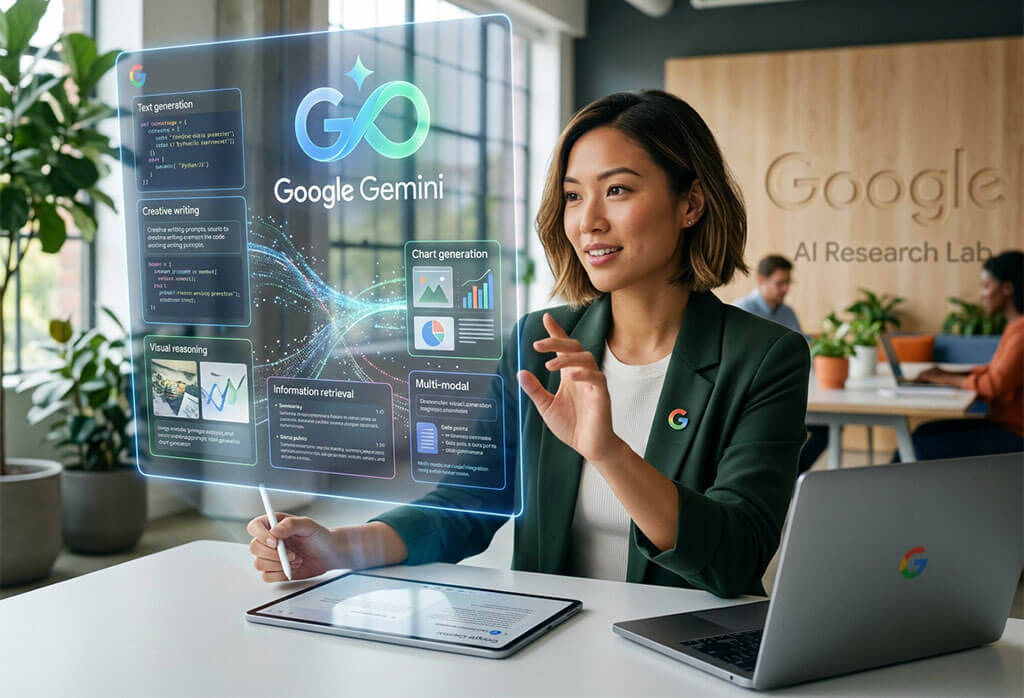
  • Google added 3D models and interactive simulations to Gemini for richer visual learning experiences.
  • Users choose Google Gemini Pro, enter prompts, and explore results through direct visual controls.
  • The AI chatbot upgrade also turns technical content into small apps and useful data displays.
  • Schools, students, and researchers gain faster ways to test ideas from many viewing angles.

Gemini interactive 3D visuals move Google’s chatbot beyond answers and into active, hands-on digital learning.

Google has pushed Gemini into a new role within digital learning and technical exploration. The latest AI chatbot upgrade gives users moving visuals instead of text alone. People now explore 3D models by rotating objects and studying details from several angles. Users also adjust values through simple controls and watch results change on screen instantly. This design brings a clearer path for learning topics that often feel abstract. Subjects like motion, structure, data, and systems become easier to inspect through direct interaction. The process starts inside Google Gemini Pro, where users request a visual or simulation.

After the reply appears, a visualisation option opens the generated interactive result. That result offers zoom tools, viewpoint changes, and flexible settings for closer inspection. Students gain a stronger grasp when movement and structure appear together in one place. Teachers also save time because one response explains a concept through words and action. For researchers, the feature supports quick tests with fresh inputs and revised conditions. Designers and developers also benefit because Gemini now handles practical visual tasks.

The update turns files and data into smaller tools that users understand faster. From my standpoint, this change matters because students learn faster when they test ideas directly.

Gemini interactive 3D visuals turn abstract lessons into clear action

The strongest part of this release lies in the balance between simplicity and control. A user does not need advanced software knowledge before exploring these visual results. Google has placed the feature inside an everyday chat flow already familiar to many users. That choice lowers friction for classrooms, teams, and solo learners using web tools daily. Instead of reading static explanations, users interact with cause and effect in real time.

A slider changes one value, then the visual responds with a new outcome. This immediate feedback helps people connect theory with visible results much more quickly. The same system also supports scientific visualisation for dense material and technical datasets. Researchers often face tables, code, and documents that hide patterns at first glance. Gemini now pulls parts of that material into visual dashboards and compact digital tools. Those outputs help users compare variables, trace movement, and inspect changing relationships clearly.

Google also says the system supports coding and design work through these richer interfaces. That wider use expands Gemini from a helper into a working environment for ideas. The move also raises pressure on rivals building learning products around large language models. Plain answers still matter, yet visual interaction now shapes the next stage of AI competition.

Where the feature matters most for schools, research, and product teams

Education looks like the clearest early winner from this new Gemini direction. A biology class, for example, gains more value from moving structures than static notes. Physics lessons also improve when interactive simulations show forces changing under new conditions. Chemistry, engineering, and geography lessons benefit when shapes and systems become easier to explore. For universities, the feature fits coursework, lab support, and guided demonstrations across disciplines. Product teams also gain practical value through quick mockups, mini apps, and tested concepts. The same applies to analysts who need cleaner views of complicated information.

Google Gemini Pro now feels closer to a visual workspace than a chat window. Gemini interactive 3D visuals also give Google a stronger place in academic technology discussions. As more users expect active learning tools, text-only assistants look less useful.

TAGS

EXPLORE MORE ON:

UAE Insurance Sector Growth 2025

Start with the profit line. AED2.6 billion became AED4 billion in a single year, a jump of roughly 54 percent that sits at the center of the UAE insurance sector growth story for 2025 now taking shape in the Central Bank’s latest figures. Numbers like that rarely move alone. Behind them sits a year of premiums outrunning claims, assets outgrowing liabilities, and a health insurance mandate that reshaped demand across five emirates almost overnight.

The Central Bank of the UAE insurance report, released as the sector’s annual statistical review, lays out the mechanics plainly. Total assets reached AED164.9 billion by the close of 2025, up 6.1 percent from AED155.5 billion the year before. Of that balance sheet, AED96.4 billion sat in invested assets, close to 58 percent of the total. Insurers in the UAE are not simply underwriting risk anymore. They are managing a pool of capital large enough to matter to the broader economy, and the Central Bank’s numbers treat that role as central rather than incidental.

Premiums, claims and the widening gap

UAE insurance gross written premiums rose 14.9 percent in 2025, reaching AED74.8 billion against AED65.1 billion a year earlier. Paid claims grew too, up 11 percent to AED46.2 billion, but at a slower pace than premium income. That gap between what insurers collected and what they paid out is where the profit growth originates. Technical provisions, the reserves insurers hold against future claims, rose a more modest 4.4 percent to AED96.3 billion, a sign that liabilities grew in step with prudence rather than in step with premium growth.

The premium retention ratio tells a related story. It climbed to 56 percent from 54.9 percent, meaning insurers kept a larger share of the risk they wrote rather than passing it to reinsurers. Retaining more risk while claims grew slower than premiums is not a coincidence. It reflects underwriting discipline holding steady even as the book of business expanded.

Health coverage reshapes the policy count

The clearest driver of new demand came from outside the balance sheet entirely. The UAE’s mandatory basic health insurance scheme, extended to private sector employees and domestic workers across the Northern Emirates from January 2025, pulled hundreds of thousands of previously uninsured residents into the market. UAE health insurance policies rose 26.1 percent over the year, the single largest movement among all reported metrics. Total active policies across the sector reached 17.3 million by year-end.

Insurance density, a measure of average spending per resident, reached around AED6,500. That figure sits alongside UAE insurance sector total assets and premium growth as evidence that coverage is widening, not just deepening among existing policyholders. Fifty-eight insurance companies now operate in the UAE, supported by 515 registered insurance-related professions, a spread that points to a market with more moving parts than its headline figures suggest.

The Central Bank’s Report

Capital adequacy closed out the picture. Available capital across the sector stood at 455 percent of the minimum regulatory requirement, a buffer far beyond what regulators typically demand. For a sector absorbing a sudden wave of new mandatory policyholders while growing its investment book, that cushion matters. It gives insurers room to write new business without straining the reserves that back existing claims.

None of these figures move in isolation. Premium growth funded profit growth. Profit growth strengthened the capital base. The capital base gave insurers room to absorb 26.1 percent more health policies without visible strain. Read together, they describe a sector that expanded on most fronts at once, a pattern the Central Bank’s report frames as continuity from prior years rather than a single standout event.

Dubai Press Club announces leading national institutions

As preparations continue for the Arab Media Summit 2026, the Dubai Press Club (DPC), organiser of the event, has announced that nine leading national institutions have joined the list of partners for this year’s edition, WAM published the announcement.

Scheduled to take place from 15th to 17th September 2026, the Summit will be held under the patronage of His Highness Sheikh Mohammed bin Rashid Al Maktoum, Vice President, Prime Minister and Ruler of Dubai, and under the directives of H.H. Sheikh Ahmed bin Mohammed bin Rashid Al Maktoum, Second Deputy Ruler of Dubai and Chairman of the Dubai Media Council.

The Roads and Transport Authority (RTA) was announced as Mobility Partner; Dubai Chambers as Global Commerce Partner; Emirates National Oil Company (ENOC Group) as Energy Partner; Dubai Customs as Trade and Economic Partner; Emirates as Airline Partner; Emirates NBD as Banking Partner; Dubai Courts as Leading Partner; Dubai Municipality as Future City Partner; and Emirates Integrated Telecom Company (du) as Telecommunication Partner.

Mona Ghanem Al Marri, Vice Chairperson and Managing Director of the Dubai Media Council, President of the Dubai Press Club, and Chairperson of the Arab Media Summit Organising Committee, highlighted the importance of the partnerships, noting that they reflect a deep understanding of the media’s role in shaping societies and guiding them towards the future, as well as the significance of the Arab Media Summit as the region’s largest media gathering.

She said, “Our national institutions have helped build an exceptional success story that has earned global recognition and strengthened Dubai’s soft power worldwide. We are pleased to partner with a distinguished group of organisations that have contributed to shaping this inspiring story.”

Al Marri added, “These partnerships reflect a clear recognition of the media’s value in advancing development and a commitment to extending its positive influence across the Arab world. By advancing a competitive and forward-looking approach grounded in professionalism, integrity and strong ethical values, Arab media can deliver impactful content that helps audiences keep pace with global progress and inspires them to play an active role in shaping the future.”

Mattar Al Tayer, Director General and Chairman of the Board of Executive Directors of Dubai’s Roads and Transport Authority (RTA), affirmed that the media is a key partner in the development journey, contributing to knowledge transfer, raising public awareness, showcasing achievements, and keeping pace with economic, social and technological transformations. He noted that the Arab Media Summit serves as a vital platform for dialogue, the exchange of expertise, and exploring the potential of modern technologies and artificial intelligence to advance media content, enhance the competitiveness of Arab media, and strengthen its readiness for the future.

Al Tayer said, “RTA’s continued partnership with the Summit reflects the vision of His Highness Sheikh Mohammed bin Rashid Al Maktoum, which recognises the media as an active partner in achieving sustainable development. It also reinforces Dubai’s pioneering position as a leading hub for Arab media, bringing together media figures, decision-makers and experts to shape the future of the sector and address rapid digital and technological transformations.”

He further emphasised that the partnership highlights the vital integration between the media and transport sectors. Dubai’s sustainable and integrated transport system plays a key role in advancing the emirate’s development, strengthening its capacity to host major events, and ensuring seamless and safe mobility for participants and visitors.

Eng. Marwan Ahmed bin Ghalita, Director General of Dubai Municipality, said, “Leading cities of the future are not built on infrastructure and technology alone, but through an integrated urban ecosystem that places people, awareness and knowledge at its core. This is where the media plays a vital role in raising public awareness of the transformations reshaping our cities and the way we live.”

He added, “Today, the media is a key partner in shaping and sharing the inspiring success stories of the UAE and Dubai with the world. It contributes to reinforcing Dubai’s approach and message as a city driven by action and achievement, and as a destination that attracts leading minds, innovators and talent to shape the future. We are proud to be the Future City Partner of the Arab Media Summit, a partnership that reflects Dubai Municipality’s commitment to supporting an exceptional platform that originated in Dubai to anticipate the future of media, shape its direction across the Arab world, and bring together prominent Arab media leaders and influential voices capable of advancing an ambitious Arab narrative around cities that are more sustainable and offer a higher quality of life.”

Mohammad Ali Rashed Lootah, President and CEO of Dubai Chambers, said, “Effective economic media serves as a vital link between markets, opportunities and the business community. It plays an important role in building confidence and strengthening cities’ positions as global centres for trade and investment. Our partnership with the Arab Media Summit reflects Dubai Chambers’ commitment to supporting platforms that bring together thought leaders and prominent figures from the media and business sectors. It also contributes to highlighting Dubai’s promising opportunities, advancing the objectives of the Dubai Economic Agenda D33, and reinforcing the emirate’s position as a global business hub.”

Dr. Abdullah Busenad, Director General of Dubai Customs, said, “The Arab Media Summit serves as an important platform for highlighting the media’s role in deepening public understanding of economic transformations and showcasing the importance of trade in driving growth and creating opportunities. Our partnership with the Summit as Trade and Economic Partner reflects Dubai Customs’ commitment to enabling trade, strengthening business confidence and enhancing economic competitiveness. These efforts support the objectives of the Dubai Economic Agenda D33 and further consolidate Dubai’s position as a leading global hub for trade and investment.”

Saif Ghanem Al Suwaidi, Director General of Dubai Courts, affirmed that Dubai Courts’ participation as Leading Partner at the Arab Media Summit 2026 reflects its belief in collaboration between judicial and media institutions and the media’s role in raising public awareness and expanding access to legal knowledge.

He said, “The Arab Media Summit is a leading platform that brings together media leaders, decision-makers and experts. We are proud of our partnership with the Dubai Press Club in an event that has established itself as a platform for dialogue and shaping the future of regional media.

“Our partnership recognises the media as an effective partner in building a more informed society. Dubai Courts continues to support initiatives that combine specialised expertise and media capabilities to present legal and judicial knowledge through innovative approaches, while developing purposeful, reliable content that reflects Dubai’s aspirations and global standing.”

Hesham Abdulla Al Qassim, Vice Chairman and Managing Director of Emirates NBD Group, said, “Emirates NBD is pleased to reaffirm its support for the Arab Media Summit 2026 as Banking Partner. As a homegrown financial institution, we remain committed to empowering the media sector, recognising its critical role in shaping the future and narrative of our region. As the region’s largest media gathering, the Summit provides a key platform for media professionals from across the Arab world to connect, exchange ideas, and discuss the most pressing challenges and opportunities facing the industry. We look forward to this year’s edition and its new format, which uniquely brings together multiple specialised forums and related events under a single, unified platform.”

Hussain Sultan Lootah, Group CEO of ENOC Group, said, “Dubai’s journey towards the future is underpinned by an integrated framework built on vision, innovation, sustainability and effective cross-sector partnerships. The Arab Media Summit is an influential platform for highlighting the media’s role in addressing the major transformations shaping the world, including the future of energy and sustainability. We are pleased to serve as the Summit’s Energy Partner and contribute to a more informed Arab dialogue on the issues shaping the economy of the future.”

Fahad Al Hassawi, CEO of du, said, “The media shapes how societies see themselves and how they are perceived by the world. Technology is amplifying this role, enabling ideas to cross borders, connect cultures and reach audiences in unprecedented ways. Through our partnership with the Arab Media Summit, we look forward to supporting a platform that brings together media, technology and innovation, while fostering meaningful discussions on the future of content, artificial intelligence and digital platforms, and their role in building a more influential media sector.”

Boutros Boutros, Executive Vice President of Corporate Communications, Marketing and Brand at Emirates Airline & Group, said, “Dubai has long served as a meeting point for the world, connecting people, cultures and ideas. The media is one of the most important bridges supporting these connections. Our partnership with the Arab Media Summit reflects our continued commitment to major initiatives that reach the world from Dubai, strengthen its presence as a global city that brings together talent, ideas and creativity, and create new opportunities for communication and influence.”

Reinforcing Dubai’s Position as a Media Hub

Maryam Al Mulla, Director of the Dubai Press Club, expressed her sincere appreciation to the Summit’s partners for their valued role in this year’s edition.

She said, “Working as one team towards shared objectives is deeply embedded in Dubai’s approach and has contributed to its exceptional achievements across sectors. This collaborative spirit continues to reinforce the emirate’s position as a centre for thought leadership and a hub for shaping the future.”

Al Mulla added: “Over the past two decades, Dubai has steadily strengthened its position as a leading regional media hub, supported by the region’s largest and most dynamic professional media community.”

The 2026 edition of the Arab Media Summit is supported by a total of 13 leading entities and institutions. Previously announced partners include DP World as Strategic Partner; Dubai Electricity and Water Authority (DEWA) as Sustainability Strategic Partner; National Media Authority as National Partner; and the Mohamed and Obaid Almulla Group and American Hospital Dubai as Strategic Healthcare Partner. They are joined by the nine new leading national entities announced as partners for this year’s edition.

The partnerships announced for the 2026 edition reinforce the Arab Media Summit’s role as a platform for constructive dialogue, knowledge exchange and cross-sector collaboration. They also reflect Dubai’s ability to bring together leading government entities, national institutions and businesses in support of initiatives with regional and global impact.

The upcoming Arab Media Summit will be the largest edition yet. This year, the Summit will bring together a diverse range of specialised events, including the Arab Media Forum, the Government Communication Forum, the Arab Youth Media Forum, the Arab Social Media Influencers Summit, the Films Forum, the Games Forum, and the Dubai PodFest, alongside several international media forums.

The Summit will also continue to recognise excellence and emerging talent through the Arab Media Award, which marks its silver jubilee this year, the Arab Social Media Influencers Award, and the Ibda’a – Arab Youth Media Award.

Alibaba eyes AI infrastructure spending

Alibaba AI infrastructure spending is climbing again, and the company wants shareholders to fund it. The Chinese ecommerce and cloud group is selling HK$80 billion of new shares, roughly $10.2 billion, with every dollar of net proceeds going into its full-stack AI capabilities. That covers chips, data centres, and the models running on top of them. The Alibaba share placement is the largest primary follow-on offering ever from a Hong Kong-listed company. Globally it ranks third this year, behind Alphabet and Intel.

Pricing tells you how the market took it. Alibaba set 710 million new shares at HK$112.70 each, against a Friday close of HK$123. Hong Kong-listed shares dropped as much as 10 percent on Monday. Buyers at the discount get exposure to the buildout. Existing holders get dilution and a longer wait for returns. US investors were excluded from the deal.

The numbers behind the raise

Alibaba AI capex hit 67.7 billion yuan in the June quarter, up 75 percent from a year earlier. Net profit fell by the same proportion over that period, to roughly $1.5 billion, and free cash outflow reached $6.6 billion. Alibaba AI infrastructure spending sits inside a three-year plan worth at least 380 billion yuan, and the company says it has already spent close to half. CEO Eddie Wu told analysts the compute capacity has to exist before the growth can be captured.

Revenue is arriving behind the bill. Alibaba Cloud revenue from AI and compute services rose 45 percent to 48.44 billion yuan in the quarter, the fastest pace in 22 quarters. Payback on AI-related investment is now expected in about 2.5 years, down from three.

What Alibaba AI infrastructure spending means for you

Hold the stock, and you absorb the dilution today for capacity that pays later, if the demand holds. Build with AI in Asia, and the calculation flips, because more compute usually means cheaper inference and stronger models. The Qwen AI model family sits at the centre of that trade. Alibaba released Qwen 3.8-Max weeks ago, and early benchmarking points to strength in agentic coding, where bots write and repair code from high-level instructions.

China AI investment runs hot

This raise lands in a market already paying up. Chipmaker CXMT pulled in $8.6 billion at listing, and its shares rose 466 percent on debut. Humanoid robotics group Unitree raised $900 million last week, with shares climbing more than 600 percent on day one after retail demand topped 5,500 times the available allotment. Moonshot’s Kimi K3 launch last month added to the mood. China AI investment at these valuations carries real risk if earnings arrive slowly.

Washington is still a problem

Regulation shapes the rest of the story. The Pentagon in June returned Alibaba to a blacklist of Chinese companies treated as a national security risk, alongside Baidu and BYD, citing alleged links to the People’s Liberation Army. Alibaba has asked a US court to overturn the order. The company denies any PLA ties and rejects the claim it takes part in military fusion, where civilian industry works with the state defence sector. Xi Jinping and Donald Trump meet in the US next week, their second summit this year, with export controls and technology restrictions on the agenda. What comes out of that room decides how far Alibaba AI infrastructure spending can travel outside China.

Share this post

on your favourite social platforms

or copy the link