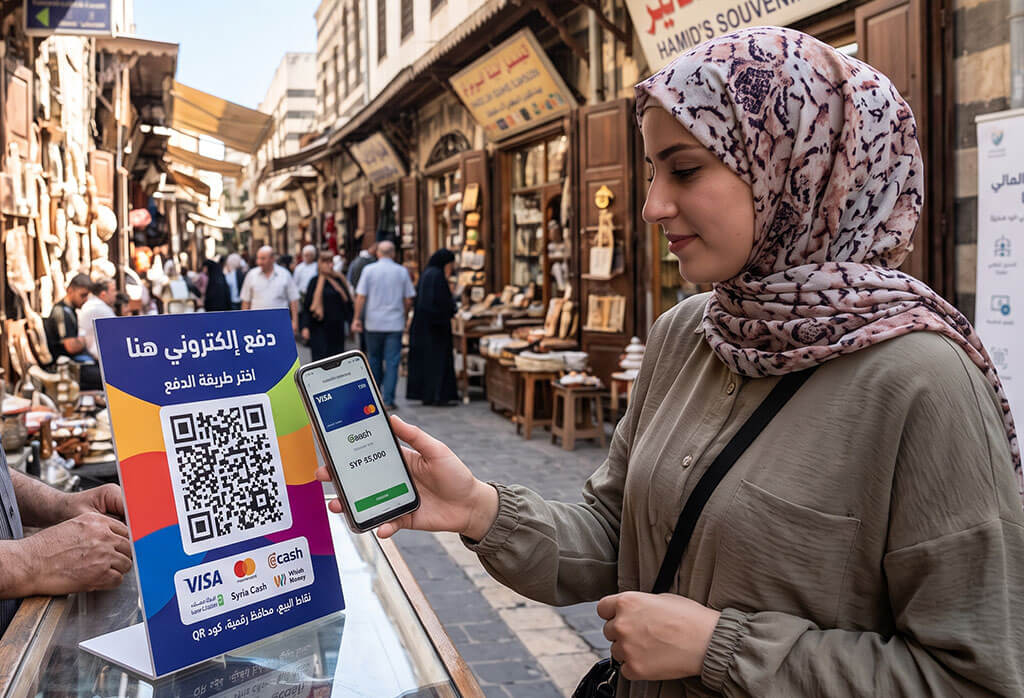



Syria’s global financial system return took visible shape this week, and it happened over a cup of coffee. President Ahmed Al-Sharaa used a Visa card to pay a Damascus vendor in a video released early Thursday, a small transaction carrying outsized symbolism for a country locked out of global banking networks for nearly five decades.
Al-Sharaa made the payment sitting beside Safwat Raslan, governor of Syria’s central bank. Raslan posted the footage on X. He described watching the president complete the country’s first Visa card payment in the capital as a feeling difficult to put into words. He noted it came one day after Syria’s removal from the list of state sponsors of terrorism, a designation that had shaped the country’s economic isolation since 1979.
أن نشهد هذه اللحظة مع فخامة السيد الرئيس أحمد الشرع @AH_AlSharaa وأن تتم أول عملية دفع باستخدام ببطاقة فيزا @Visa في قلب دمشق في اليوم التالي لرفع اسم سوريا من قائمة الدول الراعية للإرهاب، هو بالنسبة لي شعور يصعب اختصاره بالكلمات
بداية جديدة نحمل فيها الكثير من الأمل و المسؤولية pic.twitter.com/xbH7Kge9Re— Safwat Raslan (صفوت رسلان) (@SafwatRaslan) August 26, 2026
A Decades-Old Label Comes Off
The United States removed Syria from its state sponsors of terrorism list on Monday, a step Damascus had pushed for since the fall of the Assad government. The change took effect after a 45-day congressional review period that began when President Donald Trump formally notified Congress in July of his intention to rescind the designation.
US Secretary of State Marco Rubio authorized the formal rescission once that review period ended, and also delisted Hay’at Tahrir al-Sham, the group Al-Sharaa once led, as a Specially Designated Global Terrorist. Rubio framed the decision as recognition of steps Damascus had taken over the past year, saying the government of Syria had joined the global coalition against ISIS and conducted operations against terror networks including ISIS, al-Qaeda, Hezbollah, and Iran-aligned groups. He called the move another historic step by President Trump to give the Syrian people a path to prosperity.
Rebels led by Al-Sharaa overthrew longtime ruler Bashar Assad in December 2024, ending a civil war that had run for more than a decade. The terrorism designation had blocked most forms of American trade, investment, and financial contact with Syria for that entire period and long before it.
What the Designation Removal Unlocks
US Treasury Secretary Scott Bessent said the move would help foster additional investment in Syria to promote political and economic stability, adding that it followed through on a promise Trump made to deliver sanctions relief to the country. Treasury was careful to draw a line around the scope of the change. The department stressed that removing the restrictions did not change its posture on countering global terrorism or its commitment to hold bad actors in Syria accountable.
The timing lines up with a broader push already underway. In May, the Central Bank of Syria authorized local banks and electronic payment companies to work directly with international payment providers such as Visa and Mastercard, part of a plan to move the country past its reliance on cash. That decision followed a December 2025 roadmap agreement between the central bank and Visa focused on building a modern payment system. The coffee payment in Damascus put a face on work that had been building for months.
Raslan, who took over as central bank governor in May, has said publicly that Syria’s financial reforms only matter if people feel them in daily life. His remarks alongside the president echoed that theme. He described the terrorism list removal as returning Syria to its natural place in the global economic system, a framing that positions the Visa payment as proof of concept rather than a one-off gesture.
Reconstruction Money Still Has to Show Up
Syria’s global financial system return carries weight because the country needs outside capital badly. Syria’s banking industry held just $12 billion in assets as of November 2024, with state-owned banks holding 69 percent of that total. The World Bank has described those state lenders as likely distressed. Analysts covering the sector have warned that lifting sanctions does not automatically fix a banking system this weak, and that reconstruction financing depends on more than a delisting.
Lebanese, Jordanian, Bahraini, and Qatari banks that kept minimal operations running in Syria during the war are positioned to scale up activity as restrictions ease, with early focus expected on retail banking, cross-border payments, and remittances from Syrians living abroad. Gulf states including Saudi Arabia, the UAE, and Qatar have already pledged multibillion-dollar investments tied to reconstruction.
Al-Sharaa addressed the terrorism list removal directly in a recorded statement, saying Syria was shaking off a dark stain and tearing away a painful chapter of its past to embark on a path of development, reconstruction, and rebuilding. The Visa payment gave that language a physical moment attached to it.
Why the Optics Matter
A single card payment does not rebuild a banking sector. But for a government trying to convince investors, banks, and ordinary Syrians that the country is open again, small public proofs carry real weight. Syria’s global financial system’s return will ultimately be measured in trade volumes, correspondent banking relationships, and IMF assessments, not video clips. Still, the choice to stage that first Visa transaction with the central bank governor sitting next to the president was deliberate. It told a story the government wanted told, at the exact moment the story became true.
The next test comes from institutions rather than optics. Syria’s government has the remainder of 2026 and 2027 to convert this moment into durable outcomes, including restored correspondent banking relationships and completed regulatory reviews. Whether Syria’s global financial system return holds depends on those steps landing on schedule.