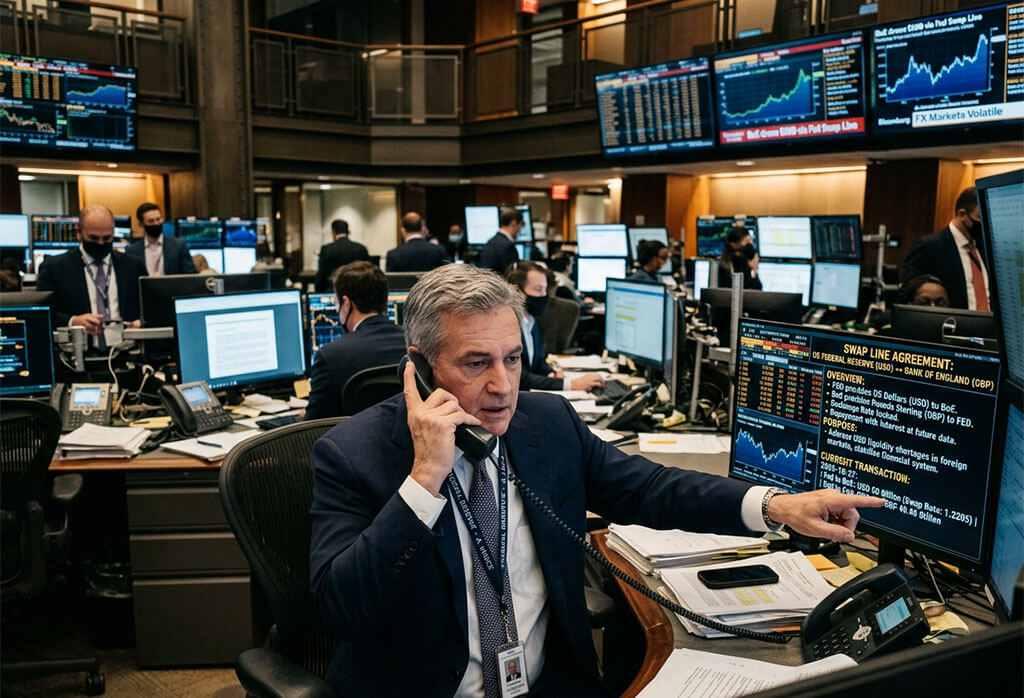



What is a Swap Line agreement, and why does it matter for global finance today? A swap line is a pact between two central banks. The deal lets them exchange currencies at a pre-agreed rate. Each side caps the size of the swap and the time window. You can picture it as a standing credit line between trusted central banks. The US Federal Reserve runs the most prominent program because the dollar leads global trade.
How the mechanics work in practice
If Country A needs dollars, its central bank gives its own currency to the Fed. In return, it receives an equal value in US Federal Reserve dollars. After a set period, the two sides reverse the trade at the original rate. The borrower pays a small interest fee tied to a benchmark rate. From my standpoint, this design removes currency risk during volatile market conditions. The locked rate protects both sides from sudden swings in foreign exchange markets.
The dollars do not sit idle inside the central bank vault. The receiving central bank lends or auctions them to commercial banks that need funding. Those banks then settle trades, meet client demand, and stabilize their balance sheets. As a result, the facility flows through to the real economy in days. This is why a reciprocal currency arrangement carries weight far beyond the two signing institutions.
ANOTHER MUST-WATCH ON ICN
Why does central bank liquidity depend on these tools?
Central bank liquidity defines how well a financial system handles stress. When banks suddenly need dollars but cannot find them, panic spreads fast. A swap line gives the central bank a direct channel to the Fed in hours. This stops credit crunches, steadies exchange rates, and keeps imports and exports moving. According to International Monetary Fund data, around 58 to 60 percent of global reserves sit in dollars. The euro holds near 20 percent, with smaller shares for the yen, pound, and yuan.
The dollar achieved this status after the Bretton Woods agreement in 1944. Even after the gold link ended in 1971, the dollar kept its leading role. Deep US Treasury markets, strict rule of law, and network effects locked in its position. As former Fed Chair Ben Bernanke once noted, swap lines act as a backstop for global stability. His view shaped the 2008 crisis response and the 2020 pandemic emergency programs.
What is a Swap Line agreement during wartime stress?
What is a Swap Line agreement worth during a war or major conflict? The answer comes down to the survival of the payment system. War triggers capital flight, drained reserves, and broken trade routes within weeks. Foreign investors pull funds, insurance costs jump, and import bills climb. Countries still need dollars to pay for food, fuel, medicine, and defense supplies. A dollar funding crisis on top of a security crisis can break a national economy.
A swap line gives the affected country a vital backstop during these shocks. It protects foreign exchange reserves from full depletion during sustained pressure. It also signals strong political and economic alignment with the partner country. That diplomatic message carries real weight when allies face shared threats. You can see why nations push hard to secure these deals before a crisis hits.
ANOTHER MUST-READ ON ICN.LIVE: OpenAI Acquiring TBPN Means Influence Over AI Industry Messaging Now
A real example of dollar dominance in trade
Consider Indonesia buying crude oil from Saudi Arabia in any given month. Neither country uses the dollar at home, yet the deal settles in dollars. Saudi Arabia quotes prices in dollars per barrel, and Indonesia pays in dollars. So Indonesia must hold strong foreign exchange reserves in dollar form. If those reserves run low, oil imports stall, no matter how much rupiah the country prints.
The same pattern shows up across global commerce every single day. Brazilian airlines buy Airbus planes priced in dollars under long-term contracts. African governments borrow from global markets in dollar-denominated bonds. Commodities like gold, copper, and wheat trade in dollars on major exchanges. This is why access to dollars sits at the heart of every major economy.
Why this matters for readers right now
You should track swap line news because these deals shape borrowing costs and market stability. A new swap line often signals trust between two governments and their financial systems. A canceled swap line can flag rising tension or weakening alliances. What is a Swap Line agreement in plain terms? It works like a fast, large-scale, time-limited dollar facility with a built-in exit mechanism. The cost stays predictable, the risk stays contained, and the support reaches commercial banks fast. For investors, importers, and policymakers, this tool remains one of the most powerful in modern finance.