


The adoption of Agentic AI across Dubai’s private sector has gained an international technology partner. Dubai Chamber of Digital Economy, one of three chambers under the Dubai Chambers umbrella, signed a Memorandum of Understanding with Alibaba Cloud, WAM announced. A Memorandum of Understanding records an intent to cooperate and sets the shape of the work, without the binding force of a full contract. This one creates a framework for the two sides to help local companies use the technology.
Agentic AI describes software that can plan a task, act on it, and correct its own steps with limited human direction. It moves past tools that only answer prompts. The shift changes the unit of work, from a single answer to a completed job. For a business, the difference is practical. An agent can carry a process from start to finish, rather than pause for each instruction.
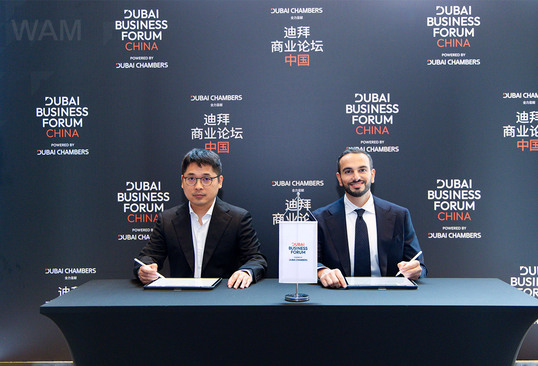
Saeed Al Gergawi, Vice President of the Dubai Chamber of Digital Economy, signed the document alongside Dr. Feifei Li, Chief Technology Officer and President of International Business at Alibaba Cloud Intelligence. The signing took place in Shenzhen at the Dubai Business Forum China, an event organised by Dubai Chambers. Shenzhen ranks among China’s technology hubs, which set the signing near Alibaba’s home market.
What the Alibaba Cloud agreement covers
The MoU supports an initiative launched by Sheikh Hamdan bin Mohammed bin Rashid Al Maktoum, Crown Prince of Dubai, Deputy Prime Minister, and Minister of Defence, to move the private sector toward technology. Dubai Chambers oversees that programme. The agreement sets out three tracks of work: building skills, backing startups, and helping larger firms deploy agents in production. Each track names concrete resources rather than broad goals, which shows how the partners expect the effort to run.
Saeed Al Gergawi, Vice President of Dubai Chamber of Digital Economy, commented: “We are committed to strengthening international partnerships in Agentic AI as an important enabler for knowledge exchange and broader access to specialised technologies and expertise. By deepening cooperation with partners from around the world, we are working to empower Dubai-based companies to develop their capabilities and leverage these technologies to enhance their operations and create innovative solutions and new business models. This will contribute to the growth of the digital economy and further strengthen Dubai’s position as a global hub for advanced technology.”
Training through Dubai Chambers Academy
Skills form the first track. Through the Dubai Chambers Academy, companies will access training content, certifications, technical workshops, and expert-led sessions. Certifications give employees a way to show the skills they build, and the workshops put those skills against real tools. The plan adds train-the-trainer programmes and educational resources, so a firm can build knowledge inside its own teams instead of leaning on outside help. This Agentic AI training is aimed at the employees who will run these systems once they go live. Capability building sits under the whole effort, because a company cannot deploy agents it does not understand.
Support for startups and compute
Startups form the second track. Alibaba Cloud will offer technical mentorship, technology credits, compute resources, and software licences. Software licences let a startup use paid tools without the upfront fee, and technology credits cover part of the running bill. Compute, the processing power that trains and runs AI models, is often the highest cost a young company carries. By covering part of it, the programme removes an early barrier. Selected startups will also connect with Alibaba Cloud programmes and its wider network, which can shorten the path from prototype to paying customers.
Eric Wan, General Manager of Middle East, Turkey and Central Asia, Alibaba Cloud Intelligence, said: “Agentic AI is moving from experimentation to everyday business use, and the companies that move first will set the pace for Dubai’s digital economy. Having served customers in the UAE since 2016, we are pleased to bring our technology, training and startup programmes to the Dubai Chamber of Digital Economy’s community — helping local businesses build the skills and confidence to put AI agents to work in their own operations.”
Enterprise pilots and the marketplace
Established firms form the third track. Here the work will explore enterprise pilots and full production deployments, with technical and implementation expertise on hand. A production deployment means an agent running inside live operations, not a test on the side. Proven solutions will appear on the Alibaba Cloud Marketplace, an online platform that links cloud users with independent software vendors. On it, buyers can test, purchase, deploy, and manage third-party applications and services. Alibaba Cloud has sold cloud services to private companies and public bodies in the UAE and the wider Middle East since 2016, and it runs two regional data centres. That footprint gives the agreement local infrastructure to build on, not a service delivered from abroad. The two sides will also develop case studies that measure business impact and commercial value, records that later adopters can weigh before they commit.
Why the adoption of Agentic AI matters for Dubai
The adoption of Agentic AI has become a stated goal for Dubai’s economy, and the government has tied it to productivity and growth. Agreements like this give the policy a route to delivery. Training supplies the people, startup support feeds the pipeline, and enterprise pilots test what holds up at scale. Dubai Chambers has built other scaffolding around the same goal. It set up an Executive Committee for Agentic AI, and it has moved to train more than 14,000 member companies through the Dubai Chambers Academy. The Alibaba Cloud deal adds a named infrastructure partner to that structure.
Risk sits beside the promise. An agent that acts on its own needs clear limits, human oversight, and a way to check its decisions. The case studies and training in the MoU point at those questions, though the text does not detail the safeguards. The two-year timeline gives a clear marker, and the case studies will show whether early projects return their cost. For now, the deal turns the adoption of Agentic AI from a public target into a set of named resources. Whether Dubai’s private sector takes them up at scale will show over the next two years, the window the wider programme has set.