
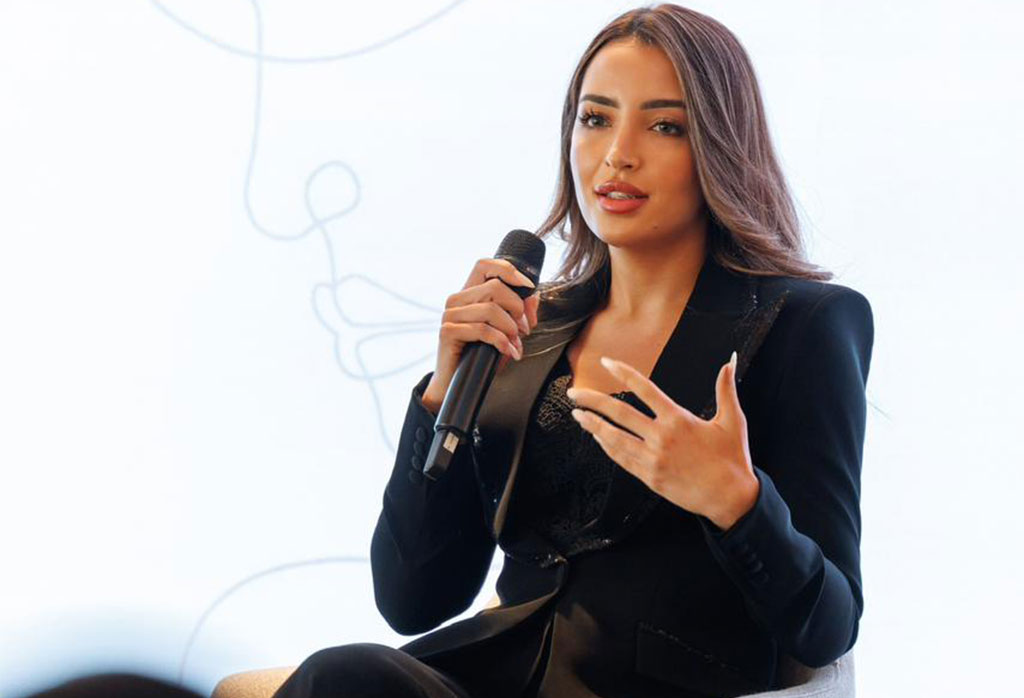
Women in finance in the GCC have more access to capital, senior networks and decision rooms than when Hasnae Taleb began her career. The investor and market commentator told ICN Business the progress is real. Then she moved the conversation from headcount to control. The harder question, she said, is who “holds the pen.”
In 2025, Taleb became the first woman to open trading at the Abu Dhabi Securities Exchange. She hosts Awwal Malyoun and is a guest on ICN.talks Business, and comments on markets for Bloomberg and CNBC Arabia. At Mintiply Capital, she is managing partner, and at Fuel Venture Capital she is the firm’s GCC partner. The region now has more women in finance leadership roles, across banks, investment teams, exchanges and regulated institutions, and she holds one of them.
Her list, in her own words, runs as follows. “Who controls the budget? Who leads the transaction? Who votes on the investment committee? Who owns carry? Who is trusted with the P&L? Who can raise a second fund based on performance?”
Carry is the manager’s share of a fund’s profits, and the P&L is the profit and loss account.
Every item on the list is a governance question for women in finance in the GCC. Each asks who answers for a result. A name on a conference programme carries no such duty. The vote on an investment committee does.
A first that has to lead somewhere. Taleb spoke about the ADX session in terms of what has to follow it.
“My moment at the Abu Dhabi Securities Exchange meant a great deal to me because firsts carry responsibility. They show the next generation what is possible. But a symbolic milestone has to lead somewhere. Its value becomes limited when institutions celebrate women publicly while withholding real authority privately. I still see women invited to speak about women, while their male peers are invited to speak about markets, capital and strategy. We will know the system has genuinely changed when a woman’s presence in a position of financial power no longer requires an explanation.”
Gender equality in finance, on this reading, is a matter of who signs, who votes and who answers when the numbers disappoint.
For women in finance in the GCC, board data gives the picture some scale. The GCC Board Gender Index, compiled by Heriot-Watt University Dubai and Aurora50, puts women at 7 percent of board positions across the region’s listed companies as of January 2026, up from 6.9 percent a year earlier. For a third year, the UAE leads, at 15 percent across its three exchanges. In UAE financial services, women hold 86 of 564 board positions.
Women in finance in the GCC and the investor’s own test
The index now counts women on boards in the GCC every year. A board vote is also one of the few forms of authority written into a company’s constitution rather than granted by invitation.
Taleb applies a similar governance test to the founders she backs. As a GCC partner at a venture firm, she is among the women in venture capital with a vote on which companies receive money. At an early stage, she said, a founder’s judgment counts for most, followed by a defensible business and a realistic route to liquidity.
Female investors in the Middle East who build a public profile face a further question of discipline, and she answered it. In public, she talks about markets, information in the open, and her approach to risk. She keeps client holdings, deals in progress and private mandates out of the conversation. The liability, in her own words, is this.
“The liability begins when the need to remain visible becomes stronger than the duty to remain discreet. It also begins when someone feels compelled to comment on every market movement, turns private relationships into content or uses an audience to create a level of authority that their record does not support.”
For women in finance in the GCC, her framework offers a measurable test. Count the votes, mandates, and profit and loss lines a woman holds, then compare the total with her invitations to speak about being a woman. Where the two diverge, the explaining falls to the institution.
Hasnae Taleb has been one of the special guests on the leading business podcast in the UAE, ICN.talks Business. You can watch her full interview here:
