


The Saudi 2027 budget asks you to hold two ideas at once. Saudi Arabia is in an escalating war with the Iran-aligned Houthis in Yemen. Yet its finance ministry expects the gap between spending and income to shrink next year.
Finance Minister Mohammed al-Jadaan put that gap at 3.6% of GDP for 2027. This year it is estimated at 4.9%. Speaking to journalists, he described the kingdom as “resilient enough to withstand a prolonged conflict” with the group.
He also pushed back on the idea that pressure could change Riyadh’s position. In his words, any belief that strikes on civilian sites, or “blackmail by missiles,” could force the kingdom to give ground on national security is “a total mistake.”
What the Saudi 2027 budget adds up to
Start with the core numbers. Revenue is set at 1.2 trillion riyals, about $319.84 billion. Spending comes to 1.39 trillion riyals, or roughly $371.76 billion. The difference, about 190 billion riyals ($50.67 billion), is Saudi Arabia budget deficit for next year.
Think of a deficit like a household that spends more each month than it earns and covers the gap with a loan. A smaller gap means the government needs to borrow less to keep its plans running. That is why a falling Saudi Arabia fiscal deficit matters to anyone who lends to the kingdom or invests there.
The economy had a rough year. GDP fell 2.1% in 2026 as oil output dropped. The plan calls for a sharp reversal, with Saudi Arabia GDP growth forecast at 10.9% in 2027. Treat that number as a forecast. It could change if the war or oil output moves in another direction.
Saudi Arabia’s slump was deeper than the UAE’s, which expects slight growth in 2026. It was far milder than the double-digit contractions expected in Qatar and Kuwait. Those two countries have no other export route around the Strait of Hormuz.
This year’s income also beat expectations. Revenue for 2026 is expected to reach 1.191 trillion riyals, 7.1% above last year and 3.7% higher than the original budget estimate. Spending grew 3.4% to 1.43 trillion riyals.

Where the money is going in 2027
You might expect a country at war to pour cash into its military. This plan does not. Military spending rises 2.2% to 263 billion riyals ($70.1 billion). Jadaan explained that Saudi Arabia had invested early in many of the systems that now matter. Should the fighting demand more, he said there is “no price tag or cap” on military funding.
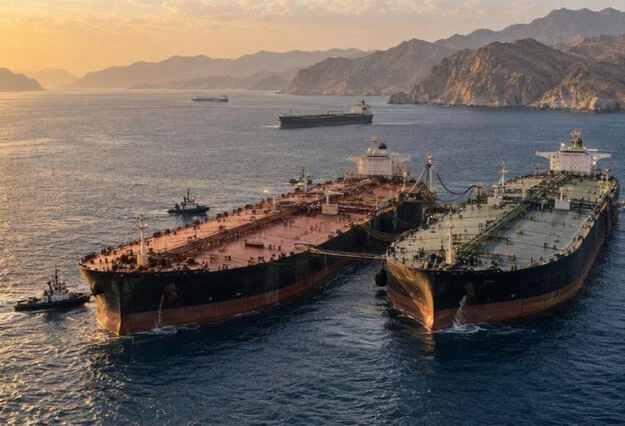
Transport tells a different story. Investors follow logistics and transport spending closely, and it falls by about 3 billion riyals ($800 million) compared with actual 2026 spending. Jadaan called 2027 mainly a planning and design year for the sector. Most construction is expected in 2028. That includes new infrastructure to move oil without passing through the Strait of Hormuz.
Services gain instead. Municipal spending climbs to 93 billion riyals ($24.8 billion), up from 83 billion riyals ($22.1 billion). Riyadh’s needs and quality-of-life projects account for the increase.
The biggest change sits in a line called general items. Most of it is debt service, which costs more as interest rises on floating-rate borrowing. A floating-rate loan works like a mortgage whose rate resets with the market. When rates climb, so does the monthly bill. Social security payments also sit in this category.
Debt limits and Vision 2030 spending
Saudi Arabia keeps a self-imposed borrowing ceiling of 40% of GDP. The Saudi debt-to-GDP ratio is forecast at 35.9% in 2027 and 39% by 2029. Jadaan sees no reason to lift the cap and said the limit “is serving us well.”
The war arrived while Vision 2030 was already being scaled back. This is the kingdom’s long-term programme to diversify away from oil, modernise society and build up investment and tourism. Cuts to Vision 2030 spending had already reached some gigaprojects, including the Mukaab, a huge cube-shaped building in Riyadh, and The Line, a steel-and-glass tower at NEOM. Some of these large projects had produced weak returns.
Houthi strikes on Riyadh’s main airport have kept it closed to most international flights. The events calendar has taken the hit. The Future Investment Initiative, the kingdom’s flagship investment conference, has moved back a full year. Soccer’s Asian Cup now takes place in December next year.
Jadaan named no specific projects. He said Vision 2030 is bigger than any single one, and that tools which do not fit the moment will change. “If some needs to be accelerated we’ll accelerate them, if some needs to be warehoused, we will warehouse them,” he said, calling the plan “our north star.”
How Saudi consumers are carrying growth
The non-oil economy, the part Vision 2030 is meant to build, has held up. It grew 1.8% in the third quarter and could expand 2.5% this year. That happened while East Coast ports were close to shutting down and disruption spread across the country.
Most of the support came from spending at home. Foreign tourist arrivals fell 7%, but Saudis travelling inside the country more than made up the difference. Consumption stayed healthy, and Jadaan said this is what keeps foreign investors interested. Saudi unemployment stood at 6.5% in the second half of 2026, lower than a year earlier.
Reforms stay in the Saudi 2027 budget
The Saudi 2027 budget keeps reforms such as subsidy cuts on schedule. “There will never be a good time to reform,” Jadaan said. “You go with the plan.”
From January 1, households and businesses will pay higher electricity and water tariffs. To ease the cost, King Salman ordered a 500-riyal monthly allowance for citizens in government jobs, retirees, and families on social security.
Jadaan did not promise easy times ahead. “It’s not a rosy world… and it is unlikely to be until we die,” he said. For you as a reader, the message in the Saudi 2027 budget is plain. Riyadh is planning for a long war, spending carefully on defence, shifting money toward services, and betting that people at home will keep the economy moving.