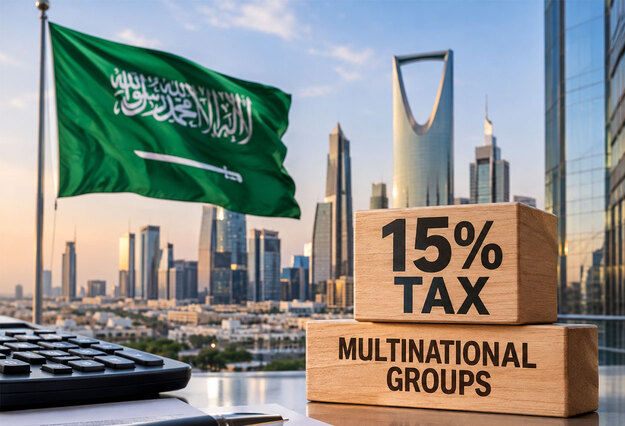



Saudi Arabia eyes a 15% tax on the profits of large multinational groups, and the clock starts on January 1, 2027. The Zakat, Tax and Customs Authority (Zatca) announced the domestic minimum top-up tax on November 19. If your company belongs to a big international group with a Saudi footprint, this rule could change your tax bill next year.
The measure follows the OECD and G20 reforms known as Pillar Two. That framework sets a global minimum tax of 15% on large multinational businesses. Each country can collect the difference at home when a group’s local effective tax rate falls short. With this step, Saudi Arabia eyes a 15% tax floor of its own.
Who falls inside the net?
The test is size, measured at group level. A Saudi entity is in scope if its multinational group posted consolidated annual revenue of at least €750 million, about $822.58 million. The group must hit that level in at least two of the four previous financial years.
Here is the catch for local managers. The revenue figure covers the entire group worldwide. A Saudi branch earning a fraction of €750 million can still be caught because its parent clears the bar.
Purely domestic companies sit outside the rules. Zatca says a business with no overseas operations and no link to a qualifying multinational group will not be covered. For most Saudi family firms and local SMEs, the new levy does not apply.
How the rule works as Saudi Arabia eyes a 15% tax
The goal is a floor. Qualifying groups should pay at least 15% on the profits they make in the kingdom. A group already paying an effective rate of 15% or higher would generally owe nothing extra.
Take a group with 100 million riyals ($26.6 million) of Saudi profit, taxed at an effective 10%. On paper, the gap is five percentage points, and a top-up tax could close it.
The real bill may be smaller. Companies can exclude amounts tied to employee salaries and to physical assets such as buildings and equipment. So the final figure depends on profit, taxes already paid, and any exclusions or relief the group qualifies for. In practice, groups with bigger Saudi payrolls and more local assets can carve out more of their profit.
Why the 20% headline rate is not the answer
Saudi Arabia already charges a standard 20% corporate income tax. It applies to the taxable share of foreign investors in resident companies and to qualifying non-resident businesses.
You might assume a 20% rate clears a 15% floor with room to spare. It does not work that simply. The new framework calculates the effective rate on its own terms, with its own treatment of taxes, income and adjustments. A company paying the headline 20% will not necessarily face extra tax. It cannot assume it is safe either, and its finance team will need to run the numbers under the new method.
Who is exempt, and where the grey areas sit
The draft rules exempt several types of organisation: government bodies, international organisations, non-profit organisations and pension funds. Some investment funds and real estate investment companies may also escape, depending on how they are set up.
Special economic zones offer no automatic shelter. A multinational inside one of those zones can still owe the top-up tax if it meets the requirements.
The biggest open question concerns regional headquarters. Saudi Arabia offers 30-year tax incentives to companies that set up their regional HQ in the kingdom. Nobody can yet say how the minimum tax interacts with those incentives. The answer will depend on the final rules and each company’s position.
What comes next for companies in scope
Saudi Arabia is not the first Gulf state to move. The UAE applied its own 15% minimum tax on large multinationals from January 2025. Bahrain, Kuwait, Oman and Qatar brought in similar rules from the same date.
Groups caught by the Saudi rules face new paperwork. They must register with the authorities, file tax returns and report their earnings and tax payments. The draft rules include temporary relief from some filing requirements while businesses adjust.
For you as an investor, supplier or employee of a global group in the kingdom, the ripple is practical. Saudi Arabia eyes a 15% tax on the biggest players, and the start date is close. Groups near the €750 million line have less than six weeks to check where they stand.