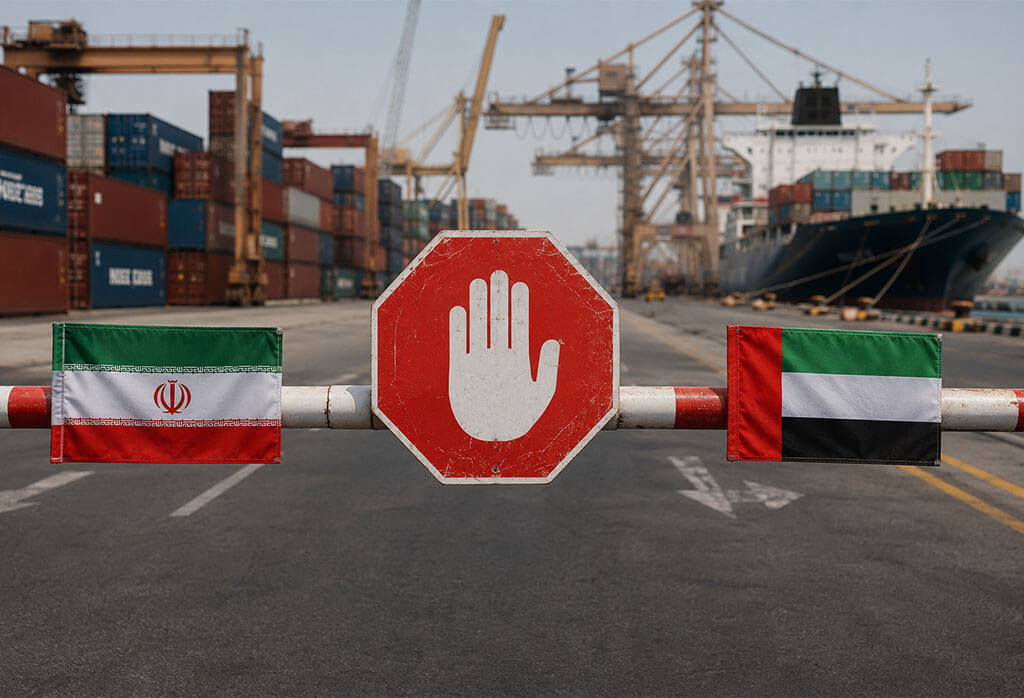



Iran trade suspension in the UAE took effect late on August 18, covering all trade, commercial exchanges, and financial transactions until further notice. Afra Al Hameli, director of the strategic communications department at the Ministry of Foreign Affairs, announced the decision. She cited regional escalations undermining regional and international peace and security. Officials gave no end date.
Abu Dhabi moved hours after its Ministry of Defence said air defences detected two ballistic missiles launched from Iran toward the country. One fell outside UAE territorial waters, and the second landed inside them. Neither caused reported damage or casualties.
Tehran rejected the account. Iranian Foreign Ministry spokesman Esmaeil Baghaei called the claim baseless. He said such accusations run against the principle of good neighbourliness and damage efforts to build trust among regional states.
What the Iran trade suspension in the UAE covers
The scope of the Iran trade suspension in the UAE reaches beyond merchandise. Banks, shipping lines, logistics operators and commodity traders with Iranian exposure face a blanket prohibition on payments and commercial dealings. Firms holding open contracts have no published guidance on wind-down periods or exemptions. Implementation details will decide how hard the measure bites.
UAE-Iran trade has run through Dubai for decades. Mark Kimmitt, a retired US general and former assistant secretary of state, told Al Jazeera the emirate had quietly become Iran’s largest supplier, ahead of China and Turkiye, providing roughly a third of Iranian imports each year. On that estimate, the embargo could cut deeper than measures Washington has imposed.
A brief reopening now reversed
Direct cargo shipping between the two countries stopped in early March, days after the war began. Sailings resumed in late June through Dubai’s Jebel Ali Port. That window lasted under two months.
Authorities also suspended roaming services for Iranian mobile users in the UAE ahead of the trade decision, cutting calls, messages and banking access for residents and travellers. Shipping and oil market fallout. Strait of Hormuz shipping remains close to a standstill. Kpler data show 10 crossings on Monday and two on Sunday. Five-day average traffic sits near 10 transits, against roughly 130 daily before the war.
A vessel sailing outbound through the strait took a hit from an unknown projectile early on Tuesday. UKMTO reported damage to the engine room and one crew death. Oman’s coastguard assisted the surviving crew. Brent crude oil price settled above $91 a barrel on Tuesday as traders weighed the risk of a longer closure. Roughly 25 percent of seaborne crude and petroleum product trade, and about 19 percent of liquefied natural gas, passed through the strait in 2025.
Diplomacy stalled
Iran trade suspension in the UAE lands one day after the 60-day window tied to the June 17 US-Iran memorandum of understanding expired without a final deal. President Donald Trump said Washington holds no talks with Tehran and has none scheduled. He also said the strait is open and cleared of mines, a claim transit data does not support.
UAE-Iran relations had shown tentative improvement earlier in the summer. Abu Dhabi has denied claims that frozen Iranian funds were released or moved through its banking system. Whether the Iran trade suspension in the UAE proves temporary will depend on the missile investigation and on any return to negotiations.